The Work Behind the Artist
Read Time:8 Minute, 27 Second
MOVIE REVIEWS
Body of Work
 –
– 

Genre: Documentary, Short
Year Released: 2026
Runtime: 25m
Director(s): Cassidy Rast, Odin Wadleigh
Writer(s): Cassidy Rast, Odin Wadleigh
Cast: Eric Anfinson, Robin Roberts, Dave Kopp, Martin Wolfe
Where to Watch: shown at the 2026 Dances with Films Los Angeles
RAVING REVIEW: The smartest decision BODY OF WORK makes is refusing to treat Eric Anfinson's injury as the whole story. It obviously changed everything, and Cassidy Rast and Odin Wadleigh never minimize what happened to him. Still, their documentary is ultimately much more interested in the person who emerged afterward than the moment that forced his life onto a different path.
That distinction matters because there’s an easy version of this documentary that could have been built almost entirely around inspiration. Anfinson sustained a spinal cord injury during a high school football game, and the circumstances alone provide enough emotional weight to carry a short documentary. Rast and Wadleigh instead give that history its proper place while gradually shifting attention toward art, identity, physical independence, and the complicated relationship Anfinson has developed with his own body.
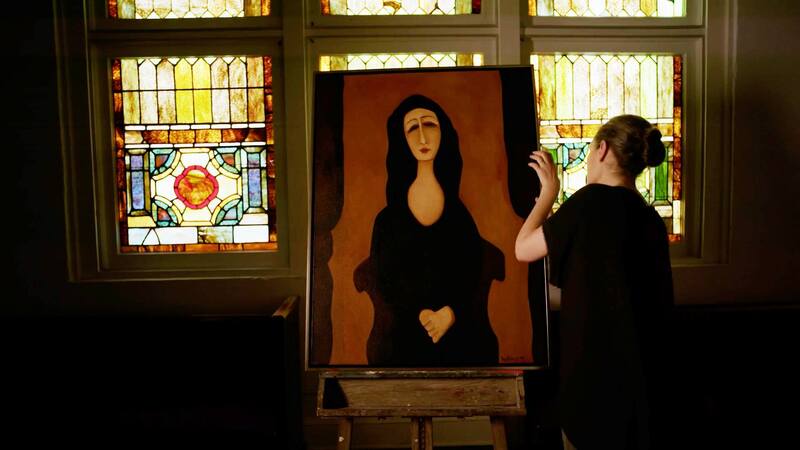
The title is particularly well chosen. A “body of work” obviously refers to the collection of paintings Anfinson created, but the documentary keeps returning to the body that made them. His physical limitations can't be separated from his process, yet they can't fully explain the artist he became. That tension gives the film considerably more substance than a straightforward biography about someone overcoming adversity.
Rast and Wadleigh also understand that a documentary about a visual artist should have its own visual personality. BODY OF WORK mixes interviews, archival material, recreations, and 16mm photography without making those different approaches feel like competing gimmicks. The shifts in texture separate periods of Anfinson's life while giving memories a slightly imperfect quality that suits how people actually remember the past.
The recreations are especially effective because they aren't pushed too hard. They establish a sense of place and let us experience fragments of Anfinson's earlier life without pretending that we're watching an exact reconstruction of every moment. When the film moves between the athletic teenager he once was and the man we meet in the present, the contrast needs little explanation. The images do much of that work on their own.
Eventually, Key West and painting become inseparable pieces of the story. Anfinson didn't simply find an activity to fill his time after his injury; he found a means of expression that became central to his identity. Seeing his work alongside the person who created it adds context without reducing the paintings to products of his disability. That may sound like a small distinction, but it's where documentaries about artists facing physical challenges can easily go wrong.
BODY OF WORK is careful not to suggest that suffering automatically produces meaningful art. Anfinson's paintings matter because of his eye, his interests, and the work he has put into developing himself as an artist, not because the circumstances of his life make every canvas inspirational by default. The filmmakers respect him enough to let the art exist beside the injury rather than continuously forcing one to justify the other.
Another strength is how much Rast and Wadleigh trust Anfinson to define his own experience. The documentary has plenty of material that could invite outside interpretation, especially when dealing with an injury that permanently altered the direction of someone’s life. Still, it rarely feels as though the filmmakers are trying to explain him to us. Interviews and archival material provide history while Anfinson remains the person determining what that history means in the present. That keeps the film from turning him into an example, allowing him to remain its subject.
The mixture of formats also gives the documentary a sense of memory that a cleaner, more conventional presentation probably wouldn’t have achieved. The 16mm material has a physical texture that fits naturally beside older photographs and archival footage. At the same time, the recreations give the filmmakers room to approach parts of Anfinson’s past that obviously couldn’t have been documented as they happened. None of these elements are especially unusual on their own, but the combination feels appropriate for a story built around looking backward while continuing to move forward. The presentation has a tactile quality that also feels fitting for a film so interested in someone who creates things with his hands and translates experience into something visual.
That becomes especially important because BODY OF WORK isn’t merely asking what happened to Anfinson after his injury. It’s interested in how a person rebuilds an understanding of himself when something once considered fundamental suddenly changes. Athletics occupied one part of his identity before the injury. At the same time, painting eventually became another outlet for expression, but the documentary doesn’t present that shift as if one passion simply replaced another. There’s loss involved in that transition, along with frustration, discovery, and an entirely different relationship with what his body can and cannot do.
I also appreciated that Anfinson’s disability is visible without becoming the film’s constant point of emphasis. The chair is part of his daily life, just as the physical realities created by his spinal cord injury remain part of his story. Still, Rast and Wadleigh don't continually direct our attention back toward them in search of an emotional response. That restraint makes the moments when Anfinson does discuss his limitations considerably more meaningful. We’re given enough space to understand what changed without being encouraged to define everything he accomplished afterward solely through what happened to him as a teenager.
That approach makes the paintings feel like an extension of Anfinson rather than evidence presented to support an inspirational narrative. They’re part of the life he built, but they’re also the result of years spent developing a craft, making choices, and continuing to create. BODY OF WORK works best when those ideas overlap naturally, because that’s where the title gains another layer: the work isn't only what Anfinson has painted, but the ongoing act of shaping a life that never followed the course he originally expected.
At times, the 25-minute runtime becomes both an advantage and a limitation. The film moves with purpose and never seems interested in stretching Anfinson's story simply because there might be enough material for something longer. At the same time, I wanted a little more opportunity to sit with his artistic process and the present-day Eric before another part of his history arrived. Glimpses of a much larger story appear here, particularly in the relationship between his changing physical abilities and his need to keep creating.
That compression also occasionally pushes the documentary toward the inspirational language it otherwise handles carefully. Resilience is naturally part of Anfinson's story, and ignoring it would feel equally dishonest, but his life becomes most interesting when BODY OF WORK allows things to remain complicated. Recovery didn't erase what happened, artistic success didn't solve every physical problem, and finding purpose didn't create some clean ending where everything afterward became easy.
Those less comfortable realities are what keep the documentary from becoming sentimental. Anfinson has already experienced one enormous redirection in his life, yet the film acknowledges that adapting isn't something a person necessarily finishes. Bodies keep changing, circumstances keep shifting, and something that once seemed like the answer can eventually raise another question.
There’s also a quiet confidence in the way Anfinson speaks about art that lets the film work without constantly telling us how remarkable he is. His relationship with painting feels personal rather than symbolic, and the documentary is strongest when we can simply observe how deeply creating has become tied to how he understands himself. Those moments don't need swelling declarations about perseverance because his investment in the work already communicates plenty.
Rast and Wadleigh could have easily made the football injury the defining image of BODY OF WORK. Instead, it becomes the beginning of a story that keeps changing shape long after the initial recovery. The documentary leaves us considering not only what Anfinson has produced, but what creating those paintings has required from him physically and emotionally over the years.
At 25 minutes, BODY OF WORK doesn't have enough room to explore every interesting corner of Eric Anfinson's life, and that's ultimately my biggest reservation with it. What it does cover, however, is handled with restraint, visual care, and an understanding that Anfinson deserves to be seen as an artist rather than an inspirational story who happens to paint. His injury redirected his life, but the work that followed is his.
Please visit https://linktr.ee/overlyhonestr for more reviews.
You can follow me on Letterboxd, Instagram, Twitter, and YouTube. You can also find my social media accounts on most platforms by searching for 'Overly Honest Reviews'.
I’m always happy to hear from my readers; please don't hesitate to say hello or send me any questions about movies.
[photo courtesy of REAL PLANET FILMS]
DISCLAIMER:
At Overly Honest Movie Reviews, we value honesty and transparency. Occasionally, we receive complimentary items for review, including DVDs, Blu-rays, CDs, Vinyl Records, Books, and more. We assure you that these arrangements do not influence our reviews, as we are committed to unbiased, sincere evaluations. We aim to help you make informed entertainment choices regardless of our relationship with distributors or producers.
Amazon Affiliate Links:
This site also contains Amazon affiliate links. If you purchase through these links, we may receive a commission. This affiliate arrangement does not affect our commitment to honest reviews and helps support our site. We appreciate your trust and support as you navigate these links.


Happy
0 %

Sad
0 %

Excited
0 %

Sleepy
0 %

Angry
0 %

Surprise
0 %
 0
0
 0
0


Average Rating