The Little Creature Feature That Could
Read Time:16 Minute, 46 Second
MOVIE REVIEW
The Deadly Spawn
 –


Genre: Horror, Science Fiction
Year Released: 1983, 2026 4K
Runtime: 1h 21m
Director(s): Douglas McKeown
Writer(s): Douglas McKeown (screenplay); Ted A. Bohus, John Dods, and Douglas McKeown (story); Tim Sullivan (additional dialogue)
Cast: Charles George Hildebrandt, Tom DeFranco, Richard Lee Porter, Jean Tafler, Karen Tighe, James L. Brewster, Elizabeth Marner-Brooks, Ethel Michelson, John Schmerling, Judith Mayes
Where to Watch: available November 10, 2026. Pre-order your copy here: www.synapsefilms.com, www.mvdshop.com, or www.amazon.com
RAVING REVIEW: If there's one lesson horror movies have spent decades trying to teach us, it's that strange noises coming from the basement should be somebody else's problem. THE DEADLY SPAWN takes that advice one step further by filling the basement with extraterrestrial creatures whose enormous mouths contain enough teeth to make a dentist reconsider their career choices. Director Douglas McKeown's 1983 creature feature embraces the wonderfully ridiculous possibilities of old-fashioned science fiction, then adds the kind of bloody violence that would have sent audiences running from the drive-in a couple of decades earlier. It's a scrappy production with obvious limitations, but the monsters alone give it considerably more personality than some films made with a small fortune. These aren't sophisticated aliens with an elaborate plan for conquering humanity. They're hungry, and unfortunately for everyone living nearby, Earth has an impressive selection of things to eat.
The trouble begins when a meteorite crashes in the New Jersey woods, attracting the attention of two campers who make the unfortunate decision to investigate. Anyone who's watched enough horror movies knows that wandering toward a mysterious object that just fell out of the sky rarely ends well, especially when it brings an unexpected passenger along for the trip. The creatures eventually find their way into the basement of a nearby home, where the residents continue their ordinary routines without realizing what's happening underneath them. The household includes two brothers, Pete (Tom DeFranco) and Charles (Charles George Hildebrandt), whose very different interests become part of the story as the extraterrestrial threat spreads.
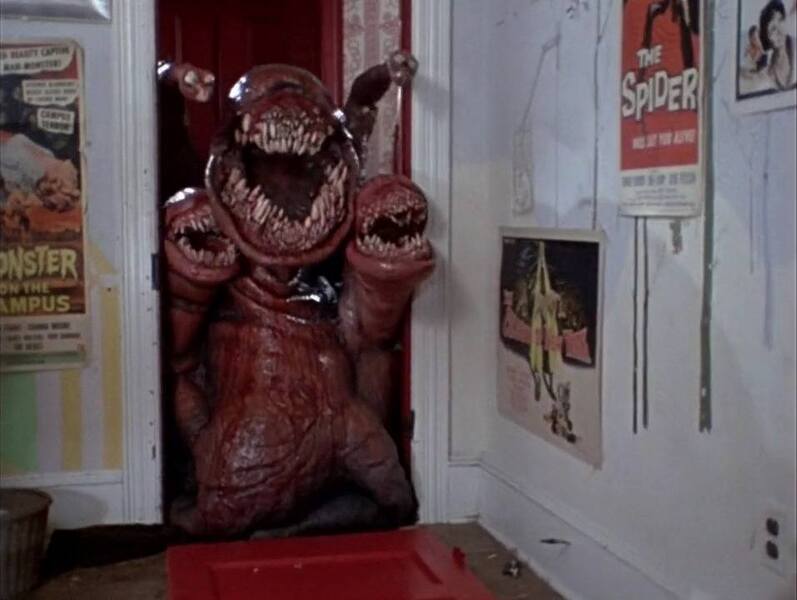
Charles is especially interesting because he's obsessed with monster movies. His room is filled with the sort of memorabilia that would immediately feel familiar to anyone who grew up surrounded by horror magazines, posters, and creature collectibles. He enjoys frightening people with homemade effects, much to the irritation of those who don't share his enthusiasm. It's a fun character detail, particularly in a movie that clearly comes from people who spent much of their own lives fascinated by the same things. Charles isn't some impossibly knowledgeable child who suddenly becomes an expert in alien biology. He's a kid whose favorite entertainment has apparently shown up uninvited, and knowing everything about fictional monsters isn't quite the same as confronting one that can actually eat you.
The movie also gives Charles an amusing relationship with his Uncle Herb (John Schmerling), a psychology professor interested in understanding the boy's fascination with horror. Herb's curiosity reflects a familiar attitude toward young people who enjoy frightening entertainment, especially during a time when violent films and horror fandom drew plenty of public scrutiny. Charles doesn't see his interests as a problem that needs explaining. He likes monsters because he finds them fascinating, and anybody who's ever defended an extensive horror collection to a confused family member can probably appreciate that distinction. The exchange adds some personality to the household before the situation becomes considerably less appropriate for casual family conversation.
Pete, meanwhile, is more interested in science and spending time with his friends. His involvement brings additional characters into the house, including Ellen (Jean Tafler), Frankie (Richard Lee Porter), and Kathy (Karen Tighe). Their ordinary teenage concerns contrast with the increasingly dangerous situation developing nearby. The film isn't especially interested in transforming these characters into an elaborate group of protagonists with complicated personal histories. Their interactions establish a fairly conventional domestic environment, with everyday conversations that wouldn't seem out of place in a family drama. That normality has a purpose, even if some of the dialogue runs longer than the material really warrants. The creatures aren't arriving in a secret government facility or a laboratory filled with specialists. They're invading a home where people have more immediate concerns than the possibility of being eaten alive.
McKeown uses that familiar environment effectively. The basement becomes an especially unpleasant location, with its restricted space and the ordinary household clutter creating plenty of opportunities for something dangerous to remain concealed. The persistent rainstorm contributes to the atmosphere, surrounding the property with miserable weather while complicating the characters' ability to recognize the danger. A basement already makes people uncomfortable when the lighting is poor, and the surroundings are unfamiliar. Add an enormous alien organism with multiple mouths, and suddenly that unfinished room doesn't seem like such a good place to store the Christmas decorations.
The house also creates an interesting gap between what the audience knows and what the characters understand. Viewers learn about the alien threat before most of the household realizes anything unusual has happened. That creates straightforward suspense, because otherwise harmless decisions become dangerous when something is waiting nearby. A character entering another room or investigating an unfamiliar sound doesn't need to be behaving foolishly for the situation to become frightening. The audience already knows enough to recognize the potential consequences. It's a familiar technique, but it suits a story involving creatures whose presence can go unnoticed until somebody gets much too close.
Of course, the main reason THE DEADLY SPAWN has developed such a devoted following is its monster design. Special effects artist John Dods created some wonderfully revolting extraterrestrial organisms, dominated by enormous, fleshy mouths packed with sharp teeth. The creatures don't resemble the familiar upright aliens seen in countless science-fiction productions. Their appearance suggests organisms driven by appetite rather than intelligence, with bodies designed more to consume unfortunate victims than to look intimidating while walking around. The grotesque design gives the film an identity of its own, even though the basic idea of a creature arriving from space and threatening an unsuspecting community was hardly new when McKeown made it.
The larger creature is imposing, with three heads emerging from a mass of organic material that looks as though someone combined several particularly unpleasant animals and then decided they needed considerably more teeth. Its appearance is exaggerated almost to the point of absurdity, but that's part of the appeal. A monster like this doesn't need an elaborate backstory or a scientific explanation of its anatomy. The filmmakers understand that an enormous mouth filled with teeth communicates danger rather efficiently. The smaller offspring introduce another problem, because the threat isn't limited to one large organism in one place. These creatures can reproduce, turning an isolated encounter into something with much broader implications.
The film's ambitions become most apparent in the practical effects. Dods and the effects team built physical creatures that had to occupy real space, interact with the performers, and function in front of the camera. Their work involved puppetry and mechanical solutions rather than the digital techniques that later became commonplace. Some movements naturally reveal the materials' limitations, and the creatures aren't always capable of the fluid motion audiences might expect from modern, effects-heavy productions. The elaborate designs have a tangible quality that suits the film's grimy surroundings. They look like objects that could actually be hiding in that basement, which makes their appearances more effective than a concept that exists only as an illustration.
The violence is every bit as enthusiastic as the creature design. THE DEADLY SPAWN belongs to a particularly enjoyable period of horror filmmaking when effects artists were increasingly willing to show audiences exactly what happened when a monster caught somebody. The creatures don't politely drag their victims offscreen so the audience can imagine the consequences. Their attacks involve gruesome makeup effects, severed body parts, and an unapologetic amount of blood. The material is graphic enough to separate the movie from the comparatively restrained science-fiction films that helped inspire it. McKeown and his collaborators weren't interested in simply recreating the entertainment they grew up watching. They wanted to explore the nastier possibilities that earlier productions might have avoided.
That difference helps distinguish THE DEADLY SPAWN from the 1950s creature features it resembles. THE BLOB is an obvious comparison, with its alien organism consuming human beings while an unsuspecting community struggles to understand the danger. Both films take an ordinary American setting and introduce a threat that doesn't require complicated motivations. But where THE BLOB depended heavily on the unsettling idea of a growing mass that could absorb almost anything, THE DEADLY SPAWN makes the danger more immediate through the creatures' enormous jaws. The alien doesn't simply engulf its victims. It tears into them, giving the effects artists opportunities to create some decidedly unpleasant results.
The film's greatest weakness is its uneven attention to the people caught in the invasion. Charles has a recognizable personality, and his interest in monsters gives him an engaging connection to the material. Many of the supporting characters don't receive the same treatment. Their conversations establish relationships and provide a necessary break from the violence, but some scenes feel more concerned with occupying time than developing the people involved. The performances also vary in quality, which isn't surprising given the production's independent origins. The actors generally fit the ordinary suburban environment, though their delivery of certain lines lacks the confidence or natural rhythm that might have made the quieter passages more engaging.
The dialogue occasionally wanders into discussions that seem oddly disconnected from the danger surrounding the characters. Some of those conversations provide recognizable family dynamics, while others slow the film without adding much to the relationships. This problem becomes more noticeable because the monster sequences have such a different level of energy. When the creatures are active, the movie has a clear sense of purpose. When the action shifts to extended conversations, the writing doesn't always provide enough substance to maintain that interest. The relatively short running time prevents these stretches from becoming overwhelming, but a more disciplined approach to the human drama could have strengthened the complete experience.
There's also a peculiar contrast between the movie's sometimes clumsy dialogue and its willingness to treat the violence seriously. THE DEADLY SPAWN has plenty of material that can inspire laughter, particularly because the creatures themselves are so outrageous. Yet the consequences of their attacks can be vicious, and the film doesn't entirely abandon the disturbing implications of innocent people encountering something they have no reasonable way to fight. That mixture gives the production a rough personality. It isn't a polished horror comedy that carefully signals when viewers should laugh. The ridiculous and the unpleasant exist side by side, leaving the audience to respond as they please.
The circumstances surrounding the production make its effects work even more interestingly. Producer Ted A. Bohus developed the original concept after reading about ancient seeds recovered from the Arctic that successfully germinated. He began wondering what might happen if an organism could survive inside a meteorite before reaching Earth. Working with Dods, Bohus developed the idea into a feature that could be made in New Jersey with very little money. The production ultimately cost approximately $20,000 to $25,000, depending on the account, an astonishingly modest figure for a movie containing such elaborate creature creations.
Dods originally considered designs that could have involved a performer wearing a conventional monster costume, but the creature evolved into the far stranger construction seen in the finished film. The large alien presented its own engineering problems, including a head that reportedly proved too heavy for its original wooden supports. These practical difficulties reveal how much experimentation can go into creating effects that occupy only a relatively small portion of a movie's running time. Somebody had to design the organism, figure out which materials would work, and construct mechanisms capable of bringing it to life. The finished creature reflects those efforts, even as the equipment's limitations remain apparent.
The production's low-budget origins also connect it to a broader tradition of regional horror filmmaking. Bohus had previously worked with Don Dohler on NIGHTBEAST and FIEND, two productions associated with the independent science-fiction and horror movement developing outside Hollywood. Filmmakers in these circles often relied on personal connections, borrowed locations, and whatever equipment they could get. THE DEADLY SPAWN was largely photographed on 16mm film at a New Jersey home, with cinematographer Harvey M. Birnbaum working within circumstances that would have made a conventional studio production considerably easier. The finished movie retains that homemade character, which is part of its history but doesn't excuse its rougher moments.
The limitations extend to the film's pacing and visual consistency. The photography varies in its ability to present the action clearly, and the editing occasionally struggles to create a smooth transition between ordinary scenes and elaborate effects sequences. Some of that irregularity is characteristic of independent filmmaking from the period, but it still affects the viewing experience. A movie's small budget can explain why certain elements aren't as polished as they could be; it doesn't necessarily make those weaknesses disappear. THE DEADLY SPAWN is at its best when the filmmakers use their resources creatively rather than asking the audience to overlook the places where those resources proved insufficient.
Composer Michael Perilstein contributed to the film's music alongside Paul Cornell and Ken Walker. The electronic scoring places the production within the recognizable sound of early 1980s genre filmmaking, when synthesizers became an affordable way to accompany suspense and science-fiction imagery. Music could provide atmosphere without requiring the financial commitment of a large orchestra, making it especially useful for projects operating on limited budgets. The score is another component of the movie's period identity, complementing a production that looks and feels firmly rooted in the era that created it.
The film's history didn't end with its original release. THE DEADLY SPAWN circulated under different titles, including RETURN OF THE ALIENS: THE DEADLY SPAWN, and gradually developed a following among viewers interested in independent creature features. Its reputation is closely tied to its monster effects, which remain distinctive enough to separate it from many similarly inexpensive productions. That continued interest has also helped keep the film available through successive home-video formats, allowing audiences who missed its original release to discover the practical craftsmanship behind its grotesque extraterrestrial visitors.
For physical-media collectors, Synapse Films' 4K restoration represents an important step in preserving that work. The company returned to the original uncut 16mm camera negative rather than relying on an older video master, preparing the film for a new high-definition presentation with Dolby Vision and HDR10 compatibility. Restoring a production like this involves more than increasing its resolution. The original photography has its own grain structure and limitations, and older film elements may contain damage that requires careful attention. The goal should be to preserve the look of the original material rather than make a modest 1983 production resemble something shot on contemporary digital equipment.
The new release also acknowledges the film's distribution history through its audio options. Both the original producer's mix and the later 21st Century Film Corporation theatrical mix are included in lossless DTS-HD Master Audio. Having access to both versions is a welcome preservation feature, especially for collectors interested in how films changed between production and theatrical distribution. The standard edition includes three commentary tracks featuring members of the creative team, along with archival material such as the original audition tapes, behind-the-scenes footage, an alternate opening credits sequence, and a featurette devoted to Dods and the creatures. These supplements offer a chance to examine the production without requiring the review itself to become an exhaustive account of every technical decision.
Synapse has also offered a limited collector's edition containing both 4K UHD and Blu-ray discs, with additional supplements and an assortment of physical extras. That package includes a 56-page book with vintage FANGORIA material, a new essay by Michael Gingold, and excerpts from Bohus's writing about the production. Artwork by Wes Benscoter, collector cards, and a fold-out poster give the edition a presentation designed for dedicated fans. The distinction between the standard release and the elaborate boxed set is worth understanding, particularly for collectors deciding whether they want the restored film itself or a more extensive collection of related material.
THE DEADLY SPAWN is an enjoyable reminder that memorable horror doesn't always come from the productions with the most impressive resources. Its story is uncomplicated, some performances are rough, and the dialogue occasionally gets in the way of the entertainment. Those shortcomings are real, but they exist alongside an imaginative monster design and practical effects that remain the film's greatest attraction. McKeown and his collaborators created a creature feature that understands the appeal of watching something completely unnatural invade an otherwise ordinary environment, then lets the consequences become gloriously unpleasant.
There's a certain satisfaction in a movie made by horror enthusiasts giving its young, monster-loving character a chance to confront the kind of creature he'd normally admire from a safe distance. Charles has spent his time studying fictional horrors, only to discover that the real thing is far less considerate of its audience. THE DEADLY SPAWN may not be the most sophisticated alien invasion movie of its era. Its bizarre creatures and enthusiastic approach to practical gore have earned it a place among the decade's memorable independent horrors. If nothing else, it provides an excellent argument for buying a house without a basement. Some storage space just isn't worth the risk.
Bonus Materials:
New 4K restoration of the original uncut 16mm camera negative by Synapse Films
Dolby Vision (HDR10 compatible) presentation in the original 1.37:1 aspect ratio
Audio options include the original producer’s feature mix and the 21st Century Film Corporation theatrical mix in lossless DTS-HD Master Audio.
Three audio commentaries featuring the producer, director, cast, and crew
A Visit with John Dods and the Deadly Spawn featurette
The Deadly Spawn comic prequel sampler
Original audition tapes
Alternate opening credits sequence
Behind-the-scenes footage
TV spot and theatrical trailer
Still gallery
Please visit https://linktr.ee/overlyhonestr for more reviews.
Follow me on Letterboxd, Instagram, Twitter, and YouTube. You can also find my social media accounts on most platforms by searching for 'Overly Honest Reviews'.
I’m always happy to hear from my readers; please don't hesitate to say hello or send me any movie questions.
[photo courtesy of SYNAPSE FILMS, MVD ENTERTAINMENT]
DISCLAIMER:
At Overly Honest Movie Reviews, we value honesty and transparency. Occasionally, we receive complimentary items for review, including DVDs, Blu-rays, CDs, Vinyl Records, Books, and more. We assure you these arrangements do not influence our reviews, as we are committed to unbiased, sincere evaluations. We aim to help you make informed entertainment choices regardless of our relationship with distributors or producers.
Amazon Affiliate Links:
This site also contains Amazon affiliate links. If you purchase through these links, we may receive a commission. This affiliate arrangement does not affect our commitment to honest reviews and helps support our site. We appreciate your trust and support as you navigate these links.


Happy
0 %

Sad
0 %

Excited
0 %

Sleepy
0 %

Angry
0 %

Surprise
0 %
 0
 0

Average Rating