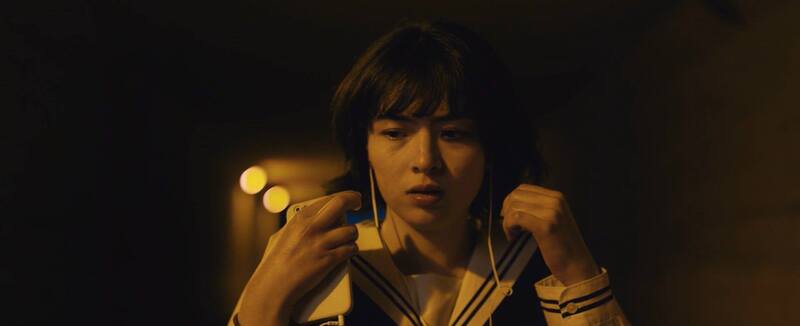
The Reality of Feeling Unwanted
Read Time:12 Minute, 17 Second
MOVIE REVIEW
The Invisible Half (Inbijiburuhafu)
 –


Genre: Horror, Mystery, Thriller
Year Released: 2025, 2026 DVD
Runtime: 1h 46m
Director(s): Masaki Nishiyama
Writer(s): Masaki Nishiyama
Cast: Lisa Siera, Miyu Okuno, Runa Hirasawa, Mayu Ozawa, Yuri Osawa, Ayumi, Ami Ishii, Takahiro Sakai
Where to Watch: available November 10, 2026. Pre-order your copy here: www.mvdshop.com or www.amazon.com
RAVING REVIEW: Elena Takahashi has the kind of school experience that makes an actual monster seem almost unnecessary. Her classmates already have plenty of ways to make her miserable, and none of them requires supernatural assistance. In Masaki Nishiyama's THE INVISIBLE HALF, the arrival of a bandaged figure that can only be detected through a smartphone turns that everyday hostility into something much stranger. The setup belongs to a recognizable tradition of Japanese horror. Its teenage protagonist faces a problem that existed long before anyone started carrying a camera in their pocket. She's treated as an outsider in a place where she has every right to belong. The film finds a promising connection between those experiences, even if its handling of the mystery isn't always as sharp as its central idea.
Elena (Lisa Siera) is a teenager of Japanese and British heritage who transfers to a school in Japan hoping for something better than the treatment she's already endured. That doesn't turn out to be as simple as changing classrooms. Her name and appearance draw attention, and students quickly use her background as an excuse to label her a foreigner. Being called *hāfu*, or half-Japanese, is not inherently an insult in every conversation. It becomes one when people use it to imply that somebody is less entitled to a Japanese identity. Elena's trouble isn't that she can't decide who she is. It's that other people keep deciding for her.
The school environment doesn't need an elaborate conspiracy to be unpleasant. Casual remarks can turn into humiliation when a group knows there will be few consequences, and the pressure to avoid standing out makes it difficult for anyone else to intervene. Nishiyama's film puts Elena in that uncomfortable position without making the entire class a collection of cartoon villains. The cruelty has a social setting. Students notice who is considered acceptable to mock, and the target is expected to absorb the embarrassment rather than make everyone uncomfortable by objecting. That dynamic gives the early stretch a more familiar kind of tension than the film's supernatural advertising might suggest.
Akari Yamamoto (Miyu Okuno) offers Elena a possible way out of that isolation. She's interested in the new student and her British background, though curiosity isn't automatically the same thing as understanding. Even friendly questions can make a person feel like an exhibit when they've spent years being defined by the traits others find unusual. The developing friendship matters because Elena needs more than somebody willing to stand beside her when things become frightening. She needs a relationship in which she isn't constantly explaining or defending her place in the world. The film leaves room for uncertainty here, because trusting another student is difficult when the wider school environment has given so many reasons to be cautious.
Another classmate, Nyan Ito (Runa Hirasawa), appears withdrawn and attached to her phone and earphones. Her isolation has a different shape from Elena's. Others have learned to dismiss or ridicule her, and her behavior only encourages more speculation. The connection between these girls helps broaden the film beyond a single account of racial prejudice. Their circumstances aren't identical, and treating all outsiders as interchangeable would flatten the very differences the story wants its audience to notice. But both know what it means to become a subject of conversation while rarely being treated as someone whose perspective deserves consideration.
Then Elena begins noticing the presence following her. The figure's covered face and unnerving appearance are recognizable horror imagery, but its rules provide the real complication. She can spot it through her smartphone camera, and her earphones allow her to hear what would otherwise be silent. Looking directly at the same space won't necessarily tell her whether she's safe. It's the sort of predicament that could make an ordinary walk unbearable. You can't spend every second holding up a phone to inspect the world around you, yet putting it away may mean losing the only warning you'll get. Modern technology has finally found a way to make checking your phone even more stressful.
The device makes THE INVISIBLE HALF an easy film to place alongside RINGU and KAIRO, two Japanese horror landmarks that understood how everyday technology could become unsettling. Nishiyama isn't simply substituting a smartphone for a cursed videotape, though. The phone becomes a tool of perception. It reveals a danger Elena's own eyes cannot register. That changes how the viewer thinks about a familiar location. A doorway or an apparently empty corridor can become threatening without the film needing to place a monster plainly in the shot. The concept is uncomplicated enough to follow, which makes the moments when Elena must decide whether to look all the more interesting.
Sound contributes something different. Because Elena's earphones govern what she hears, the film can play with the difference between the surrounding world and her private experience of it. Director Nishiyama has spoken about his interest in making that muffled, restricted perspective part of the presentation. It's an unusually fitting idea for a teenager whose devices have already become part of how she navigates the school day. A teacher or parent may see someone who refuses to take out her earphones; Elena may understand that removing them comes with a much more frightening cost. That conflict supplies a concrete source of suspense without requiring anyone to deliver a long explanation of the curse.
Lisa Siera has to carry a story in which the character spends considerable time uncertain of the people around her and the evidence of her own senses. Elena isn't written as a witty horror expert who immediately understands the rules and starts issuing instructions. She's a frightened teenager, already worn down by how she's been treated. That vulnerability gives the supernatural material a human starting point. At the same time, the screenplay can lean so heavily on her distress that she has fewer opportunities to develop outside the circumstances hurting her. More room for her everyday interests and decisions would have made her life feel less defined by what others do to her.
The contrast with Akari is useful in that respect. Akari's willingness to approach Elena creates possibilities that the bullying alone cannot, but friendship also brings its own awkward choices. Somebody can mean well and still misunderstand what another person needs. The film doesn't have to resolve that immediately to make the relationship worthwhile. It is enough to recognize the difference between a student being fascinated by Elena's background and somebody taking the trouble to listen to her. Miyu Okuno's role is important because the movie would become unbearably closed off if Elena had no chance of forming a connection with anyone at all.
Nishiyama's filmmaking background helps explain why this material is presented through a device rather than confined to a conventional haunting. He began making independent films in his teens and had already experimented with smartphone-oriented horror before undertaking his first feature. In interviews, he traced the initial inspiration to the hostility of anonymous online attacks, where people can direct intense abuse at someone while remaining effectively invisible themselves. That is a more specific starting point than the familiar observation that teenagers spend too much time online. The phone isn't the villain because technology is inherently bad. It reveals how frightening it can be to feel watched by something you cannot confront on equal terms.
The production was made in Japan's Ehime prefecture, away from the country's main filmmaking centers, with support from local collaborators. Nishiyama has described an extended process of preparation and postproduction, including extensive storyboarding and years of visual-effects development. That planning is relevant to a film whose premise depends on maintaining a consistent distinction between what Elena can see and what the camera can show. Cinematographer Shuhei Yamamoto and visual-effects artist Cao Moji are among the collaborators responsible for building that screen language. The monster's disturbing bandaged appearance also has a practical design component, credited to Kaiho. These choices give the project an identity beyond the novelty of its central device.
There are moments when THE INVISIBLE HALF experiments with how information is presented, including dreamlike imagery and intertitles. Those departures from straightforward narration suit a character who is increasingly unsure what to trust. They also risk making an already mysterious story harder to follow if the viewer has too little context for the new images. A nightmare can communicate fear without providing an answer, but the surrounding narrative still needs to establish which questions matter. Nishiyama has interesting instincts for presenting uncertainty; the challenge is knowing when another unsettling image develops that uncertainty and when it merely adds to it.
At 106 minutes, the movie gives itself generous space for a story built around a fairly direct supernatural rule. That length allows its school relationships to develop and gives Elena's situation more weight than a quick sequence of scares would. It also leaves the mystery exposed whenever the characters' immediate decisions stop moving it forward. The shifts between social drama and investigative horror aren't always seamless. Some of the material about exclusion belongs in a film with room to breathe, but the central threat needs an equally clear progression. Otherwise, the audience can feel as if two compelling starting points are competing for the same running time.
The bullying is where the subject matter demands the most care. It would be easy for a film like this to imply that cruelty produces a supernatural punishment and thereby reduce real suffering to a plot mechanism. THE INVISIBLE HALF's better idea is that being targeted changes the way someone moves through ordinary life. A person who expects ridicule may stop asking questions, avoid attention, or become suspicious of an apparently harmless remark. Those responses are grounded in experience, not fantasy. The monster makes those everyday calculations more dangerous, but it doesn't have to stand for every bad thing that has happened to Elena. The human behavior remains disturbing without any assistance from an elaborate curse.
That distinction also keeps the title from becoming too neat a metaphor. Elena isn't literally half a person, and her heritage doesn't make her identity deficient. The word points toward a judgment imposed upon her. The supernatural story, meanwhile, asks what happens when a person can perceive something others cannot and struggles to be believed. There's a connection between being dismissed and being alone with frightening knowledge, but you don't need to turn every encounter into a symbolic lesson. The film's characters are better served when their immediate problems are real rather than explanations of the theme.
One element worth preserving in this conversation is the film's status as a feature debut. Nishiyama has an identifiable interest in what a camera can conceal and what it reveals, and his earlier work with vertical-format smartphone horror gives that interest some history. His decision to write and edit THE INVISIBLE HALF himself also means its narrative rhythms are closely connected to his own creative choices. That degree of control can produce distinctive filmmaking, though it can also leave a debut without the outside discipline that might simplify a complicated final stretch. The film contains ideas that deserve attention without requiring every one to be fully realized.
The Cleopatra Venom DVD offers the film in its original Japanese-language version as well as an English-language version. That's a meaningful choice for a story in which cultural identity and the way characters address one another are so central. The distributor's information doesn't promise a large package of commentary tracks or retrospective supplements, so approach the disc primarily as a way to access the feature. Its region-free designation also makes the edition convenient for collectors whose equipment supports DVDs from different territories. None of those specifications establishes how the disc looks or sounds in practice; that would require a separate assessment of the actual presentation.
THE INVISIBLE HALF has more going for it than a clever poster-ready gimmick. The relationship between Elena's difficult school life and the unseen creature supplies enough substance to sustain serious discussion, while the phone-and-earphone rules give the horror a practical shape. The movie feels less assured when its mystery grows more elaborate, and its characters have to compete with the mechanics of the haunting for attention. Nishiyama's debut shows a filmmaker interested in doing something personal with familiar genre material, even if the pieces don't always fit together cleanly. Elena spends much of the film trying to establish whether something frightening is there. The harder question is why so many people can look directly at her and still refuse to see her.
Please visit https://linktr.ee/overlyhonestr for more reviews.
Follow me on Letterboxd, Instagram, Twitter, and YouTube. You can also find my social media accounts on most platforms by searching for 'Overly Honest Reviews'.
I’m always happy to hear from my readers; please don't hesitate to say hello or send me any movie questions.
[photo courtesy of CLEOPATRA VENOM, MVD ENTERTAINMENT]
DISCLAIMER:
At Overly Honest Movie Reviews, we value honesty and transparency. Occasionally, we receive complimentary items for review, including DVDs, Blu-rays, CDs, Vinyl Records, Books, and more. We assure you these arrangements do not influence our reviews, as we are committed to unbiased, sincere evaluations. We aim to help you make informed entertainment choices regardless of our relationship with distributors or producers.
Amazon Affiliate Links:
This site also contains Amazon affiliate links. If you purchase through these links, we may receive a commission. This affiliate arrangement does not affect our commitment to honest reviews and helps support our site. We appreciate your trust and support as you navigate these links.


Happy
0 %

Sad
0 %

Excited
0 %

Sleepy
0 %

Angry
0 %

Surprise
0 %
 0
 0


Average Rating