A Future That Still Feels Strange
Read Time:8 Minute, 41 Second
MOVIE REVIEWS
Forbidden Planet
G – 

Genre: Science Fiction, Adventure
Year Released: 1956, 2026 4K
Runtime: 1h 38m
Director: Fred M. Wilcox
Writers: Cyril Hume, Irving Block, Allen Adler
Cast: Walter Pidgeon, Anne Francis, Leslie Nielsen, Warren Stevens, Jack Kelly, Richard Anderson
Where to Watch: available now; order your copy here: www.arrowvideo.com, www.mvdshop.com, or www.amazon.com
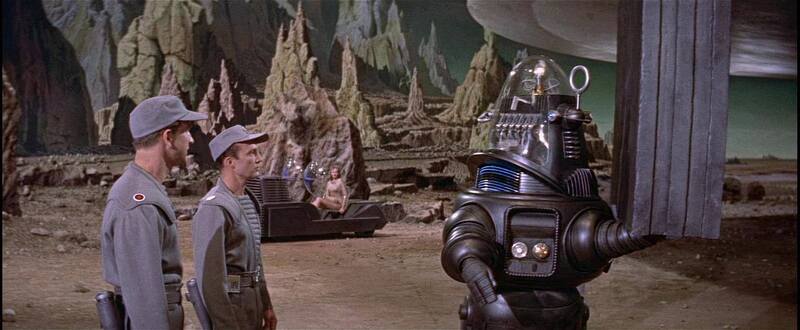
RAVING REVIEW: The quickest way to make a nearly 70-year-old science-fiction movie feel its age is to ask it to predict the future. FORBIDDEN PLANET somehow survives that challenge because its version of tomorrow is so committed to being strange that realism almost stops mattering. The control panels, uniforms, enormous machinery, painted landscapes, electronic noises, and wonderfully bulky Robby the Robot don't resemble our world in 2026. However, together they create a future that still feels like someplace else.
That distinction matters because FORBIDDEN PLANET could easily be admired only as an important piece of science-fiction history. Instead, Fred M. Wilcox's movie remains genuinely entertaining, even when some undeniably 1950s attitudes threaten to pull it backward. The impressive part isn't simply how much later science fiction borrowed from it; it's how often the movie still manages to make Altair IV feel mysterious before you even consider what came afterward.
Commander John Adams (Leslie Nielsen) and the crew of the C-57D arrive on a distant planet to investigate what happened to an expedition sent there decades earlier. Their welcome isn't exactly warm. Dr. Edward Morbius (Walter Pidgeon) warns them away. Yet, Adams discovers Morbius living comfortably with his daughter Altaira (Anne Francis), the extraordinarily capable Robby the Robot, and the remains of the advanced Krell civilization beneath them.
Some elements have aged much better than others, and the treatment of Altaira is the hardest part to ignore. The movie establishes a woman who has spent her entire life isolated from other men and then has members of the arriving crew practically lining up to make their move. Those scenes certainly intend humor. Still, the constant attention and romantic competition become uncomfortable by modern standards and make Altaira seem less independent than Anne Francis' performance otherwise suggests.
The occasional comic relief has similar trouble fitting alongside everything else. FORBIDDEN PLANET is at its best when it trusts the unfamiliar world, lets its electronic sounds fill the silence, and allows questions about Morbius and the Krell to build naturally. When it breaks away for broad jokes involving the crew, especially the ship's cook, it briefly feels like a much more ordinary movie from the period.
Then the film shows us something like the Krell underground complex and those complaints suddenly seem much smaller. The scale is remarkable, with towering machinery, endless corridors, massive doors, glowing controls, and spaces designed to make human beings look insignificant. Matte paintings and practical sets combine to create locations that don't need photorealism because their size and imagination sell the illusion.
That sense of scale becomes even more striking when contrasted with Robby the Robot. Robby could have been an amusing prop that appeared for a few scenes, but the movie gives him personality, rules, abilities, and a surprisingly natural place within the story. His bulky transparent dome, spinning mechanisms, mechanical arms, and flashing components should look ridiculous now, yet he remains one of the most charming parts of the movie.
There's also something almost surreal about seeing Leslie Nielsen playing everything completely straight. Decades of comedy make it difficult not to expect a joke whenever he appears. Still, Nielsen is convincing as a confident commander who doesn't become needlessly aggressive simply because Morbius wants him gone. Walter Pidgeon gives Morbius considerably more weight, making him intelligent, polite, defensive, and just unsettling enough that you're never completely sure how much he knows.
Anne Francis has the harder job because Altaira is stuck between the movie's better ideas and its dated ones. Francis still gives her curiosity and warmth that keep her from becoming nothing more than the beautiful woman waiting on an alien planet. She also shares an easy chemistry with Robby that makes their relationship more memorable than several of the movie's human interactions.
Nothing separates FORBIDDEN PLANET from most science fiction of its period faster than its sound. Bebe and Louis Barron's electronic tonalities don't behave like a traditional movie score, frequently blending so completely with machinery, spacecraft, doors, alarms, and the planet itself that music and sound effects become difficult to separate. The strange pulses, hums, squeals, and electronic movement give Altair IV an identity before the movie has fully explained anything about it.
That soundtrack still sounds unusual today, which might be the film's greatest technical accomplishment. Electronic scoring obviously became commonplace afterward, but this doesn't sound like someone simply replacing an orchestra with newer instruments. The Barrons created something that seems to be coming from the world we're watching, and that makes the movie considerably more eerie than its colorful MGM presentation might suggest.
The story itself loosely borrows from Shakespeare's THE TEMPEST, particularly through the isolated father and daughter, the unexpected visitors, and extraordinary forces controlled from within their remote home. You don't need to know anything about Shakespeare for the story to work, however. FORBIDDEN PLANET gradually becomes interested in intelligence, power, technology, and the dangerous assumption that scientific advancement automatically means that the people using it have advanced just as far.
That's where the movie remains surprisingly sharp. The Krell aren't interesting simply because they built bigger machines or understood technology beyond human comprehension. Their disappearance raises a question over every incredible discovery, letting the movie treat limitless knowledge as both an achievement and a warning without turning everything into a lecture.
The unseen threat stalking the planet gives those ideas something physical to push against. FORBIDDEN PLANET wisely avoids showing too much too quickly, using damaged equipment, footprints, defensive barriers, sound, and reaction to create something far more intimidating than another actor inside an alien costume. When the effects finally become more elaborate, the mix of animation and live action has an energy that still works despite decades of visual-effects progress.
Arrow's new release gives that visual imagination plenty of room with a 4K restoration from the original 35mm negative presented in the original 2.55:1 CinemaScope ratio. The extremely wide frame is important for a movie built around huge spaces, whether the crew is standing beneath the C-57D or disappearing inside the enormous structures left behind by the Krell. The limited edition also restores the original Perspecta stereo alongside the mono track. It includes an extensive second disc of archival material, featurettes, deleted material, galleries, and even THE INVISIBLE BOY with Robby returning the following year.
FORBIDDEN PLANET isn't timeless in every respect, and pretending otherwise would mean overlooking some of its most noticeable weaknesses. Its gender politics can be rough, parts of the humor belong firmly to another era, and some stretches rely heavily on characters explaining discoveries rather than letting us experience them. None of that stopped me from becoming increasingly impressed by just how ambitious this thing must have seemed in 1956.
Plenty of older science-fiction movies are worth seeing because they helped create what came later. FORBIDDEN PLANET has that historical importance, but it doesn't need to survive on importance alone. Altair IV remains beautiful, Robby remains lovable, the Barrons' electronic sounds remain wonderfully alien, and beneath all those colorful sets is an idea about human nature that's considerably darker than the movie initially lets on. Nearly seven decades later, this particular vision of tomorrow still has enough imagination left to make the future feel unknown.
Bonus Materials:
4K ULTRA HD LIMITED EDITION CONTENTS
Brand new 4K restoration from the original 35mm negative by Arrow Films in the original 2.55:1 aspect ratio
Reversible sleeve featuring original artwork options
Double-sided fold-out poster
Reversible sleeve featuring two original artwork options
Collectors’ booklet containing new writing by critics Frank Collins and Johnny Mains, plus select archival material
DISC 1 – FEATURE (4K ULTRA HD BLU-RAY)
4K (2160p) Ultra HD Blu-ray presentation in Dolby Vision (HDR10 compatible)
Restored original lossless mono, restored original Perspecta stereo, and DTS-HD MA 5.1 audio options
Optional English subtitles for people who are hard of hearing
Brand new audio commentary by film historians Kim Newman and Barry Forshaw
DISC 2 – EXTRAS (BLU-RAY)
Unearthly Aura, a newly filmed appreciation of Bebe & Louis Barron’s pioneering electronic score by historian and composer Neil Brand
Watch the Skies!: Science Fiction, The 1950s and Us, an archival documentary
Amazing!: Exploring the Far Reaches of Forbidden Planet, an archival documentary
Robby the Robot: Engineering a Sci-FiIcon, an archival featurette
Deleted Scenes
Lost Footage
The Invisible Boy, a bonus movie featuring Robby the Robot in his second feature film
“Robot Client,” an episode of The Thin Man TV series featuring Robby the Robot
Two excerpts from MGM Parade
Original Shooting Script
Theatrical trailer
Image galleries
Please visit https://linktr.ee/overlyhonestr for more reviews.
You can follow me on Letterboxd, Instagram, Twitter, and YouTube. You can also find my social media accounts on most platforms by searching for 'Overly Honest Reviews'.
I’m always happy to hear from my readers; please don't hesitate to say hello or send me any questions about movies.
[photo courtesy of ARROW VIDEO, MVD ENTERTAINMENT]
DISCLAIMER:
At Overly Honest Movie Reviews, we value honesty and transparency. Occasionally, we receive complimentary items for review, including DVDs, Blu-rays, CDs, Vinyl Records, Books, and more. We assure you these arrangements do not influence our reviews, as we are committed to unbiased, sincere evaluations. We aim to help you make informed entertainment choices regardless of our relationship with distributors or producers.
Amazon Affiliate Links:
This site also contains Amazon affiliate links. If you purchase through these links, we may receive a commission. This affiliate arrangement does not affect our commitment to honest reviews and helps support our site. We appreciate your trust and support as you navigate these links.


Happy
0 %

Sad
0 %

Excited
100 %

Sleepy
0 %

Angry
0 %

Surprise
0 %
 1
1
 0
0


Average Rating