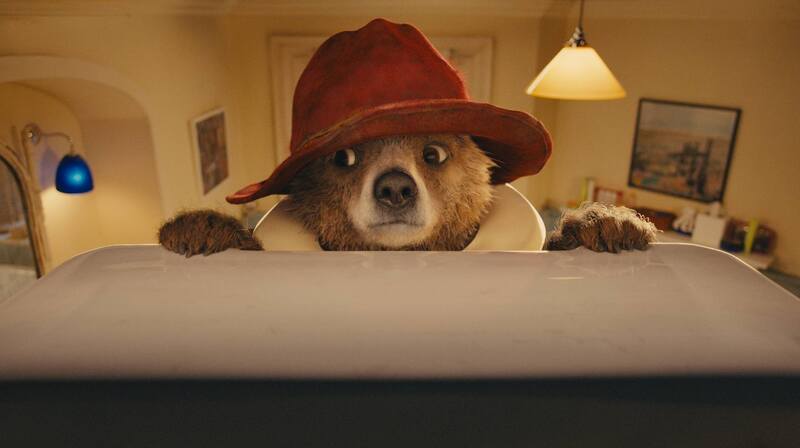
How Could You Say No to That Face
Read Time:11 Minute, 10 Second
MOVIE REVIEW
Paddington
 –


Genre: Children, Family, Comedy
Year: 2014, 2026 4K Steelbook
Runtime: 1h 35m
Director: Paul King
Writers: Paul King, Hamish McColl
Cast: Ben Whishaw, Hugh Bonneville, Sally Hawkins, Nicole Kidman, Julie Walters, Jim Broadbent, Peter Capaldi, Madeleine Harris, Samuel Joslin, Imelda Staunton, Michael Gambon
Where to Watch: available on 4K Ultra HD + Blu-ray™ + Digital on November 10, 2026, exclusively at Lionsgate Limited. Pre-order your copy here: www.lionsgatelimited.com
RAVING REVIEW: A tiny bear with a handwritten request for help shouldn't be hard to fix! Give him a place to sleep, something to eat, and try not to make a fuss about the fact that he talks. Yet when Paddington arrives in London, most people ignore him. That contradiction is the foundation for PADDINGTON, a family comedy that doesn't require its audience to be children to understand what's at stake. Being polite is easy when nothing is asked of you. The test comes when somebody actually needs something, especially when helping would make your day a lot less convenient.
Paul King's adaptation of Michael Bond's creation begins in Peru, where Paddington (voiced by Ben Whishaw) has learned about England from his Aunt Lucy (Imelda Staunton) and Uncle Pastuzo (Michael Gambon). When his circumstances change, he heads to London expecting the warmth he'd been told to anticipate. The Browns find him at Paddington Station. Mary (Sally Hawkins) thinks they should offer him a temporary home; Henry (Hugh Bonneville) sees a walking catalog of possible disasters. Their children, Judy (Madeleine Harris) and Jonathan (Samuel Joslin), have their own opinions. Naturally, inviting an inexperienced bear into a house equipped with plumbing turns out to be rather more complicated than anyone planned.
The comedy depends on Paddington being a specific sort of character, not simply a cute digital creature that can destroy household objects. He takes instructions seriously. He believes people mean what they say. When something goes wrong, his embarrassment matters as much as the spectacle. Whishaw's vocal performance maintains that sincerity without pushing it into babyish helplessness. Paddington is observant and resourceful, even if he doesn't always know the customs governing the place he's trying to navigate. That's a better basis for a whole movie than an endless succession of exaggerated reactions from a cuddly mascot.
King and co-writer Hamish McColl also understand the difference between adapting a character's spirit and treating the source material like a list of mandatory references. Bond's bear is associated with small-scale misadventures, a useful foundation for comedy but not automatically enough to sustain a feature. The film connects Paddington's search for a home with the Browns' uneasy accommodation of a stranger. That gives the mishaps consequences beyond the immediate joke. The family isn't merely waiting for the next catastrophe; their guest's arrival exposes ways they're already failing to understand one another.
Henry could easily have been a tedious obstacle, the sort of movie father who spends the entire running time barking that nobody is having any fun. Instead, Bonneville gives him a recognizable logic. Henry loves his family, but he's become so focused on preventing trouble that his version of protection leaves little room for living. Paddington makes his calculations look ridiculous because no spreadsheet has a sensible category for an orphaned talking bear. The joke isn't that parents shouldn't worry about their children. It's that treating every unknown as a threat can make a home feel narrower than it needs to be.
Hawkins has an entirely different job as Mary, and the film doesn't require her to make grand speeches about why she wants to help. Mary's impulse is immediate! Somebody is stranded, and she can do something about it. That generosity is appealing partly because the script allows it to be impractical. She's not presented as a flawless decision-maker, just a person unwilling to confuse inconvenience with a good reason to turn someone away. Walters brings an equally welcome no-nonsense energy to Mrs. Bird, the housekeeper who can respond to the absurdity without pretending it isn't absurd. These performers give the household a comic texture that Paddington couldn't create by himself.
Judy and Jonathan are more than miniature versions of their parents. Judy is keenly aware of how embarrassing a family can be, which makes her especially alert to the possibility of attracting more unwanted attention. Jonathan's interests and instincts pull him in a different direction. Neither child needs an elaborate subplot to help illustrate why the Browns aren't a perfectly united group even before their visitor arrives. The children's distinct reactions also prevent the picture from falling into the lazy assumption that young people automatically accept every strange creature. At the same time, the grown-ups have to learn a lesson.
Then Nicole Kidman enters the movie as Millicent Clyde, a taxidermist whose idea of appreciating a rare animal is far more permanent than taking it home for tea. Kidman plays the villain with an icy confidence that suits this deliberately heightened world. Her pursuit gives the adventure external danger and gives the supporting cast room to participate in something larger than domestic damage control. It's a familiar mechanism, and Millicent isn't a psychologically complicated antagonist. She doesn't need to be. The fun is in the contrast between her severe self-possession and a hero who generally assumes other people have good intentions.
A nasty little idea also lurks beneath her pursuit. Millicent regards Paddington as an acquisition, something that matters because of its rarity rather than its personality. The Browns initially disagree about having him around, but at least their arguments acknowledge him as a guest with needs. That distinction makes the film's talk of respect more concrete. You can be fascinated by someone unusual and still fail to treat them decently. PADDINGTON gets that point across through the villain's profession and behavior, rather than stopping the story to explain it.
Much of the laughter comes from physical comedy, and King's staging helps it feel distinct from every other talking-animal picture. A household bathroom becomes a place of genuine peril when its newest user has no idea how the equipment works. The joke can be broad, but the sequence has a clear progression. Paddington tries to solve one problem, misunderstands the result, and creates a larger one. That cause-and-effect construction is important. Random destruction gets old quickly. Watching a conscientious character become the architect of disaster through perfectly understandable mistakes is much funnier.
The visual design has a similar sense of play. King's London feels assembled for a storybook without abandoning the recognizable streets and buildings that give the setting its identity. Interiors are arranged with the attention of someone who knows that a room can say plenty about its inhabitants before anyone opens their mouth. The Brown home, full of distinct spaces and personalities, feels like a place that can generate its own jokes. Occasional flourishes in the presentation make the city more expressive than a straightforward live-action backdrop. None of this requires the viewer to stop and admire the production design as a separate achievement; it supports the film's slightly eccentric take on everyday life.
Paddington himself has to share those physical spaces convincingly, which is where the visual-effects work becomes a practical storytelling tool. DNEG contributed to the production, helping create a bear who can interact with human performers and objects rather than merely appear beside them. The character's expressiveness is crucial because so much of his personality lies in small reactions. A pause after an embarrassing accident can be just as useful as a complicated stunt. Digital effects are often discussed in terms of how big an impossible event can become. Here their value is measured by whether an improbable houseguest can seem present enough for a conversation to work.
The film's humor isn't exclusively slapstick. Peter Capaldi's Mr. Curry brings the peculiar aggravation of a neighbor who makes other people's business his own. Jim Broadbent's Mr. Gruber offers a gentler presence, somebody whose connection with Paddington isn't built on spectacle. Those supporting characters expand the social world outside the Brown house. They also make London feel less like one uniform crowd of unfriendly strangers. The city has pockets of suspicion and kindness, busybodies and people willing to listen. That variety makes Paddington's effort to find his place more believable within the story's exaggerated logic.
The film also benefits from refusing to disguise sweetness with constant sarcasm. Much family entertainment seems terrified that an earnest scene will frighten away adults, so somebody has to puncture it with a joke. PADDINGTON is comfortable allowing an affectionate exchange to remain affectionate. That's not the same as being humorless or cloying. The script has spent enough time establishing its characters' quirks that a sincere moment can arrive without the sensation that a message has been pasted onto the movie. Even Henry's resistance carries a little understandable emotion, not just an invitation to laugh at him.
Bond's stories have a history worth remembering here. The character was influenced by images of children evacuated during the Second World War, including the labels they wore as they traveled. King's film draws on that association through its displaced traveler, modest possessions, and appeal to strangers' goodwill. It doesn't need to spell out a direct modern political comparison for the imagery to have meaning. A newcomer can love the idea of a country and still discover that the people living there aren't uniformly welcoming. Younger viewers can follow the adventure without knowing that background; adults have another layer to consider if they're interested. The historical reference enriches the central situation without swallowing it.
The film's familiar adventure structure has limits. Once the villain's pursuit moves to the foreground, the story travels through recognizable territory, and some of its suspense is more energetic than surprising. That isn't necessarily a serious complaint about a picture pitched to families. The important thing is that the action doesn't suddenly turn Paddington into a wisecracking superhero or discard the qualities that made him worth following. The larger narrative is conventional, but the character remains distinct. I'd rather have an appealing story told confidently than a strained attempt to manufacture clever twists for their own sake.
The listed supplements include older features such as MEET THE CHARACTERS, WHEN A BEAR COMES TO STAY, and FROM PAGE TO SCREEN, plus the “Shine” music video, a making-of piece involving Gwen Stefani and Pharrell Williams, and the theatrical trailer. The new PLEASE LOOK AFTER THIS BEAR mini-documentary features Paul King discussing his connection to the character and the adaptation. That's a more useful selling point than a vague promise of exclusive content, especially for people curious about how the books became this particular film. The label also notes that its 4K discs are region-free, with the accompanying Blu-ray restricted to Region A. Buyers outside North America should factor that into their expectations.
What stays with PADDINGTON isn't the novelty of seeing a bear in a duffle coat or the scale of the trouble he causes. It's that he never treats ordinary consideration as an extraordinary favor. He thanks people. He apologizes when he makes a mess. He asks for help because he has every reason to believe somebody might offer it. The film gets plenty of comedy out of how impractical that outlook can be, then has the good sense not to make him abandon it. London may not know quite what to do with Paddington when he arrives, but by the end it's hard to imagine the city without him.
Please visit https://linktr.ee/overlyhonestr for more reviews.
Follow me on Letterboxd, Instagram, Twitter, and YouTube. You can also find my social media accounts on most platforms by searching for 'Overly Honest Reviews'.
I’m always happy to hear from my readers; please don't hesitate to say hello or send me any movie questions.
[photo courtesy of LIONSGATE LIMITED]
DISCLAIMER:
At Overly Honest Movie Reviews, we value honesty and transparency. Occasionally, we receive complimentary items for review, including DVDs, Blu-rays, CDs, Vinyl Records, Books, and more. We assure you these arrangements do not influence our reviews, as we are committed to unbiased, sincere evaluations. We aim to help you make informed entertainment choices regardless of our relationship with distributors or producers.
Amazon Affiliate Links:
This site also contains Amazon affiliate links. If you purchase through these links, we may receive a commission. This affiliate arrangement does not affect our commitment to honest reviews and helps support our site. We appreciate your trust and support as you navigate these links.


Happy
0 %

Sad
0 %

Excited
0 %

Sleepy
0 %

Angry
0 %

Surprise
0 %
 0
 0


Average Rating