A Forgotten Chapter of Fulci’s Brutality
Read Time:10 Minute, 10 Second
MOVIE REVIEW
Beatrice Cenci (The Conspiracy of Torture)
 –


Genre: Historical Drama, Horror
Year Released: 1969, 2026 Blu-ray
Runtime: 1h 34m
Director: Lucio Fulci
Writers: Lucio Fulci, Roberto Gianviti
Cast: Adrienne La Russa, Tomas Milian, Georges Wilson, Mavie Bardanzellu, Antonio Casagrande, Ignazio Spalla, Raymond Pellegrin
Where to Watch: available now; order your copy here: www.mvdshop.com or www.amazon.com
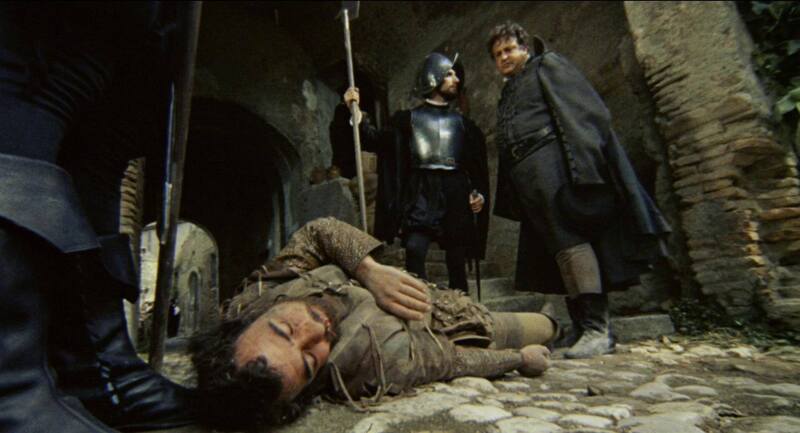
RAVING REVIEW: Lucio Fulci's name usually brings to mind the grotesque imagery of his later horror films, which makes BEATRICE CENCI an interesting reminder of how much more varied his career was. Released in 1969 and also known as THE CONSPIRACY OF TORTURE, this historical drama has no interest in offering the kind of entertainment that made him a cult favorite. It follows a wealthy Italian family whose cruelty becomes a matter for the courts, and the institutions responsible for delivering justice prove deeply compromised themselves. There's violence here, and some of it is difficult to watch, but the larger concern is who gets to exercise power over another person's life.
The film draws from the case of Beatrice Cenci, a young Roman noblewoman whose father, Francesco, was notorious for his brutality. In Fulci's telling, Francesco rules his household through humiliation and fear, with his daughter and other family members trapped in a situation that offers them few legitimate means of escape. Beatrice's relationship with Olimpo Calvetti, a servant played by Tomas Milian, becomes entangled with a plan to end Francesco's abuse. That outline sounds like a straightforward revenge story. Fulci is interested in the consequences of living under a system that protects the powerful long before anyone considers what happens when their victims fight back.
Georges Wilson's Francesco is essential to understanding why the story becomes so uncomfortable. He's not presented as an eccentric aristocrat whose temper occasionally gets the better of him. His authority makes cruelty an ordinary feature of domestic life, and his standing in society shields that cruelty. The threat facing Beatrice extends beyond her father's immediate actions because the people who might intervene exist within the same hierarchy. Fulci doesn't need to make Francesco sympathetic to complicate the situation. He makes the limits of everyone else's freedom painfully apparent.
Adrienne La Russa plays Beatrice as a person forced to make decisions in circumstances she didn't create. It's an important distinction in a story that can easily be reduced to the scandal of a daughter plotting against her father. The character's predicament gives the film an emotional foundation, even when the narrative's structure prevents her perspective from receiving the uninterrupted attention it deserves. Beatrice isn't granted the comfort of a world in which resisting abuse automatically makes someone safe. The film follows the far less reassuring possibility that the very act of resistance can place a victim in danger from an entirely different direction.
Fulci tells this story through a fractured chronology, moving between the events surrounding Francesco's death and the circumstances that led to it. This choice creates a sense that the family's fate is being pieced together through testimony, suspicion, and competing interests. It also makes the film harder to settle into than a chronological account would have been. The movement between periods occasionally interrupts the momentum of individual relationships, especially when the viewer is trying to understand where each character fits into the larger conflict. There is a purpose to that construction, but purpose alone doesn't make every transition equally effective.
The investigation gives the story a different kind of tension from the household drama. Once suspicion falls on the family, the authorities pursue answers in an environment where a confession can be treated as the desired outcome rather than evidence to be examined. Torture exposes the gap between the language of lawful procedure and the methods used to enforce it. Fulci approaches this material with an anger that feels entirely consistent with the concerns of his later work. The violence isn't confined to people operating outside society's rules. Some of the most frightening conduct comes from those empowered to uphold them.
That religious and political dimension is arguably the film's most enduring point of interest. The Catholic Church isn't simply part of the historical backdrop. Its influence helps define who is protected, what conduct is punished, and how moral authority can be used to justify plainly cruel actions. Fulci makes institutional hypocrisy part of the story's machinery. The resulting criticism is more specific than a general declaration that religious officials are corrupt. It asks what justice amounts to when the people responsible for administering it are also invested in preserving their own position.
The historical case adds a disturbing context that exists beyond the film's interpretation. Beatrice and members of her family were prosecuted following Francesco's murder, and Pope Clement VIII refused clemency before the executions in 1599. Over the centuries, Beatrice's story inspired plays, literature, and visual art, with her image often transformed into that of a tragic symbol of resistance. Historical scholarship has also questioned details that later retellings took for granted. Fulci works within that long tradition of dramatizing the case, making clear thematic choices instead of offering an impartial reconstruction of every disputed event. Knowing this distinction helps explain the film's force without treating its dramatic account as a documentary record.
Tomas Milian brings a useful contrast to the aristocratic world around him. As Olimpo, his character occupies a much more vulnerable social position, changing what loyalty and involvement in Beatrice's situation might cost him. Their relationship also shows how different the consequences of one act can be depending on a person's place in society. Milian's presence will be familiar to viewers who know him from more volatile roles in Italian genre cinema, but this material gives him a different set of pressures to convey. The character isn't merely an accomplice added to move the plot along. His social standing is one more way the film demonstrates the uneven distribution of power.
Fulci's visual approach deserves attention because BEATRICE CENCI is far removed from the image of a director concerned only with staging outrageous deaths. Working with cinematographer Erico Menczer, he places the characters within a world of imposing buildings and austere interiors that reinforce the social divisions governing their lives. The period setting doesn't invite admiration of aristocratic elegance. Its appeal is deliberately compromised by the conditions inside those spaces. That approach gives the film a convincing identity of its own, even for viewers who have no particular attachment to Fulci's horror reputation.
The violence is an important part of that identity, though the film's reputation can create the wrong expectations. BEATRICE CENCI isn't a nonstop procession of elaborate killings, and treating it as an early version of THE BEYOND would do both productions a disservice. The brutality here is tied to punishment, intimidation, and the methods by which people are made to submit. It can be upsetting without relying on the escalating excess associated with Fulci's later films. The more interesting connection to his horror work lies in his distrust of authority and his willingness to depict the human body as vulnerable to institutions that claim to know what is right.
For all of those strengths, the film's dramatic engagement isn't as consistent as its ideas. The fragmented storytelling makes certain passages feel more concerned with reconstructing the case than with letting the characters develop naturally in the moment. The number of people involved can also demand extra attention, particularly when the story shifts between private grievances and official proceedings. These aren't fatal problems, and they don't erase the ambition of Fulci's approach. They do help explain why this can be an easier film to appreciate for its direction and subject matter than to become completely absorbed in from beginning to end.
There's also an interesting difference between the movie's title character and the broader portrait Fulci constructs around her. BEATRICE CENCI sounds like an intimate examination of one woman's experience, and that element matters enormously. The film repeatedly widens its attention to encompass the conduct of relatives, servants, investigators, and religious authorities. The result is a story about an entire culture of privilege and punishment, with Beatrice caught within its most destructive contradictions. That scope gives the material historical reach, even if a tighter focus on her experience might have made the emotional impact more immediate.
For collectors, the 88 Films edition is particularly valuable because it makes this less-frequently discussed Fulci title accessible in an uncut, high-definition presentation in the United States. The label lists a 2K restoration from the original negative, along with remastered uncompressed English and Italian mono audio, newly translated subtitles for the Italian track, and optional English SDH subtitles. Those choices matter for a film whose dialogue and period context require attention. The technical specifications also remind us that this release is intended as more than a convenient way to fill a gap in a director's filmography.
The supplements strengthen that archival purpose. Troy Howarth contributes an audio commentary, while Stephen Thrower, the author of BEYOND TERROR, provides an interview devoted to the film and its place in Fulci's career. An interview with cast member Antonio Casagrande supplies another perspective on the production. The package includes an O-ring slipcase featuring original poster artwork and a reversible sleeve with alternate Italian art. Collectors who follow boutique labels will recognize the appeal of that combination. The larger reason to welcome the edition is that it gives an overlooked work a more prominent place in the conversation about Fulci.
The director reportedly regarded BEATRICE CENCI as one of his finest films, which is revealing even if viewers don't share that assessment. Its ambitions are different from those of the horror titles that defined his international following, and they show a filmmaker engaging seriously with historical tragedy and the abuse of power. The movie's uneven pacing and occasionally distancing structure keep it from becoming an entirely satisfying experience, but its anger and craftsmanship make it worth seeking out. Anyone expecting the familiar Fulci formula may come away surprised. There's more to this than early curiosity, even if it isn't among his most consistently compelling films.
Bonus Materials:
O-Ring Slip Case With Original Poster Artwork
2K Restoration From The Original Negative
Remastered Uncompressed English Audio
Remastered Uncompressed Italian Audio with Newly Translated Subtitles
Optional English SDH Subtitles
Audio Commentary by Genre Expert Troy Howarth
Interview with actor Antonio Casagrande
Interview with Stephen Thrower (author of Nightmare USA and Beyond Terror)
Reversible sleeve with alternative Italian poster
Please visit https://linktr.ee/overlyhonestr for more reviews.
Follow me on Letterboxd, Instagram, Twitter, and YouTube. You can also find my social media accounts on most platforms by searching for 'Overly Honest Reviews'.
I’m always happy to hear from my readers; please don't hesitate to say hello or send me any movie questions.
[photo courtesy of 88 FILMS, MVD ENTERTAINMENT]
DISCLAIMER:
At Overly Honest Movie Reviews, we value honesty and transparency. Occasionally, we receive complimentary items for review, including DVDs, Blu-rays, CDs, Vinyl Records, Books, and more. We assure you these arrangements do not influence our reviews, as we are committed to unbiased, sincere evaluations. We aim to help you make informed entertainment choices regardless of our relationship with distributors or producers.
Amazon Affiliate Links:
This site also contains Amazon affiliate links. If you purchase through these links, we may receive a commission. This affiliate arrangement does not affect our commitment to honest reviews and helps support our site. We appreciate your trust and support as you navigate these links.


Happy
0 %

Sad
0 %

Excited
0 %

Sleepy
0 %

Angry
0 %

Surprise
0 %
 0
 0

Average Rating