A Crown Forged From Resentment
Read Time:7 Minute, 29 Second
MOVIE REVIEW
King of the Iron Will
 –
– 

Genre: Historical Drama
Year Released: 2026
Runtime: 15m
Director: Scott Vickers
Writers: Liam James Collins, Scott Vickers
Cast: Liam James Collins, Charlie Creed-Miles, Tom Tully
Where to Watch: shown at the 2026 HollyShorts Film Festival
RAVING REVIEW: A throne can somehow even be emptier with a king sitting on it. KING OF THE IRON WILL understands that rule is partly a performance, sustained by ceremony, architecture, fear, and the expectation that everyone else will continue believing. When those supports disappear, the crown remains, but its authority begins to resemble costume jewelry resting on the head of a lonely man.
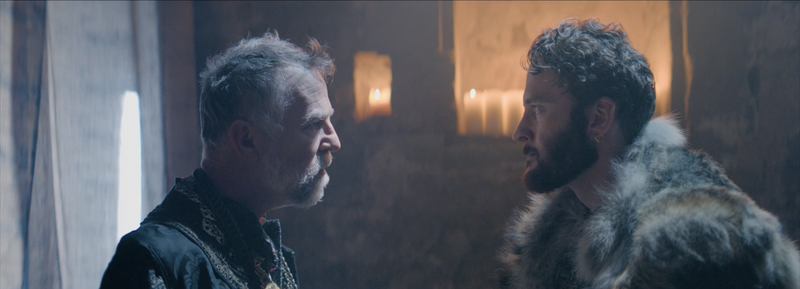
King Draven has reached that stage by the time King Baron enters his stronghold. The fallen tyrant once destroyed Baron’s life, and the survivor has spent years turning injury into purpose. Baron now possesses the advantage, the army, and the opportunity to confront the man who made him. What should feel like justice gradually becomes something less reassuring. Draven may have lost his kingdom, but he retains enough understanding of power to recognize what it has already done to his enemy.
Liam James Collins and Scott Vickers wrote their 15-minute historical drama entirely in Shakespearean language, an ambitious decision that could easily have become the film’s most distracting feature. KING OF THE IRON WILL doesn’t use that as ornamental proof of intelligence. Its speech allows Baron and Draven to argue in terms large enough to match the lives they believe they represent. Neither man is merely settling a private dispute. Each speaks as though history itself will adopt his interpretation.
That scale places considerable pressure on the performances. A weak delivery would reduce the dialogue to theatricality, particularly when the audience has so little time to adjust. Collins and Charlie Creed-Miles resist the temptation to emphasize every phrase. Their exchanges remain emotional before they become literary, letting accusations, evasions, and threats determine the rhythm. The language isn’t effortless throughout. A few passages call attention to their construction, temporarily placing the writing between the actors and the audience. The short occasionally sounds like a contemporary production working hard to establish its classical credentials. Those moments are brief, and the emotional stakes remain clear even when an individual line requires greater concentration.
Collins plays Baron as a man who has mistaken endurance for moral authority. His title, “The Iron Will,” describes both the quality that allowed him to survive and the condition now preventing him from reconsidering the purpose of that survival. Baron has built an identity around resistance. Reaching Draven should complete the story he’s told himself, but revenge offers no meaningful role for the person who remains afterward.
Collins brings certainty to the character without making him invulnerable. Baron’s posture presents control, while the performance underneath it suggests someone waiting for his suffering to receive recognition. He doesn’t only want Draven defeated. He wants the former king to understand the scale of the damage, confess his responsibility, and confirm that Baron’s long pursuit carried meaning. The confrontation becomes unstable because Draven refuses to provide that satisfaction in the expected form.
Creed-Miles gives Draven responsibility for cruelty on a scale that should make him easy to despise, and the short never attempts to excuse his reign. His political defeat hasn’t erased his ability to read another man. From his diminished position, he identifies the anger, pride, and appetite for domination Baron has renamed justice. Draven’s warning carries obvious self-interest. A condemned tyrant will use any available argument to delay punishment or weaken the resolve of his captor. Creed-Miles prevents that manipulation from invalidating the truth within it. His performance leaves open the possibility that Draven has achieved a degree of self-knowledge only after losing the power to act upon it. Recognition doesn’t become redemption, but it makes him more dangerous in conversation.
The film’s tension depends upon that uncertainty. Draven may be protecting himself, offering an honest warning, or doing both at once. His insight into corruption doesn’t absolve him of having embraced it. Baron’s justified hatred doesn’t guarantee that his next act will be just. KING OF THE IRON WILL refuses the arrangement in which the hero defeats evil and automatically restores moral order.
Vickers directs the confrontation with an appropriate sense of enclosure. The historic Scottish locations provide scale, though the film doesn’t allow the castles to overwhelm the two men occupying them. Stone walls, firelight, and coastal surroundings make them feel physically embedded in the world. These aren’t rulers standing against a generic backdrop. The age and weight of the spaces suggest that other kings have occupied them before and others will follow.
A longer version could trace the compromises required to turn an injured man into a conquering king. That isn’t necessarily the film Collins and Vickers wanted to make. Their interest lies in the final confrontation, after the campaigns have ended and victory can no longer distract Baron from what he has become. Even so, the compressed history limits how deeply the possibility of his corruption can surprise us. The film begins when the evidence is already visible.
Tom Tully’s Eunuch exists outside the primary struggle while remaining part of the world surrounding it. His presence is a reminder that royal conflicts are never confined to rulers, regardless of how personally those rulers describe them. Kings speak of destiny, honor, and legacy. Other people live with the physical consequences of those ideas.
That distinction strengthens the film’s consideration of class. KING OF THE IRON WILL uses the form and language associated with classical drama without presenting Shakespeare as property reserved for elite institutions. Collins and Vickers approach the language as something active and direct. The characters may be kings, but their resentment, insecurity, and desire to prove themselves aren’t exclusive to royalty.
Baron’s motivation is especially recognizable. Many people have used rejection as fuel, building careers or identities around the promise of proving someone wrong. Spite can generate discipline. It can also preserve the original injury long after success should have made it irrelevant. Every achievement becomes another message addressed to a person who may no longer be listening.
KING OF THE IRON WILL expands that into political danger. A leader who rises primarily to defeat an enemy may discover that opposition was the only principle holding it all together. Once the enemy falls, the anger remains and requires a new object. Baron believes the crown will validate his suffering, while Draven knows that a crown more often amplifies whatever a person carried toward it.
The film’s relevance doesn’t require direct references to a specific government or political figure. Its warning is more durable. Removing an abusive leader doesn’t guarantee that the structures supporting abuse have disappeared. Justice can become another name for retaliation, and resistance can reproduce the methods it once condemned. Moral certainty offers little protection when power makes accountability optional.
The conclusion wisely preserves some unease rather than resolving the argument into a statement about revenge. Whatever Baron chooses, Draven has already altered the terms of his victory. The defeated king’s power is forcing his conqueror to recognize himself within the enemy he hates.
KING OF THE IRON WILL delivers the scale of a historical drama through a conversation between men who have reached opposite ends of the same path. One has been destroyed by power. The other has spent his life becoming powerful enough to destroy him. Between them sits a throne that promises justice, legitimacy, and control while offering no defense against the person who claims it.
Please visit https://linktr.ee/overlyhonestr for more reviews.
You can follow me on Letterboxd, Instagram, Twitter, and YouTube. My social media accounts can also be found on most platforms by searching for 'Overly Honest Reviews'.
I’m always happy to hear from my readers; please don't hesitate to say hello or send me any questions about movies.
DISCLAIMER:
At Overly Honest Movie Reviews, we value honesty and transparency. Occasionally, we receive complimentary items for review, including DVDs, Blu-rays, CDs, Vinyl Records, Books, and more. We assure you that these arrangements do not influence our reviews, as we are committed to providing unbiased and sincere evaluations. We aim to help you make informed entertainment choices regardless of our relationship with distributors or producers.
Amazon Affiliate Links:
Additionally, this site contains Amazon affiliate links. If you purchase through these links, we may receive a commission. This affiliate arrangement does not affect our commitment to honest reviews and helps support our site. We appreciate your trust and support as you navigate these links.


Happy
0 %

Sad
0 %

Excited
0 %

Sleepy
0 %

Angry
0 %

Surprise
0 %
 0
0
 0
0


Average Rating