The Distance Between Blood Relatives
Read Time:7 Minute, 8 Second
MOVIE REVIEW
Father Mother Sister Brother [Blu-ray]
 –
– 

Genre: Comedy, Drama
Year Released: 2025, 2026 Blu-ray
Runtime: 1h 50m
Director: Jim Jarmusch
Writer: Jim Jarmusch
Cast: Tom Waits, Adam Driver, Mayim Bialik, Charlotte Rampling, Cate Blanchett, Vicky Krieps, Sarah Greene, Indya Moore, Luka Sabbat, Françoise Lebrun
Where to Watch: available August 25, 2026, pre-order your copy here: www.moviesunlimited.com or www.amazon.com
RAVING REVIEW: FATHER MOTHER SISTER BROTHER finds Jim Jarmusch observing families who have plenty to say to one another but rarely know how to say it. That’s such an interesting exploration of what family means and how it functions. Across its three stories, conversations drift around resentment, silences and the rituals people fall back on when genuine connection becomes difficult.
Split into chapters, the film examines what happens when adult children enter spaces where their childhood roles remain waiting for them. Years may have passed, careers may have developed, and relationships may have changed. One visit can reduce an adult to the defensive son, guarded daughter or overlooked sibling they thought they had outgrown. Nobody needs to announce this transformation. Jarmusch lets it emerge through posture, hesitation and the subtle changes people make to their voices around family.
That restraint defines the film, although it also limits how deeply some parts of it land. Conversations regularly continue through what isn’t being said, with pauses carrying animosity, suspicion or embarrassment. Several of those silences reveal more than an argument could. Others retain the same emotion after their meaning has already become clear, leaving the scene suspended.
“Father” follows Jeff and Emily, played by Adam Driver and Mayim Bialik, as they visit their widowed father in the northeastern United States. The siblings come to the table with different understandings of who their father is and what he needs from them. Jeff approaches the visit through responsibility, carrying concern that has become part obligation and part habit. Emily’s skepticism suggests someone who stopped accepting the family’s story long ago.
Their father, played by Tom Waits, initially appears to be the person requiring attention, although Waits introduces enough uncertainty to make every complaint feel practiced in a way. His appearance, home, and behavior suggest neglect, but he never seems entirely unaware of the effect they’re having. Waits can turn a shrug into a defense strategy. The father’s apparent helplessness gradually begins to resemble another form of control, allowing him to keep his children worried without granting them access to his life.
Driver and Bialik are especially convincing when Jeff and Emily are alone together. Their exchanges carry the feeling of siblings who don’t need to explain the family history because each already believes they understand it better than the other. Jeff’s concern isn’t presented as generosity, and Emily’s detachment isn’t treated as cruelty. Both have developed methods of surviving their father, and each quietly resents what the other person’s method implies about their own.
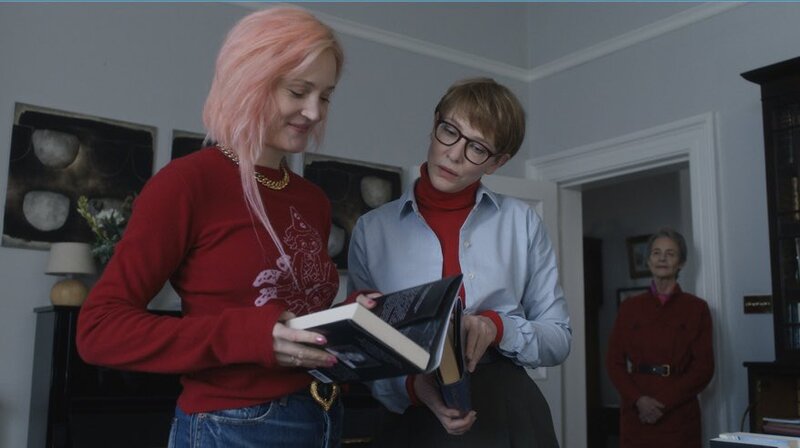
The Dublin-set “Mother” replaces disorder with refinement. Charlotte Rampling presides over a carefully arranged afternoon tea as a successful novelist visits her daughters, Timothea and Lilith, for an annual visit. Every detail, from the food to the room to the way their mother conducts the conversation, is examined. Hospitality becomes a test nobody remembers agreeing to take.
Rampling doesn’t need hostility to establish authority. A question delivered can contain years of judgment, and a compliment can feel like an examination of everything her daughters haven’t accomplished. Cate Blanchett strips away much of her usual control as Timothea, giving her a practicality that makes the character look almost apologetic for taking up space. Vicky Krieps plays Lilith as someone monitoring every sentence before allowing it to leave her mouth. Her discomfort isn’t limited to what her mother might say. It comes from knowing how quickly any disclosure could be converted into evidence.
The three women behave as though completion of the visit matters more than closeness. They can sit together, drink tea and accomplish what’s needed in the ritual without ever risking a conversation that might alter the relationship. Jarmusch recognizes the peculiar exhaustion of family gatherings where everyone remains polite because honesty would require too much effort.
“Sister Brother” changes the emotional conditions we’ve explored so far. Skye and Billy, played by Indya Moore and Luka Sabbat, reunite in Paris after the deaths of their parents in an aviation accident. They move through the apartment and possessions left behind, encountering the responsibilities that follow grief. Where the first two chapters place parents across the room from their children, this one leaves the siblings alone with memory.
Moore and Sabbat create the film’s most natural connection. Their affection doesn’t erase disagreement or sorrow, but neither person seems required to protect themselves from the other. Small jokes and shared recollections give the chapter a warmth largely absent from the earlier visits. Skye and Billy aren’t trying to decode whether their parents loved them. They’re confronting the question of what happens to that love when the people who expressed it are no longer present.
The shift gives FATHER MOTHER SISTER BROTHER an opening after two chapters built around avoidance. It also exposes an imbalance. The first families are withholding by nature and design, while the final siblings are permitted greater tenderness, movement and release. Their story feels more affecting because Jarmusch finally allows affection to occupy the room.
Each location reflects the family occupying it. The father’s cluttered home invites concern while concealing information. The mother’s immaculate house turns appearances into a form of discipline. The Paris apartment has become a container for lives that have to be now sorted, moved, or discarded. Jarmusch pays close attention to how people behave when surrounded by evidence of someone else’s choices. Rooms don’t merely host these encounters; they preserve the identities everyone has been assigned.
Jarmusch refuses to declare which children have failed their parents or which parents created the distance surrounding them. That absence allows the characters to remain complicated, although his reluctance to press beyond observation occasionally feels evasive. The film identifies patterns of dishonesty, guilt and emotional self-preservation without always exploring what those patterns have cost. Its modest scale is intentional; its emotional slightness isn’t always as easy to excuse.
The actors make the quietest moments worth studying. Waits gives his father a mixture of frailty and calculation. Rampling turns composure into something nearly structural. Driver, Bialik, Blanchett and Krieps convey the exhaustion of adults pulled back into familiar family conflicts. At the same time, Moore and Sabbat provide the connection that keeps the film from becoming entirely enclosed by discomfort.
FATHER MOTHER SISTER BROTHER understands that estrangement doesn’t always involve screaming, abandonment, or a breakdown. Sometimes it looks like a visit in which everybody arrives on time, behaves, and leaves without saying anything that matters. Families drink, serve cake, carry boxes, and maintain their preferred versions of one another. Love may survive inside those routines, but Jarmusch leaves open the harder question of whether anyone involved still knows how to reach it.
Please visit https://linktr.ee/overlyhonestr for more reviews.
You can follow me on Letterboxd, Instagram, Twitter, and YouTube. My social media accounts can also be found on most platforms by searching for 'Overly Honest Reviews'.
I’m always happy to hear from my readers; please don't hesitate to say hello or send me any questions about movies.
[photo courtesy of MUBI INC., MOVIES UNLIMITED, ALLIANCE HOME ENTERTAINMENT]
DISCLAIMER:
At Overly Honest Movie Reviews, we value honesty and transparency. Occasionally, we receive complimentary items for review, including DVDs, Blu-rays, CDs, Vinyl Records, Books, and more. We assure you that these arrangements do not influence our reviews, as we are committed to providing unbiased and sincere evaluations. We aim to help you make informed entertainment choices regardless of our relationship with distributors or producers.
Amazon Affiliate Links:
Additionally, this site contains Amazon affiliate links. If you purchase through these links, we may receive a commission. This affiliate arrangement does not affect our commitment to honest reviews and helps support our site. We appreciate your trust and support as you navigate these links.


Happy
0 %

Sad
0 %

Excited
0 %

Sleepy
0 %

Angry
0 %

Surprise
0 %
 0
0
 0
0

Average Rating