A Ghost Story With New Rules
Read Time:9 Minute, 32 Second
MOVIE REVIEWS
Never After Dark
 –
– 

Genre: Horror, Thriller
Year Released: 2026
Runtime: 1h 44m
Director: Dave Boyle
Writer: Dave Boyle
Cast: Moeka Hoshi, Kurumi Inagaki, Kento Kaku, Mutsuo Yoshioka, Bokuzō Masana, Tae Kimura
Where to Watch: opening in Chicago on October 9, 2026, and nationwide. Find a showing here: www.magpictures.com
RAVING REVIEW: Airi knows exactly what to do when a ghost refuses to leave. That confidence is what makes NEVER AFTER DARK, because writer-director Dave Boyle doesn’t introduce his lead as someone stumbling into the supernatural for the first time. She arrives with tools, rules, a practiced ritual, and the calm of someone who has done this often enough that fear has become part of the job.
That immediately changes the usual haunted-house setup. Instead of waiting for Airi to accept that ghosts are real, the movie can spend its time asking a more interesting question: what happens when a professional encounters something that doesn’t behave the way it should? Moeka Hoshi plays that shift beautifully, letting small cracks appear in Airi’s confidence long before the film asks her to panic openly.
Airi also isn’t working completely alone. Her dead sister Miku, played by Kurumi Inagaki, remains beside her, visible through reflective surfaces and treated less like a shocking apparition than a constant companion. Their relationship gives the early scenes an easy familiarity that makes the supernatural feel almost ordinary, which is exactly what the movie needs before it begins making Airi doubt the rules she trusts.
Boyle is patient about explaining those rules. NEVER AFTER DARK doesn’t stop for a long speech about how Airi’s abilities work or where her rituals come from. We learn through repetition, behavior, objects, and small warnings, gradually understanding that she has limits and that those limits exist for a reason.
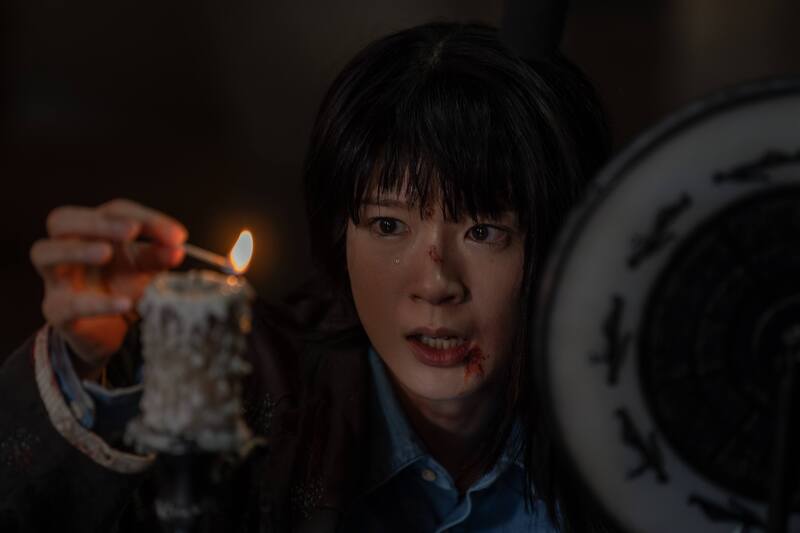
The most striking piece of that ritual is a spinning mirror device used when Airi crosses into the spirit world. Production designer Yuji Hayashida created it specifically for the film, and the zoetrope-like movement gives the process a physical identity instead of reducing it to a glow effect or a few whispered words. Candles, scissors, reflections, and carefully controlled movement make the ceremony feel like something Airi has learned, not something the screenplay invented five minutes earlier.
That detail matters because the film’s supernatural world is fictional, not drawn directly from an established religious or folkloric practice. Boyle wanted Airi to come from a tradition created specifically for the story, neither a Western psychic nor a Japanese onmyoji. The movie treats that invented ritual with enough consistency that it feels like we’re seeing one small part of a much larger belief system.
NEVER AFTER DARK becomes much creepier once that system starts failing her. Airi is summoned to an isolated former hotel converted into a private residence, where a new owner wants an unwanted presence removed. The building is large enough to feel empty even when several people are inside it, and Boyle repeatedly uses hallways, doorways, darkened rooms, and reflections to make distance itself uncomfortable.
Patrick Ouziel’s photography gives the house two personalities without making either one feel artificial. Ordinary night carries warm pockets of light surrounded by darkness, while what the filmmakers call “ceremonial night” moves into a colder, teal-colored space beyond the veil. The transition is beautiful enough to draw Airi forward even when every horror instinct says she should turn around.
A lot of that work was achieved practically, and you can feel the difference. The team created day-to-night transitions through lighting, did mirror effects largely in camera, and relied on doubles and live poltergeist effects whenever possible, using digital work only as an enhancement. It matters because the actors look like they’re occupying the same physical nightmare as everything happening around them.
The apparition at the heart of the case is a strong example. Mutsuo Yoshioka’s appearance is grotesque without becoming something the movie needs to display from every possible angle. Boyle knows that one clear look can be more effective when we’ve spent several scenes trying to understand what we only partially saw before.
The makeup does plenty of the work, but Yoshioka’s physical performance is just as important. There’s a deliberate quality to the way the figure moves that avoids the familiar twitching and frantic lunging used by so many screen ghosts. The restraint makes him more unsettling because he never seems rushed, and a threat that doesn’t appear worried about catching you is usually worse than one sprinting toward the camera.
Sound contributes just as much as the imagery. Old wood, doors, clocks, distant movement, and stretches of quiet allow the house to feel occupied before the film confirms anything, while Jonathan Snipes’ score knows when to stay out of the way. NEVER AFTER DARK doesn’t treat every silent moment as a countdown to a jump scare, so the scares it does use have room to land.
Hoshi holds it all together because Airi has to stay interesting during long sections where she listens, watches, or prepares rather than talks. A tiredness under her professionalism makes it feel like this work has taken something from her, and her bond with Miku gives that weariness an emotional source without turning the movie into a grief monologue. Hoshi can make a pause feel like a decision, which is invaluable in a story this dependent on observation.
There’s also a wonderfully odd sequence in which Airi briefly lets her guard down and dances by herself. In another horror film it might feel like the story wandered off course, but here it gives Hoshi a chance to show a person underneath the ritual and responsibility. The movie benefits from letting her be playful for a moment because fear hits harder when the character has been allowed to exist outside it.
Kento Kaku’s Gunji creates a different kind of friction. His skepticism toward Airi could have been written as the usual character who refuses to believe obvious supernatural evidence, but the movie uses that tension more carefully. His presence changes how Airi operates because she isn’t simply dealing with a ghost; she is also dealing with people whose histories, assumptions, and motives are harder to read than the dead.
That idea becomes increasingly important as NEVER AFTER DARK moves forward. Boyle built the film to combine a ghost story with a home-invasion thriller, and without revealing how that develops, the shift is one of the main reasons the movie rises above a well-made collection of haunted-house scares. The source of danger changes, but the film doesn’t throw away everything it established to become something else.
That transition could have been disastrous. A story that spends so much time teaching us its supernatural rules risks feeling like it changed movies halfway through if the later material suddenly becomes more physical. Boyle avoids most of that problem by making control the connecting idea: Airi is comfortable with spirits because she has a procedure, but living people don’t have to follow any of her rules.
My biggest reservation comes from how much the film has to carry once it begins revealing what has actually been happening. The final stretch adds information, changes the nature of the threat, and pushes Airi into a far more immediate fight for survival. Most of it works, but some of the emotional material established earlier, especially the relationship between Airi and Miku, doesn’t get quite as much room as I wanted once the thriller mechanics take over.
The story could also trust some of its mystery a little longer. Its first half is excellent at letting an object, sound, or strange behavior sit unexplained, while the later sections naturally have to provide more answers. That makes the back end feel busier than the beginning, even though the movie never collapses under the weight of those explanations.
Those are relatively small complaints because Boyle’s control remains impressive throughout. This is his first horror feature, but he approaches the genre like someone interested in why haunted-house tools work rather than simply copying the surface of movies he likes. Familiar ingredients are here, but the rules governing them are specific enough to keep the film from feeling assembled from other ghost stories.
The house helps enormously. Boyle and Kaku intentionally moved from the sprawling production of HOUSE OF NINJAS to a smaller theatrical project built largely around one location, and the former hotel they found in Kiyosato gives the film an actual geography. A corridor that seemed harmless earlier can become threatening later because we remember where it leads, while the repeated use of mirrors turns something decorative into another possible doorway.
At 104 minutes, NEVER AFTER DARK gives itself enough time to build that familiarity before disrupting it. There are faster horror movies and certainly louder ones, but speed would work against what Boyle is doing here. The tension comes from watching a capable person realize her expertise may not be enough, then seeing how she adapts once the situation stops resembling anything she's handled before.
That’s ultimately why the 4 out of 5 feels right. The movie isn’t reinventing the haunted-house story from the ground up, and the later explanations aren’t quite as elegant as the mystery that precedes them. What it does accomplish is harder than it looks: it creates a supernatural system that feels specific, gives us a lead worth following, builds genuine dread without constantly forcing it, and then finds a way to make the living every bit as frightening as the dead.
NEVER AFTER DARK leaves me wanting more of Airi rather than simply more scares, and that may be its best sign of success. Boyle builds a world that suggests other mediums, other rituals, and other cases without turning the movie into a franchise advertisement. At the same time, Hoshi makes Airi feel capable enough to survive another story and human enough that we’d actually want to follow her into one.
Please visit https://linktr.ee/overlyhonestr for more reviews.
You can follow me on Letterboxd, Instagram, Twitter, and YouTube. You can also find my social media accounts on most platforms by searching for 'Overly Honest Reviews'.
I’m always happy to hear from my readers; please don't hesitate to say hello or send me any questions about movies.
[photo courtesy of MAGNOLIA PICTURES, SIGNAL181, UNITED LOUNGE TOKYO]
DISCLAIMER:
At Overly Honest Movie Reviews, we value honesty and transparency. Occasionally, we receive complimentary items for review, including DVDs, Blu-rays, CDs, Vinyl Records, Books, and more. We assure you these arrangements do not influence our reviews, as we are committed to unbiased, sincere evaluations. We aim to help you make informed entertainment choices regardless of our relationship with distributors or producers.
Amazon Affiliate Links:
This site also contains Amazon affiliate links. If you purchase through these links, we may receive a commission. This affiliate arrangement does not affect our commitment to honest reviews and helps support our site. We appreciate your trust and support as you navigate these links.


Happy
0 %

Sad
0 %

Excited
0 %

Sleepy
0 %

Angry
0 %

Surprise
0 %
 0
0
 0
0


Average Rating