The Sweetness Makes the Darkness Hurt
Read Time:9 Minute, 28 Second
MOVIE REVIEWS
Little Shop of Horrors
 –
– 

Genre: Musical, Comedy, Horror
Year Released: 1986, 2026 4K
Runtime: 1h 34m (Theatrical Cut); 1h 43m (Director’s Cut)
Director: Frank Oz
Writer: Howard Ashman
Cast: Rick Moranis, Ellen Greene, Vincent Gardenia, Steve Martin, Levi Stubbs, Tisha Campbell, Tichina Arnold, Michelle Weeks
Where to Watch: available October 6, 2026. Pre-order your copy here: www.amazon.com
RAVING REVIEW: LITTLE SHOP OF HORRORS does a lot of things right, but one of the most impressive things it does is convince you that all of this belongs together. A lonely florist, a singing man-eating plant, a sadistic dentist, a love story, and a parade of musical numbers shouldn’t fit inside the same 94 minutes. Yet Frank Oz keeps the movie moving with the confidence of someone who knows hesitation would be fatal.
The story had already been around for a long time before reaching Oz. Roger Corman’s 1960 horror comedy became the basis for Howard Ashman and Alan Menken’s off-Broadway musical, and the 1986 film then had to turn a stage production into something that could fill a movie screen without losing its intimacy. That last step is what makes this work as well as it does.
You can see it right away in how Skid Row is built. Everything looks heightened without losing its importance, from the crowded storefronts to the exaggerated grime and oversized interiors, and the artificiality feels deliberate instead of cheap. Oz isn’t trying to disguise the theatrical roots. He finds ways to make them work on film while preserving the sense that these characters live in a world where breaking into song is as natural as opening the flower shop in the morning.
Crystal, Ronette, and Chiffon are central to making that possible. Tichina Arnold, Michelle Weeks, and Tisha Campbell don’t simply pop in between scenes to sing the story to the audience; they establish the rules of the movie from the opening minutes and keep returning like commentators who know more than everyone trapped inside the story. Their presence gives the film momentum and lets transitions happen without the awkward pause where a movie seems to let you know that a song is about to begin.
Rick Moranis is the perfect choice for Seymour because he never plays the awkwardness as a joke by itself. Seymour is funny, insecure, frightened, selfish, and genuinely sweet in different combinations depending on the scene, which makes his choices increasingly uncomfortable without turning him into a different person. Moranis gives him enough decency that you want him to escape the mess he creates, even when the movie refuses to let him off the hook for how much he benefits from it.
That matters because the story’s comedy can hide how ugly some of the material actually is. Seymour’s success is tied to a creature that demands more from him every time he gets what he wants, and the arrangement keeps becoming harder to excuse as the rewards grow. The movie never stops being funny, but it understands that Seymour’s weakness is more interesting than simple innocence.
Ellen Greene has an even harder job as Audrey. The character could easily collapse into a collection of mannerisms, especially with the high voice, exaggerated clothes, and broad romantic fantasy she carries around. Greene gets laughs from all of that while making Audrey’s sadness impossible to ignore.
Her performance is one of the reasons “Somewhere That’s Green” still lands as more than a cute musical number. Audrey’s dream is deliberately modest, almost painfully so, and Greene makes it clear that she isn’t asking for glamour or excitement. She wants safety, affection, and a life where cruelty isn’t waiting for her at home, which gives the sweetness of the song a much darker edge.
That darkness becomes even more obvious once Steve Martin enters as Orin Scrivello. Martin goes enormous with the role, turning the dentist into a swaggering monster who enjoys causing pain and seems delighted by his own awfulness. In another movie, the performance could overwhelm everything around it, but LITTLE SHOP OF HORRORS has already created a world elastic enough to contain him.
The musical number built around Orin is also a perfect example of the film’s balancing act. The scene is funny because Martin commits so completely to the absurdity, but Audrey’s relationship with him isn’t treated as harmless background material. The movie lets the comedy get broad without pretending that the situation underneath it is equally light.
Bill Murray’s brief appearance pushes the movie in yet another direction. His scene is essentially a comic side trip, but it works because the film has already made room for characters who feel like they wandered in from their own strange corner of the same city. John Candy and Christopher Guest have similarly compact appearances, and neither feels like a celebrity cameo stopping the movie so the audience can applaud.
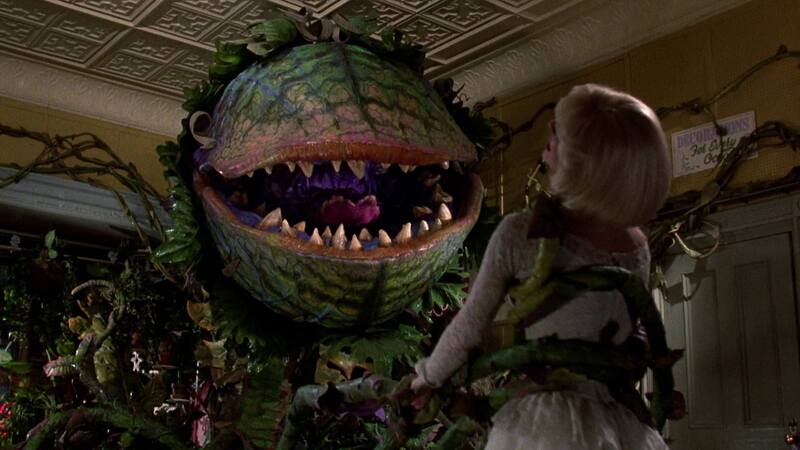
Then there’s Audrey II, which remains the production’s great technical achievement. The plant grows through several stages, and each version has enough physical presence that Moranis can lean toward it, recoil from it, feed it, argue with it, and eventually look genuinely small beside it. There’s weight to the creature because it occupies the same space as the actors rather than floating above them as an effect added later.
Levi Stubbs gives that physical creation a personality big enough to match its size. Audrey II doesn’t sound monstrous in the obvious way; it sounds persuasive, funny, impatient, and increasingly entitled, which makes the plant more entertaining the worse it becomes. “Feed Me” works because the temptation is as important as the threat.
The practical effects become even more impressive when the larger Audrey II has to sing. Its mouth, leaves, vines, body, and rhythm all have to feel connected to Stubbs’ performance, and the illusion holds up remarkably well four decades later. Modern effects could make the movements smoother, but smoothness isn’t necessarily an improvement when the slight resistance of a physical puppet helps sell the idea that Seymour is standing next to something enormous and alive.
The songs are strong enough that it would be easy to credit Ashman and Menken for carrying the entire film, but Oz understands how much staging matters. “Skid Row (Downtown)” expands the world, “Suddenly, Seymour” strips much of that world away so two people can finally connect, and the larger comic numbers use movement and editing without cutting so aggressively that the performances lose their shape. The movie knows when spectacle helps and when the actors need the space.
If there’s a weakness, it's how quickly the film sometimes moves past the consequences of its darker turns. The tone is so energetic that a disturbing event can be followed almost immediately by another joke, song, or burst of plot, and there are moments when I wanted a little more time for Seymour’s decisions to sit with him. The briskness is part of the appeal, but it can also soften material that deserves to sting.
The theatrical ending has always been part of that conversation, and the 40th-anniversary 4K wisely includes both the theatrical and director’s cuts. Without getting into spoiler territory, the two versions leave very different impressions of what Seymour’s choices ultimately mean. Having both available makes the release feel complete rather than asking one ending to erase the other.
The director’s cut also provides a fascinating look at how much audience attachment can change a story when it moves from stage to screen. Moranis and Greene make Seymour and Audrey so likable together that the movie creates emotional expectations the darker material has to fight against. That tension has followed the film for decades, and seeing both versions makes it easier to understand why the debate never completely went away.
The new 4K presentation suits a movie this tactile. The production design, costumes, makeup, puppetry, and lighting all benefit from the added detail because so much of the pleasure comes from seeing actual materials, actual sets, and performers physically interacting with what surrounds them. This is exactly the kind of catalog title where restoration can make old craftsmanship easier to appreciate rather than simply make an old movie look sharper.
Warner Bros.’ anniversary edition also adds new material looking back at the making of the film and Audrey II, which feels appropriate for a production whose behind-the-scenes work is nearly as interesting as what ended up on screen. The more you learn about the coordination required to make the plant perform, the less surprising it becomes that Audrey II still looks convincing. It wasn’t a single trick; it was an entire department working to make the impossible behave like another actor.
Forty years later, LITTLE SHOP OF HORRORS still succeeds because none of its ingredients cancel each other out. The romance is sincere enough to matter, the comedy is broad without becoming empty, the horror has teeth, and the musical numbers actually move the characters rather than pausing the story. Even the celebrity appearances know when to get out of the way.
A 4 out of 5 feels right because I love far more of the movie than I question, even as its speed and cheerfulness sweep some of the emotional consequences aside. Those rough edges don’t weaken the identity of the film; if anything, they’re part of why it remains so easy to revisit, argue about, sing along with, and admire.
The giant plant understandably gets most of the attention, but the real achievement is the balance around it. LITTLE SHOP OF HORRORS makes tenderness, cruelty, puppetry, Motown-inspired music, black comedy, and a ridiculous science-fiction premise feel like they were always meant to share the same flower shop, and forty years later, very few movie musicals have managed anything quite like it.
Please visit https://linktr.ee/overlyhonestr for more reviews.
You can follow me on Letterboxd, Instagram, Twitter, and YouTube. You can also find my social media accounts on most platforms by searching for 'Overly Honest Reviews'.
I’m always happy to hear from my readers; please don't hesitate to say hello or send me any questions about movies.
[photo courtesy of WARNER BROS. HOME ENTERTAINMENT]
DISCLAIMER:
At Overly Honest Movie Reviews, we value honesty and transparency. Occasionally, we receive complimentary items for review, including DVDs, Blu-rays, CDs, Vinyl Records, Books, and more. We assure you these arrangements do not influence our reviews, as we are committed to unbiased, sincere evaluations. We aim to help you make informed entertainment choices regardless of our relationship with distributors or producers.
Amazon Affiliate Links:
This site also contains Amazon affiliate links. If you purchase through these links, we may receive a commission. This affiliate arrangement does not affect our commitment to honest reviews and helps support our site. We appreciate your trust and support as you navigate these links.


Happy
0 %

Sad
0 %

Excited
0 %

Sleepy
0 %

Angry
0 %

Surprise
0 %
 0
0
 0
0

Average Rating