A Nightmare Worth Staying Awake For
Read Time:8 Minute, 5 Second
MOVIE REVIEWS
Parasomnia
 –
– 

Genre: Horror
Year Released: 2026
Runtime: 1h 25m
Director(s): James Ross II
Writer(s): James Ross II
Cast: Jasmine Mathews, RJ Brown, Sally Stewart, Stephen Barrington, Danny Brown, Simon Longnight
Where to Watch: streaming on Shudder starting September 4, 2026
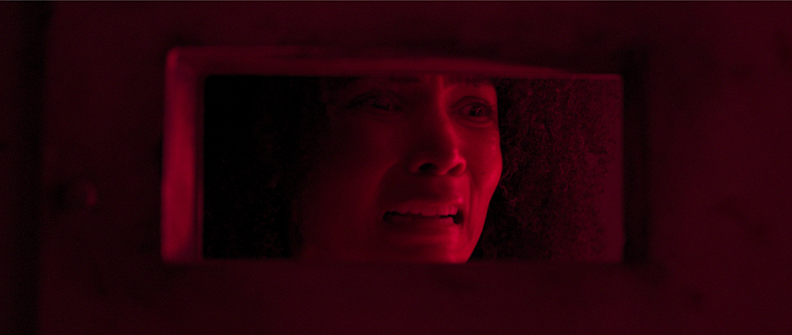
RAVING REVIEW: James Ross II spends some of PARASOMNIA’s best moments watching Riley prepare to sleep. There’s an anxiety to the process because bedtime isn’t an ordinary part of her day. It’s something she has to manage. Jasmine Mathews plays those routines with the weariness of someone who has been dealing with the same problem for years, and the movie understands that something is frightening about needing a strategy for an act the body eventually demands anyway. Riley can postpone sleep, prepare for it, and convince herself that tonight might be different. Eventually, she still has to close her eyes.
That vulnerability gives PARASOMNIA a strong foundation before Ross introduces much of the supernatural material. Riley has suffered from night terrors since childhood, with terrible events surrounding episodes she can’t fully understand. The past hasn’t faded as she has gotten older. It has instead shaped the way she lives, the relationships she maintains,s and the amount of trust she places in her own perception. When people around her begin disappearing, the demonic presence Riley knows from her nightmares no longer feels safely contained inside them.
A horror movie built around dangerous sleep immediately carries the shadow of A NIGHTMARE ON ELM STREET, something Ross clearly understands. He doesn’t try to pretend Wes Craven never existed. His interest is different enough that the comparison gradually becomes less important. Freddy Krueger turned dreams into an imaginative playground where almost anything could happen. PARASOMNIA is more interested in the helplessness involved in surrendering consciousness and waking up uncertain about what happened while you were gone.
Ross also gives the nightmares a visual language that separates them from Riley’s waking life. The dream material has a rough, degraded quality at times, almost as though these images were recovered rather than photographed. Grain, darkness, flashes of color, and unstable imagery make the sequences feel less controlled than the rest of the movie. They aren’t simply conventional scenes with strange things happening inside them. They feel damaged.
That distinction matters because PARASOMNIA spends a lot of time asking how much Riley can trust her own perception. Ross doesn’t turn that question into an endless series of fake-outs. Dreams and reality can overlap, but the movie isn’t interested in constantly pulling the rug out from underneath the audience. The uncertainty is more personal. Riley is the one who has lived long enough with these experiences to doubt herself, and Mathews makes that uncertainty exhausting rather than theatrical. She’s the reason much of the movie holds together.
Mathews gives Riley a guarded quality without making her distant. There’s fear underneath almost everything she does, although she’s also clearly learned how to function beside it. That makes the moments when her control starts slipping more effective. Riley isn’t discovering fear for the first time. She’s recognizing something she thought she understood and realizing that she may have been wrong about it all along.
Her relationship with David, played by Stephen Barrington, becomes especially important. They share history that other characters don’t, and Barrington brings an immediate familiarity to their scenes together. There’s affection there, but also damage neither person can completely leave behind. Their connection gives the movie emotional weight without forcing it into romance, and that friendship becomes one of the better choices Ross makes in the screenplay.
RJ Brown’s Cam occupies a more difficult position because he’s dealing with a part of Riley’s life he can understand intellectually without ever having experienced it. Brown doesn’t play him as the obligatory horror boyfriend who dismisses everything until it’s too late. There are frustrations between them, but PARASOMNIA generally allows its characters to behave like people rather than pieces being positioned for the next scare.
The movie grows stranger as Ross begins to explain what has followed Riley throughout her life. This is where PARASOMNIA takes its biggest chances and occasionally gets in its own way. The mythology expands beyond the comparatively simple idea of a woman haunted in her sleep, bringing in ritual, generational history and supernatural rules that make the story considerably denser. Some of it is fascinating. Some of it asks the audience to absorb more information than an 85-minute movie can comfortably explore.
The third act is consequently less controlled than the first half. Ross has been good at withholding information, and once the answers begin arriving, several of them arrive close together. The movie has to explain relationships, motivations, and supernatural mechanics while continuing to move toward its climax. There were moments when I wanted PARASOMNIA to slow down and give one particular revelation more room rather than immediately moving to the next.
That ambition is also part of why I liked it as much as I did. Ross could have made a much safer first feature. The setup would have supported 85 minutes of a shadowy demon appearing whenever Riley fell asleep, followed by increasingly elaborate attempts to stay awake. PARASOMNIA wants a history behind its monster and human motivations behind its horror. Not every piece fits with equal ease, but the movie is trying to build something rather than merely supply another variation on a familiar sleep-horror premise.
The Seer, played by Simon Longnight, benefits from Ross resisting the urge to put him front and center immediately. Early appearances use distance and darkness well. Sometimes the question of whether something moved in the background is more effective than clearly seeing what moved. Longnight’s background as a movement performer becomes useful once the figure has a stronger physical presence, giving the creature an unnatural posture without depending entirely on digital manipulation.
The makeup and prosthetic work deserve particular credit. PARASOMNIA gets considerably more graphic than its early mood might suggest, and the effects have a tactile ugliness that works with the movie’s rougher nightmare imagery. Ross doesn’t flood the screen with gore just because he can. When the film does become violent, there’s usually an idea behind the specific imagery, particularly its repeated focus on sight, perception, and what characters are willing or able to see.
Christopher Lee Fatt’s cinematography is equally important to the quieter stretches. Darkness isn’t treated as empty black space waiting for something to jump into frame. Rooms have depth, and Ross frequently uses that depth to prompt the audience to look behind the actors. PARASOMNIA understands how quickly viewers start scanning the background once they’ve been given a reason not to trust it.
There are scares that land because of timing, others because of an image, and a few because the sound design makes something ordinary feel wrong before the movie reveals why. The best of them don’t announce themselves too far in advance. Ross has enough confidence to allow discomfort to build without cutting every quiet stretch short.
That confidence makes the rougher pieces easier to forgive. The mythology could use another pass. A few supporting characters are doing more narrative work than character work, and the final portion tries to resolve a lot very quickly. PARASOMNIA also occasionally explains imagery that was more unsettling when it remained unexplained.
For a feature debut, though, this is a filmmaker making choices. Ross knows what frightens him about sleep and finds several ways to translate that fear without spending the entire movie chasing another filmmaker’s nightmare. There’s personality in the low-fi dream sequences, genuine nastiness in the practical effects, and enough emotional investment in Riley to keep the supernatural story from becoming a collection of scares waiting for connective tissue.
PARASOMNIA may begin with the familiar fear that something terrible can happen after you fall asleep, but its more disturbing idea is what waking up can’t fix. Riley has spent years opening her eyes and discovering that the fear is still there. Ross builds his movie around that exhaustion, then gradually gives it a face. For all the demons and blood that follow, that’s the part that stayed with me.
Please visit https://linktr.ee/overlyhonestr for more reviews.
You can follow me on Letterboxd, Instagram, Twitter, and YouTube. My social media accounts can also be found on most platforms by searching for 'Overly Honest Reviews'.
I’m always happy to hear from my readers; please don't hesitate to say hello or send me any questions about movies.
[photo courtesy of SHUDDER]
DISCLAIMER:
At Overly Honest Movie Reviews, we value honesty and transparency. Occasionally, we receive complimentary items for review, including DVDs, Blu-rays, CDs, Vinyl Records, Books, and more. We assure you that these arrangements do not influence our reviews, as we are committed to providing unbiased and sincere evaluations. We aim to help you make informed entertainment choices regardless of our relationship with distributors or producers.
Amazon Affiliate Links:
Additionally, this site contains Amazon affiliate links. If you purchase through these links, we may receive a commission. This affiliate arrangement does not affect our commitment to honest reviews and helps support our site. We appreciate your trust and support as you navigate these links.


Happy
0 %

Sad
0 %

Excited
0 %

Sleepy
0 %

Angry
0 %

Surprise
0 %
 0
0
 0
0

Average Rating