Brotherhood Collides With Black Magic
Read Time:7 Minute, 56 Second
MOVIE REVIEW
The Nine Demons (Jiu zi tian mo) [Visual Vengeance Collector's Edition]
 –
– 

Genre: Martial Arts, Horror, Fantasy
Year Released: 1984, 2026 Visual Vengeance Blu-ray
Runtime: 1h 38m
Director: Chang Cheh
Writer: Ni Kuang
Cast: Cheng Tien-Chi, Lu Feng, Chiang Sheng, Yu Tai-Ping, Lee Chung-Yat, Chris Lee Kin-Sang
Where to Watch: available now, order your copy here: www.mvdshop.com or www.amazon.com
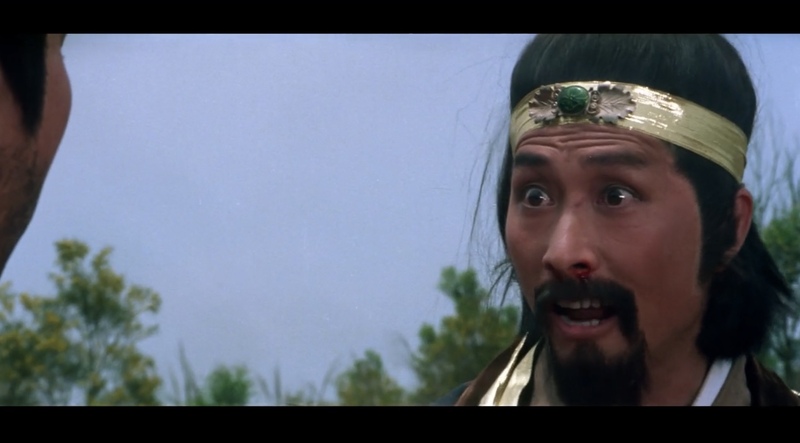
RAVING REVIEW: A necklace of grinning skulls hangs across Zou Qi’s chest, and every one of them is hungry. The image is strange, theatrical, faintly ridiculous, and genuinely threatening at the same time. That combination defines THE NINE DEMONS, a martial arts fantasy that keeps adding blood, colored lights, supernatural children, flying props, and elaborate combat until its modest production can barely contain it.
Zou Qi, played by Cheng Tien-Chi, survives an attack that destroys his family and threatens his childhood friend, Gan Yun. Revenge would already be enough to send most stories into motion, but Zou Qi’s path takes him basically to hell and beyond. He encounters the Black Prince of Hell and accepts a bargain granting him control over nine demons. They can destroy his enemies, rescue those he cares about, and give him power beyond any fighter. They also require a steady supply of blood.
The agreement makes Zou Qi stronger without making his life easier. His new servants emerge from the skulls he carries, attack with little restraint, and turn every command into another step toward disaster. He believes he can direct their appetite toward people who deserve punishment, but the demons don’t share his interest in limits. They’re tools only as long as their hunger permits.
Director Chang Cheh made THE NINE DEMONS after his defining years at Shaw Brothers, working with fewer resources but several familiar collaborators. Lu Feng and Chiang Sheng return from the group commonly known as the Venom Mob, while Cheng Tien-Chi joins them in carrying the film’s demanding physical action. The result lacks the scale and finish of Chang’s most celebrated studio work, although it also feels less restricted by expectations of good taste or tonal consistency.
Nothing here suggests restraint was ever discussed. Hell is represented through fog, harsh lighting, painted sets, abrupt editing, and rooms that resemble stages rather than physical locations. The demons spin, leap, materialize, and fly through scenes using effects that never attempt realism. Some shots resemble elaborate theatrical tricks. Others look as though someone discovered a new editing technique and immediately decided to use it six times.
The limitations are visible, but hiding them would have stripped away much of the film’s character. THE NINE DEMONS works best when handmade effects, physical performances, and unapologetically artificial settings collide. Flying skulls don’t need to appear convincing, because their crude movement reinforces the sense that Zou Qi has released something that doesn’t belong in the human world. The demons don’t enter scenes; they invade them.
Their “humans” are even stranger. Eight childlike creatures follow a maternal demon whose presence turns the familiar idea of a supernatural family into something parasitic. They behave with an unsettling mixture of obedience and delight, treating violence as nourishment. Chang doesn’t make them tragic or misunderstood. Their purpose is consumption, and any affection they show toward Zou Qi exists beside their willingness to drain everyone around him.
The horror imagery gives THE NINE DEMONS its identity, but the martial arts performances keep it moving. Lu Feng, Chiang Sheng, and Cheng Tien-Chi bring the acrobatic precision associated with their previous collaborations, grounding the supernatural disorder in bodies that can perform difficult choreography without frantic editing. Fighters twist around weapons, spring through formations, and use the surrounding sets as extensions of their attacks. The camera frequently allows enough space to see how one movement leads into another.
Those sequences become more inventive once demonic abilities enter the conflict. Traditional weapons and hand-to-hand exchanges are interrupted by sudden appearances, bursts of light, airborne skulls, and opponents who don’t follow ordinary physical rules. The action can be excessive, but it rarely becomes anonymous. Chang and his performers keep searching for another arrangement of bodies, weapons, and supernatural interference.
Zou Qi’s corruption should provide the film with a stronger dramatic spine than it does. His bargain creates an obvious conflict between loyalty and moral surrender, and Cheng gives the character a convincing intensity. The screenplay spends more time demonstrating his powers than examining how quickly his judgment changes after receiving them. His descent is there, but it often feels like a requirement of the story rather than a transformation unfolding inside a person.
Zou Qi initially accepts the demons for reasons an audience can understand. He wants justice for his family and the power to protect a friend. Once blood becomes the cost, the story has an opportunity to test every justification he makes. Instead, his choices sometimes disappear beneath another extended battle or a new revelation about the surrounding conflict.
Gan Yun’s friendship with Zou Qi is meant to preserve the human stakes, though the relationship never becomes as affecting as Chang’s better stories of male loyalty and sacrifice. Lu Feng has the physical authority needed for this world, but the emotional connection between the two men remains secondary to the mechanics of revenge. The film tells us that brotherhood motivates enormous sacrifices without spending enough quiet time showing why this particular bond deserves them.
Chang treats betrayal and sacrifice with complete seriousness, while the demons and their effects can provoke laughter without seeming like jokes. Horror, fantasy, and martial arts don’t merge into a single cohesive atmosphere. They fight for control just as aggressively as the characters do. That inconsistency will be part of the appeal for viewers who seek out neglected genre films. THE NINE DEMONS isn’t careful enough to become frightening for long, and its story isn’t focused enough to make every act of vengeance matter. It does possess a willingness to attempt images and confrontations that safer productions would have dismissed before filming began.
Visual Vengeance’s Collector’s Edition gives the movie an overdue North American disc release. The new 2K transfer doesn’t erase every sign of age or damage within the surviving elements. But it allows the saturated lighting, compositions, costumes, and physical choreography to register with more clarity than the bootlegged copies.
The commentary, interviews, essays, podcast episode, alternate artwork, and booklet also treat THE NINE DEMONS as more than an oddity. The film belongs to a transitional phase of Chang Cheh’s career, when resources had changed but his interest in loyalty, sacrifice, violent spectacle, and physical performance remained. The extras provide needed context without trying to convince viewers that every strange decision was secretly brilliant.
THE NINE DEMONS is too uneven to praise as one of Chang’s finest works, but dismissing it as cheap nonsense would ignore the skill inside. The choreography remains impressive, the supernatural imagery has a personality of its own, and the film commits to its demonic bargain with admirable nerve. Its appetite exceeds its control, which is also the exact problem faced by its hero. Zou Qi believes nine demons can solve a human conflict. Chang Cheh responds with ninety-eight minutes, proving that this unruly power never stays pointed in one direction.
Bonus Materials:
New 2K transfer from original film elements supervised by film archivist Toby Russell
Commentary with martial arts film historians Justin Decloux and Dylan Cheung
The Discovery of James Wu Kuo-Ren: Video Essay
The Late Period Chang Che: Video Essay
Actor Yu Tai-Ping Interview
Unsung Horrors Podcast: The Nine Demons episode
Nine Demons: complete old school ‘Dirty VHS’ version
Image Gallery
Trailer
Includes both English dubbed and original Chinese language Options
Folded mini-poster featuring original theatrical art
Reversible sleeve featuring original alternate art
‘Stick Your Own’ VHS sticker set – FIRST PRESSING ONLY
Enter: The Venom Mob – liner notes booklet by C.J. Lines – FIRST PRESSING ONLY
Limited Edition O-card featuring art by Uncle Frank
Visual Vengeance Trailers
Optional English subtitles
Closed captions (ENG dubbed version)
Please visit https://linktr.ee/overlyhonestr for more reviews.
You can follow me on Letterboxd, Instagram, Twitter, and YouTube. You can also find my social media accounts on most platforms by searching for 'Overly Honest Reviews'.
I’m always happy to hear from my readers; please don't hesitate to say hello or send me any questions about movies.
[photo courtesy of VISUAL VENGEANCE, MVD ENTERTAINMENT]
DISCLAIMER:
At Overly Honest Movie Reviews, we value honesty and transparency. Occasionally, we receive complimentary items for review, including DVDs, Blu-rays, CDs, Vinyl Records, Books, and more. We assure you that these arrangements do not influence our reviews, as we are committed to providing unbiased and sincere evaluations. We aim to help you make informed entertainment choices regardless of our relationship with distributors or producers.
Amazon Affiliate Links:
Additionally, this site contains Amazon affiliate links. If you purchase through these links, we may receive a commission. This affiliate arrangement does not affect our commitment to honest reviews and helps support our site. We appreciate your trust and support as you navigate these links.


Happy
100 %

Sad
0 %

Excited
0 %

Sleepy
0 %

Angry
0 %

Surprise
0 %
 1
1
 0
0


Average Rating