The Abbey Keeps Its Secrets
Read Time:8 Minute, 1 Second
MOVIE REVIEW
The Name of the Rose Limited Edition 4K UHD & Blu-ray
 –
– 

Genre: Historical Drama, Mystery, Thriller
Year Released: 1986, 2026 Second Sight 4K
Runtime: 2h 11m
Director: Jean-Jacques Annaud
Writers: Andrew Birkin, Gérard Brach, Howard Franklin, Alain Godard, based on the novel by Umberto Eco
Cast: Sean Connery, Christian Slater, F. Murray Abraham, Ron Perlman, Michael Lonsdale, Feodor Chaliapin Jr., William Hickey, Valentina Vargas
Where to Watch: available August 10, 2026, pre-order your copy here: www.secondsightfilms.co.uk
RAVING REVIEW: Someone inside this abbey is terrified of laughter. That fear ultimately reveals as much about the killings as any footprint, manuscript, or fingertip discovered by William of Baskerville. THE NAME OF THE ROSE presents itself as a medieval murder mystery. Jean-Jacques Annaud is just as interested in what happens when powerful men decide that curiosity itself poses a threat.
The year is 1327. William, a Franciscan friar known for trusting reason over superstition, arrives at an isolated Benedictine abbey with his young novice, Adso of Melk. They’ve come for a theological debate concerning the Church’s wealth, and whether Christ lived in poverty, an argument that carries far more political danger than its wording initially suggests. A monk has recently fallen to his death, however, and William quickly recognizes details that don’t support the abbey’s explanation.
More bodies follow. Fear spreads through the monastery, encouraging theories about demons, prophecy, divine punishment, and an approaching apocalypse. William instead studies the physical evidence, asks unwelcome questions, and treats each death as something caused by human choices. The distinction places him in conflict with men who find supernatural terror useful because it prevents anyone from examining their authority too closely.
Annaud opens the movie by calling it a “palimpsest” of Umberto Eco’s novel, an unusually honest description of what follows. Eco’s book layers detective fiction with semiotics, medieval history, theological disagreement, philosophy, literary references, and arguments about how meaning is created. A two-hour movie was never going to preserve all of that. Annaud and the four credited screenwriters strip away many of the novel’s deeper passages and build their adaptation around the investigation.
The result loses some complexity, though it doesn’t reduce the material to a routine whodunit. Questions about knowledge, poverty, obedience, and institutional control remain tied to the murders. The mystery gives those ideas forward motion, allowing regular viewers to enter an intimidating world through the familiar process of gathering clues and narrowing suspects. Some connections are made too abruptly, and William occasionally arrives at an answer before the movie has shown enough of his reasoning. Even so, the investigation provides a sturdy route through material that could easily have collapsed beneath its own weight.
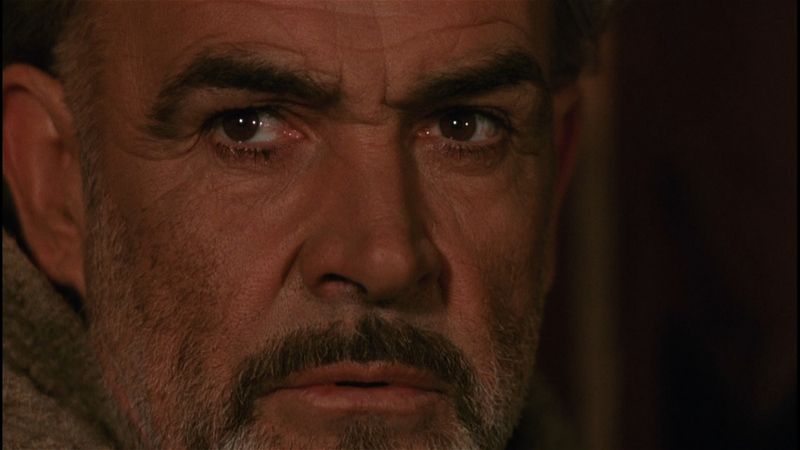
Sean Connery brings his expected authority to William without making him seem infallible. The character is intelligent because he observes and listens, not because the screenplay constantly announces his brilliance. Connery lets amusement creep into William’s exchanges with the monks, suggesting a man who has survived religious politics by learning when to challenge them and when to appear harmless. His recognizable Scottish voice might seem out of place in a 14th-century Italian monastery, but the performance settles that concern almost immediately. Connery speaks complicated dialogue with a natural rhythm and gives William enough humor to distinguish him from the frightened, suspicious men surrounding him. He’s a believer who doesn’t consider faith incompatible with evidence, and his refusal to accept that contradiction becomes the movie’s moral foundation.
Christian Slater was still a teenager when he played Adso, and the slight modernity in his manner sometimes shows. It also suits a novice whose understanding of the world is being rebuilt in real time. Adso admires William’s intellect but hasn’t acquired his emotional distance, leaving him more vulnerable to desire, fear, and the Church’s promises of certainty. Their relationship keeps the heavier material from becoming a series of lectures. William explains ideas because Adso genuinely needs them explained, while Adso’s questions expose the limits of his teacher’s confidence. Connery and Slater develop a warm, understated connection that makes the film feel partly like the memory of an education. Adso isn’t merely learning how to solve a crime. He’s discovering that institutions claiming divine truth can be driven by pride, fear, and self-preservation.
Dante Ferretti’s production design gives those lessons a physical home. The abbey seems carved from cold stone and accumulated dread, filled with narrow passages, uneven stairs, dripping walls, smoky chambers, and rooms that appear to have existed long before anyone thought to make them comfortable. Tonino Delli Colli’s cinematography rarely allows the surroundings to become picturesque. Firelight struggles against the darkness, faces emerge from shadows, and the monastery’s towering exterior looks less like a sanctuary than a fortress built to keep knowledge contained.
The library corridors and stairways form a structure that seems to resist being understood, turning scholarship into an act of physical trespassing. Books are treated as objects of immense value and possible corruption. The men guarding them don’t merely fear what readers might learn. They fear losing the right to decide which thoughts are allowed to survive.
That conflict becomes more urgent once Bernardo Gui arrives. F. Murray Abraham doesn’t play the inquisitor as a man burdened by uncertainty. Gui enters with conclusions already formed and uses the appearance of an investigation to validate them. Torture, forced confession, and execution aren’t failures of his process; they’re the process functioning exactly as intended.
Abraham’s scenes with Connery are among the movie’s strongest because both characters understand that their disagreement extends beyond the immediate deaths. William believes truth must be pursued even when it destabilizes authority. Gui believes authority determines what will be accepted as truth. Their history gives every exchange an underlying hostility, and Abraham’s cruelty makes Gui much more frightening than a louder villain would have been.
Ron Perlman moves in the opposite direction as Salvatore, a former heretic whose speech combines several languages into a frantic jumble. The performance is physical and deliberately uncomfortable. Perlman gives Salvatore the behavior of someone who has spent his life adapting to whichever group might allow him to survive. However, the makeup and animalistic manner sometimes push the character close to parody. That problem extends to several monks. Annaud fills the abbey with weathered, damaged, and unusual faces, rejecting the polished appearance normally associated with historical Hollywood productions. The casting creates an unforgettable population, but it also encourages an overly simplistic contrast between Connery’s healthy, rational William and the misshapen men surrounding him. Physical difference becomes visual shorthand for corruption or instability too often for the choice to pass without criticism.
Second Sight’s 4K presentation gives the abbey’s darkness greater definition without making it unnaturally bright. Dolby Vision allows candle flames, snow, pale skin, and daylight to stand apart from the heavy blacks, while the stonework and dirty fabrics reveal texture. Grain remains visible, and the earthy palette retains the grim, damp appearance that Annaud and Delli Colli intended.
Second Sight has built the Limited Edition around the adaptation itself rather than treating the movie as a self-contained object. A new track from James Marsh joins Jean-Jacques Annaud’s commentary, while interviews with Annaud, Slater, Perlman, and screenwriter Andrew Birkin revisit the production from several perspectives. The Abbey of Crime: Umberto Eco’s THE NAME OF THE ROSE addresses the source material, and the accompanying 120-page book offers additional room for the historical, literary, and religious questions the film can only introduce.
THE NAME OF THE ROSE may be less philosophically intricate than Eco’s novel, but its compromises are largely needed choices. Annaud turns an enormous work into an accessible mystery without removing the argument beating beneath it. People who control knowledge can make ignorance appear holy. Connery gives that struggle warmth and wit, Abraham supplies its institutional menace, and the abbey traps both men inside a world where a book can be treated as dangerously as a weapon. Nearly forty years later, its warning about leaders who fear questions hasn’t lost any of its force.
Please visit https://linktr.ee/overlyhonestr for more reviews.
You can follow me on Letterboxd, Instagram, Twitter, and YouTube. You can also find my social media accounts on most platforms by searching for 'Overly Honest Reviews'.
I’m always happy to hear from my readers; please don't hesitate to say hello or send me any questions about movies.
[photo courtesy of SECOND SIGHT]
DISCLAIMER:
At Overly Honest Movie Reviews, we value honesty and transparency. Occasionally, we receive complimentary items for review, including DVDs, Blu-rays, CDs, Vinyl Records, Books, and more. We assure you that these arrangements do not influence our reviews, as we are committed to providing unbiased and sincere evaluations. We aim to help you make informed entertainment choices regardless of our relationship with distributors or producers.
Amazon Affiliate Links:
Additionally, this site contains Amazon affiliate links. If you purchase through these links, we may receive a commission. This affiliate arrangement does not affect our commitment to honest reviews and helps support our site. We appreciate your trust and support as you navigate these links.


Happy
0 %

Sad
0 %

Excited
0 %

Sleepy
0 %

Angry
0 %

Surprise
0 %
 0
0
 0
0

Average Rating