The Formula Eventually Catches Up
Read Time:7 Minute, 46 Second
MOVIE REVIEWS
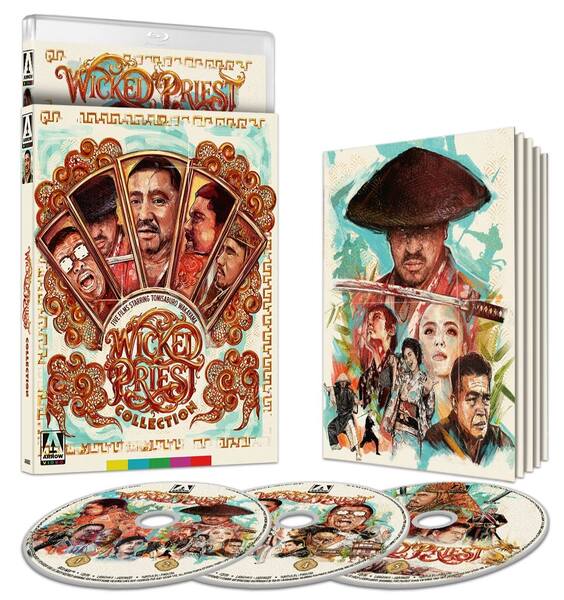
Wicked Priest Collection [Limited Edition]
 –
– 

Genre: Action, Comedy, Crime
Year Released: 1968–1971, 2026 Blu-ray
Runtime: 7h 33m
Directors: Kiyoshi Saeki, Takashi Harada, Buichi Saitō
Writers: Akira Murao, Hideaki Yamamoto, Kōji Takada
Cast: Tomisaburō Wakayama, Bunta Sugawara, Masumi Tachibana, Kenjirō Ishiyama, Tatsuo Endō, Takashi Shimura
Where to Watch: available September 15, 2026. Pre-order your copy here: www.arrowvideo.com, www.mvdshop.com, or www.amazon.com
RAVING REVIEW: The easiest way to understand the WICKED PRIEST films is to forget about trying to make sense of Shinkai as a respectable Buddhist monk. No, seriously, I know that goes against logic, but hear me out. Tomisaburō Wakayama plays him as a walking contradiction who drinks, gambles, chases women, picks fights, and regularly behaves in ways that should have him thrown out of any order willing to claim him. Then somebody vulnerable needs help, corruption starts hurting ordinary people, and Shinkai suddenly becomes the most principled person in the room.
That idea is at the core of what carries Arrow Video’s WICKED PRIEST COLLECTION a lot further than the stories themselves ever could. Across five films, Shinkai repeatedly wanders into communities where gangsters, crooked authority, or other opportunists are taking advantage of people who can’t defend themselves. He usually spends some time indulging whichever vice interests him before deciding that enough is enough, and Wakayama makes the transition from shameless troublemaker to frighteningly capable fighter seem completely natural.
Anyone familiar with Wakayama as Ogami Ittō from LONE WOLF AND CUB gets an especially entertaining reminder of how much range he had within this kind of material. Shinkai has the same imposing presence, but practically none of the solemnity. Wakayama can turn a dirty joke, a gambling scene, an annoyed glance, and a brutal fight into parts of the same character without making Shinkai feel as if he changes personalities whenever the movie changes genres.
WICKED PRIEST establishes that formula with enough attitude to make Shinkai memorable from the start. His willingness to use his fists where another monk might offer spiritual guidance is already funny, although the joke works because there’s more behind it than simple hypocrisy. Shinkai may break nearly every rule placed before him, but he has far less patience for people who use religion, status, or organized power as an excuse to hurt others.
WICKED PRIEST 2: BALLAD OF MURDER is where the series feels most comfortable pushing that personality into something bigger. Shinkai is now more of a wandering troublemaker, while Bunta Sugawara’s Ryotatsu becomes an increasingly important counterweight. Their ongoing hostility gives the series something to return to beyond the group of criminals causing problems that week, and the second movie delivers some of the collection’s strongest action.
Ryotatsu is one of the smartest additions to the formula because he’s capable of matching Shinkai without simply becoming another disposable villain. Their unfinished business keeps getting complicated by the circumstances around them, eventually turning their rivalry into something stranger and more entertaining than a basic hero-versus-enemy relationship. Sugawara brings enough brute force to the role that his appearances continue to matter even after the pattern surrounding them becomes predictable.
That predictability becomes harder to ignore by the third film. WICKED PRIEST 3: A KILLER’S PILGRIMAGE sends Shinkai into another conflict, this time involving a coastal village and revolutionaries, and there are still plenty of strange choices along the way. The series has established its identity by then, and you begin to recognize the core mechanics underneath Shinkai’s latest adventure before the characters themselves do.
The fourth movie finds more life by making Shinkai’s return home feel personal. WICKED PRIEST 4: THE KILLER PRIEST COMES BACK connects him to his past, his mother, an old friend, and a community being exploited, giving Wakayama something to play off of beyond another variation on wandering into trouble. Its snowy setting also changes the texture, while the darker tone creates an interesting contrast with the shameless behavior that originally defined the series.
That doesn’t mean the films always improve as they continue. In fact, one of the biggest limitations of watching the entire WICKED PRIEST COLLECTION together is how clearly the repetition reveals itself. Gambling, drinking, women, Shinkai gets involved, Ryotatsu shows back up again, and an eruption of violence become dependable ingredients rather than surprises. Sometimes familiarity is part of the pleasure, especially because Wakayama is so enjoyable that watching Shinkai repeat himself never becomes completely tiresome. Five films totaling more than seven and a half hours expose where the series could have pushed harder against its own ideas.
WICKED PRIEST 5: BLOOD ON THE COMMANDMENTS illustrates both sides of that problem. There’s enjoyment in seeing the established parts all come together for one last run, particularly with Shinkai and Ryotatsu moving toward the confrontation the movies have repeatedly delayed. The final installment also has stretches where the momentum almost stops and familiarity weighs more heavily, ultimately leaving a satisfying conclusion without necessarily making it the strongest movie.
Arrow’s presentation gives these films considerably more historical love than their cheerfully disreputable personalities might suggest. All five receive new restorations and 1080p presentations, with the original Japanese mono tracks presented in lossless audio and optional English subtitles. Bringing the complete series together for its first North American Blu-ray release also makes this much easier to appreciate as a single body of work rather than five obscure titles.
The supplementary material understands that these movies are more interesting once you look beyond the fighting and dirty jokes. Video essays cover composer Isao Tomita, the films’ depiction of historical Japan, the changing Japanese film industry of the 1960s, Wakayama’s career, and the relationship between Buddhism and popular entertainment. Those pieces add useful context without trying to convince anyone that Shinkai’s adventures are secretly something more respectable than they are.
By the fifth movie, I was ready for Shinkai to reach the end of the road, but I was never tired of Wakayama himself. That distinction probably says everything about the WICKED PRIEST COLLECTION! These aren’t five equally strong films, and the increasingly obvious formula keeps the set from climbing higher for me. Yet, its lead character remains incredibly difficult to resist.
A collection with one terrific antihero, some excellent bursts of martial-arts action, plenty of shameless comedy, and enough repetition to make five films feel like more. Arrow’s restoration and extras make this the best way to discover Shinkai. In contrast, Wakayama makes the strongest argument for staying with him through every broken vow, drunken detour, gambling table, and thoroughly un-Buddhist solution to somebody else’s bad behavior.
Bonus Materials:
LIMITED EDITION CONTENTS
Brand new restorations of all five films in the series: Wicked Priest, Wicked Priest 2: Ballad of Murder, Wicked Priest 3: A Killer’s Pilgrimage, Wicked Priest 4: The Killer Priest Comes Back and Wicked Priest 5: Blood on the Commandments
High-Definition (1080p) Blu-ray presentations of all five films
Original lossless Japanese mono audio on all five films
Optional English subtitles on all five films
Composing the Gospel, a brand new video essay on Wicked Priest composer and electronic music pioneer Isao Tomita by music supervisor and Japanese cinema expert James Balmont
Taisho Troubles, a brand new video essay on Wicked Priest’s depictions of historical Japan by Japanese cinema expert Jonathan Clements
Offscreen Battles, a brand new interview with Asian cinema expert James Mudge on the tumultuous landscape of 1960s Japanese cinema
Martial Arts and Super Mario Brothers, a brand new interview with Japanese cinema experts Patrick Macias and Matt Alt on Wicked Priest star and Japanese screen icon Tomisaburo Wakayama
Priest or Monk, a brand new primer on Buddhism and pop culture as depicted in the Wicked Priest films by Patrick Macias and Matt Alt
Original theatrical trailers for all five films
Reversible sleeve featuring newly commissioned artwork by Chris Malbon
Collectors’ booklet featuring new writing on the films by Camille Zaurin
Please visit https://linktr.ee/overlyhonestr for more reviews.
You can follow me on Letterboxd, Instagram, Twitter, and YouTube. My social media accounts can also be found on most platforms by searching for 'Overly Honest Reviews'.
I’m always happy to hear from my readers; please don't hesitate to say hello or send me any questions about movies.
[photo courtesy of ARROW VIDEO, MVD ENTERTAINMENT]
DISCLAIMER:
At Overly Honest Movie Reviews, we value honesty and transparency. Occasionally, we receive complimentary items for review, including DVDs, Blu-rays, CDs, Vinyl Records, Books, and more. We assure you that these arrangements do not influence our reviews, as we are committed to providing unbiased and sincere evaluations. We aim to help you make informed entertainment choices regardless of our relationship with distributors or producers.
Amazon Affiliate Links:
Additionally, this site contains Amazon affiliate links. If you purchase through these links, we may receive a commission. This affiliate arrangement does not affect our commitment to honest reviews and helps support our site. We appreciate your trust and support as you navigate these links.


Happy
0 %

Sad
0 %

Excited
0 %

Sleepy
0 %

Angry
0 %

Surprise
100 %
 1
1
 0
0

Average Rating