
The Sound of a Society Losing Its Soul
Read Time:6 Minute, 17 Second
MOVIE REVIEW
Yes
 –
– 


Genre: Drama, Satire, Political
Year Released: 2025, 2026
Runtime: 2h 32m
Director(s): Nadav Lapid
Writer(s): Nadav Lapid
Cast: Ariel Bronz, Efrat Dor, Naama Preis, Alexey Serebryakov
Where to Watch: opens June 13, 2026, in Chicago at Facets
RAVING REVIEW: I had no clue what to expect going into this, and I’m still not entirely sure I get it all. There are films built to persuade audiences, films built to entertain them, and films built to make viewers feel trapped inside somebody else’s emotional state for two and a half hours. YES belongs firmly in that last category. Nadav Lapid doesn’t approach this story like a careful political dramatist trying to guide audiences toward a specific conclusion. He attacks the screen with panic, rebellion, exhaustion, rage, absurdity, music, screaming, and sensory overload until the entire movie starts feeling less like a traditional narrative and more like a prolonged spiritual collapse caught on camera.
That approach will alienate a lot of people, and it doesn’t take long to get there. Honestly, I understand why. YES often feels intentionally hostile toward traditional viewing expectations. Characters scream over each other. The camera thrashes around like it’s trying to escape the scene itself. Emotional states shift violently from satire to despair to comedy without warning. Entire sequences seem designed to overwhelm viewers rather than reassure them. But reducing the film to chaos misses what Lapid is actually doing beneath all the noise.
YES is obsessed with identity, shame, nationalism, artistic responsibility, and the relationship between individuals and the systems surrounding them. The difference here is that Lapid no longer seems interested in resistance as a solution. Earlier films like AHED’S KNEE still carried traces of the belief that anger itself could accomplish something meaningful. YES feels made by somebody who has reached the point beyond outrage, where fury curdles into submission, numbness, performance, and exhaustion within morality.
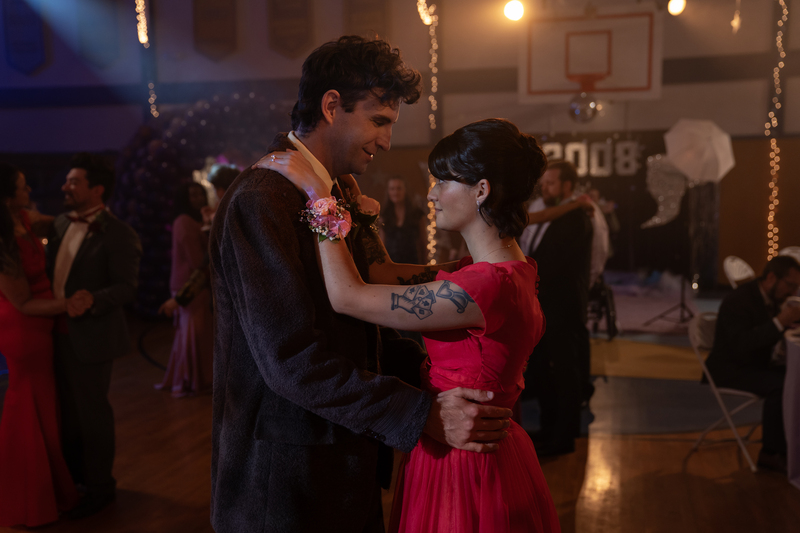
Y., played with terrifying physical commitment by Ariel Bronz, isn’t framed as a heroic dissenter. He’s weak, morally compromised, emotionally shifty, and increasingly willing to prostitute both himself and his art to survive on a social or financial level. Following the aftermath of October 7 and the war in Gaza, he and his wife Yasmin drift deeper into elite social circles where entertainment, patriotism, nationalism, and moral rot all start blending into one monstrous performance.
Bronz gives one of the most exhausting performances I’ve seen in recent years, not just from who they are, but what they mean within the framework of who they are. Y. rarely seems at rest. He dances instead of answering questions. He writhes through conversations like somebody trying to outrun his own consciousness. Even moments of joy feel unstable, as if the character is constantly seconds away from emotional implosion. Lapid repeatedly frames him as both a participant and a victim in the machinery surrounding him. Y. profits from submission while simultaneously degrading himself through it.
Efrat Dor is equally important to the film’s success. Yasmin could’ve easily become symbolic shorthand inside such an aggressively stylized movie, but Dor gives the character enough ambiguity to keep her grounded. The relationship between Y. and Yasmin becomes one of the film’s most intriguing elements because it constantly shifts between tenderness, destruction, dependence, performance, and shared denial. They aren’t simply characters moving through political allegory. They feel like people slowly losing the ability to distinguish between survival and complicity.
There’s a sequence in which the creation of a patriotic anthem becomes one of the film’s most disturbing ideas. While bombs fall and violence escalates outside the frame, art itself becomes weaponized spectacle. Music stops functioning as an expression and turns into a propaganda machine. Lapid clearly sees artistic neutrality as impossible inside that environment. Either art confronts power, or it eventually serves it.
YES, absolutely tests its own limits. The 152-minute runtime becomes difficult to ignore during the middle stretch, especially because Lapid favors emotional escalation over narrative discipline. The film sometimes circles the same ideas repeatedly with increasing intensity rather than developing them into something deeper. There are scenes where the sensory assault becomes exhausting instead of illuminating. I’d argue the film’s excess is inseparable from its purpose. Lapid clearly isn’t trying to construct a political thesis. He’s capturing the overwhelming style that mirrors a society drowning in nationalism, violence, denial, grief, and spectacle. The movie frequently resembles a panic attack because that’s exactly the emotional terrain it’s exploring.
There are no easy moral victories here. No triumphant catharsis. No comforting distance between viewers and the ugliness onscreen. Even the satire becomes uncomfortable because the characters aren’t cartoon villains. They’re people adapting themselves to horrifying conditions one compromise at a time. The movie also works surprisingly well as a broader statement about artists themselves. Y.’s descent into propaganda and performance isn’t presented as uniquely Israeli. Lapid repeatedly suggests that artists everywhere are vulnerable to the same systems of money, status, nationalism, survival, and institutional pressure. The specifics are deeply tied to Israel and Gaza, but the fear underneath the film extends far beyond one country.
There will absolutely be viewers who reject YES outright. Some will find it self-indulgent. Others will see the film’s screaming intensity as overwhelming to the point of parody. Certain scenes intentionally flirt with absurdity so aggressively that they risk pushing audiences out of the experience altogether. But honestly, smoothing the experience into something more palatable would probably destroy what makes it feel alive. This is one of those rare modern political films that genuinely feels dangerous, not because it’s trying to provoke headlines, but because it’s willing to become ugly, unstable, excessive, and emotionally self-destructive in pursuit of what it wants to say.
YES is exhausting. Sometimes frustrating. Occasionally brilliant. Intentionally abrasive. Deeply angry. But it’s also impossible to mistake for anything other than a filmmaker putting every ounce of himself onscreen without concern for whether audiences will follow him there. In an era when so much political cinema feels cautious or engineered for consensus, the film alone makes it hard to ignore.
Please visit https://linktr.ee/overlyhonestr for more reviews.
You can follow me on Letterboxd, Instagram, Twitter, and YouTube. My social media accounts can also be found on most platforms by searching for 'Overly Honest Reviews'.
I’m always happy to hear from my readers; please don't hesitate to say hello or send me any questions about movies.
[photo courtesy of KINO LORBER]
DISCLAIMER:
At Overly Honest Movie Reviews, we value honesty and transparency. Occasionally, we receive complimentary items for review, including DVDs, Blu-rays, CDs, Vinyl Records, Books, and more. We assure you that these arrangements do not influence our reviews, as we are committed to providing unbiased and sincere evaluations. We aim to help you make informed entertainment choices regardless of our relationship with distributors or producers.
Amazon Affiliate Links:
Additionally, this site contains Amazon affiliate links. If you purchase through these links, we may receive a commission. This affiliate arrangement does not affect our commitment to honest reviews and helps support our site. We appreciate your trust and support as you navigate these links.


Happy
0 %

Sad
0 %

Excited
0 %

Sleepy
0 %

Angry
0 %

Surprise
0 %
 0
0
 0
0


Average Rating