Dreaming Loudly Through Dublin’s Gray
Read Time:8 Minute, 27 Second
MOVIE REVIEW
Sing Street 4K + Blu-ray + Digital Collector’s Set and VHS
 –
– 

Genre: Comedy, Drama, Music, Romance
Year Released: 2016, 2026
Runtime: 1h 45m
Director: John Carney
Writers: John Carney, Simon Carmody
Cast: Ferdia Walsh-Peelo, Lucy Boynton, Jack Reynor, Mark McKenna, Maria Doyle Kennedy, Aidan Gillen, Kelly Thornton, Ian Kenny
Where to Watch: 4K + Blu-ray + Digital Collector’s Set and VHS Available on August 11th exclusively at Lionsgate Limited, available for pre-order here: www.lionsgatelimited.com
RAVING REVIEW: Ten years later, SING STREET remains every bit as warm, funny, and emotionally heartfelt as it was upon release in 2016. John Carney’s coming-of-age musical gets so much of its energy from Conor’s decision to start a band and impress Raphina, but its more peaceful sadness stands out more on a return visit. Brendan’s role carries added weight, especially as he pushes his younger brother toward the kind of escape he never managed for himself.
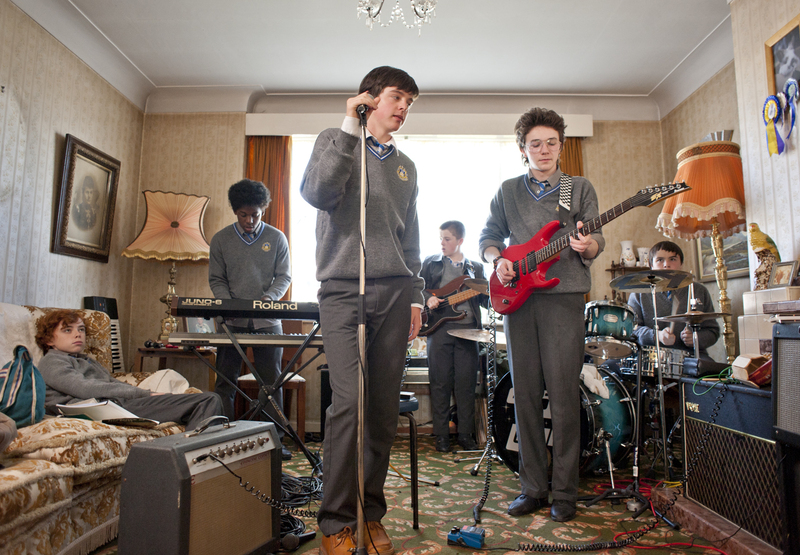
Conor, played by Ferdia Walsh-Peelo, is growing up in 1985 Dublin as his family’s finances and his parents’ marriage collapse around him. He’s transferred from a private school to the tougher Synge Street, where he’s immediately targeted by a bully, humiliated, and confronted by an institution that seems designed to strip away whatever individuality its students possess. Then he notices Raphina, played by Lucy Boynton, standing across the street. Conor tells her he’s in a band and asks her to appear in a music video. She agrees, leaving him with the minor inconvenience of having to form the band he just invented.
John Carney understands that identity is often assembled through imitation. Conor doesn’t immediately become the musician he promised. He borrows whatever Brendan has presented, changing the band’s clothes, hair, and sound every time he discovers another record. Duran Duran leads to one appearance, The Cure inspires another, and the group’s abrupt transformations become some of the film’s funniest moments.
The humor never treats those experiments as meaningless. Every imitation brings Conor closer to understanding what he actually likes and who he might become. Adolescence is filled with borrowed personalities, especially for teenagers who haven’t been given much space to develop one of their own. Conor tries on musical styles because the rest of his life has been assigned to him by parents, priests, teachers, and the limits of where he was born.
Walsh-Peelo lets Conor’s confidence emerge gradually throughout the process. The early swagger is mostly performance, barely concealing how unprepared he is for Raphina, his new school, or the problems waiting at home. His posture changes as the band improves. He starts speaking with greater certainty and taking risks that the boy from the opening scenes wouldn’t have attempted. Music doesn’t solve his problems. It gives him a way to answer them.
That keeps SING STREET from becoming just encouragement about following a dream. Conor’s family remains short of money. His parents continue tearing each other apart. The school remains hostile, and Dublin doesn’t suddenly offer a future because a group of teenagers wrote a few catchy songs. The band gives Conor a community and a reason to stop accepting every condition placed in front of him.
Mark McKenna’s Eamon is essential to that transformation. Conor may bring the lyrics, ambition, and obsession, but Eamon can seemingly pick up any instrument and understand what the song needs. Their friendship develops without any forced conflict. Two teenagers sit together, build something from nothing, and become better because neither is worried about receiving all the credit.
The remaining band members have recognizable appearances and personalities, but the screenplay rarely follows them beyond rehearsals, videos, and school. That’s noticeable because the film is so perceptive about Conor, Brendan, and Eamon. A little more time with the full group could have strengthened the sense that each member needed this refuge for a different reason.
Raphina is also caught between being a person and being the mysterious girl Conor wants her to be. Boynton supplies the uncertainty that the writing sometimes withholds, allowing fear to appear beneath Raphina’s confidence and carefully curated image. She talks about modeling in London as though everything has already been arranged, although her future largely depends on an older boyfriend whose promises become increasingly doubtful.
Conor initially looks at her as proof that another world exists. She’s glamorous, older, unpredictable, and willing to jump into the deep end, all for a music video. The film gradually reveals that much of this is her performing a role as much as he is. Her makeup, clothing, stories, and plans are another form of self-invention, created by someone desperate to avoid being defined by her current circumstances. SING STREET could have given her greater independence from Conor’s evolution. Much of Raphina’s life must be inferred through Boynton’s performance, while Conor receives the clearer emotional progression. Their relationship remains affecting because both are trying to become the people they’ve described to each other. The romance is less about discovering someone’s true self than finding a person willing to believe in the identity being attempted.
The film’s deepest relationship belongs to Conor and Brendan. Jack Reynor gives the movie a bruised adult awareness, even though Brendan is only a few years older than his brother. He serves as teacher, critic, music curator, and warning. Brendan understands everything Conor needs to do because he has spent years thinking about why he never did it himself. His advice can be funny, arrogant, or unreasonably specific, but the affection beneath it is never in question. Brendan wants Conor to take the chances that he abandoned. When he admits that he cleared a path for his younger brother, the movie briefly shifts its weight toward everyone whose unrealized ambitions helped somebody else move forward.
Aidan Gillen and Maria Doyle Kennedy play Conor’s parents without turning their failing marriage into a collection of screaming matches. The household has the exhausted atmosphere of a relationship that ended before anyone was prepared to say so. Their children understand what’s happening through half-heard arguments, uncomfortable meals, and announcements delivered after the important decisions have already been made. Carney places that breakdown beside a school governed by humiliation and rigid Catholic authority. Don Wycherley’s Brother Baxter is effective as an obstacle, although the character is drawn with less complexity than the family members. The same applies to Ian Kenny’s Barry, the bully whose violence initially appears almost automatic. The film eventually allows Barry a small measure of vulnerability, but both figures primarily exist to give Conor something visible to resist.
The music supplies the resistance that ordinary conversation can’t. The original songs are catchy enough to justify everyone’s growing confidence while retaining the slightly unfinished quality of teenagers discovering songwriting in real time. “The Riddle of the Model” has the excitement of a first breakthrough, while “Up” shows how quickly Conor and Eamon are learning to turn personal frustration into something buoyant.
Lionsgate Limited’s tenth-anniversary edition gives SING STREET its first 4K presentation, pairing Dolby Vision with a new Dolby Atmos mix. The visual upgrade respects Yaron Orbach’s subdued photography rather than forcing the film into an unnatural look. Dublin’s exteriors, aging interiors, school corridors, and worn clothing retain their modest appearance, while the music videos and stage lighting receive the strongest bursts of color. The increase in detail is most apparent in faces, fabric, brickwork, and the cramped rooms surrounding the characters. The Dolby Vision presentation improves depth, separation, and stability without making 1985 Dublin look newly renovated.
The collector’s set adds the new featurette “The Risk of Rock & Roll: Going Back to Sing Street” alongside the previous making-of, cast auditions, John Carney and Adam Levine’s discussion, trailers, television spots, B-roll, and the “Drive It Like You Stole It” music video. The retrospective addition is a welcome addition. Releasing a VHS edition is an amusing extension of the film’s affection for older media and handmade music videos.
Ten years haven’t weakened SING STREET’s warmth, although time has made its sadness harder to overlook. Conor’s enthusiasm remains infectious, Raphina’s uncertainty feels more pronounced, and Brendan’s sacrificed future now carries as much emotional force as the younger characters’ romance. The picture may be sharper, and the room sounds fuller, but the reason to return hasn’t changed. SING STREET understands that a song written in a bedroom can be the first step toward leaving it.
Please visit https://linktr.ee/overlyhonestr for more reviews.
You can follow me on Letterboxd, Instagram, Twitter, and YouTube. You can also find my social media accounts on most platforms by searching for 'Overly Honest Reviews'.
I’m always happy to hear from my readers; please don't hesitate to say hello or send me any questions about movies.
[photo courtesy of LIONSGATE LIMITED]
DISCLAIMER:
At Overly Honest Movie Reviews, we value honesty and transparency. Occasionally, we receive complimentary items for review, including DVDs, Blu-rays, CDs, Vinyl Records, Books, and more. We assure you that these arrangements do not influence our reviews, as we are committed to providing unbiased and sincere evaluations. We aim to help you make informed entertainment choices regardless of our relationship with distributors or producers.
Amazon Affiliate Links:
Additionally, this site contains Amazon affiliate links. If you purchase through these links, we may receive a commission. This affiliate arrangement does not affect our commitment to honest reviews and helps support our site. We appreciate your trust and support as you navigate these links.


Happy
0 %

Sad
0 %

Excited
0 %

Sleepy
0 %

Angry
0 %

Surprise
0 %
 0
0
 0
0


Average Rating