Every Wrong Turn Starts Over
Read Time:7 Minute, 1 Second
MOVIE REVIEW
Exit 8
 –
– 

Genre: Horror, Mystery, Thriller
Year Released: 2025, 2026 Blu-ray
Runtime: 1h 35m
Director: Genki Kawamura
Writers: Kentaro Hirase, Genki Kawamura
Cast: Kazunari Ninomiya, Yamato Kochi, Naru Asanuma, Nana Komatsu, Kotone Hanase
Where to Watch: available August 7, 2026, pre-order your copy here: www.moviesunlimited.com or www.amazon.com
RAVING REVIEW: The fluorescent lights never look threatening on their own. Neither do the tiles, security cameras, advertisements on the walls, ventilation grates, or the middle-aged man carrying a briefcase. After director/co-writer Genki Kawamura makes us study them long enough, every detail begins to feel like a warning placed there specifically to test whether we’re paying attention.
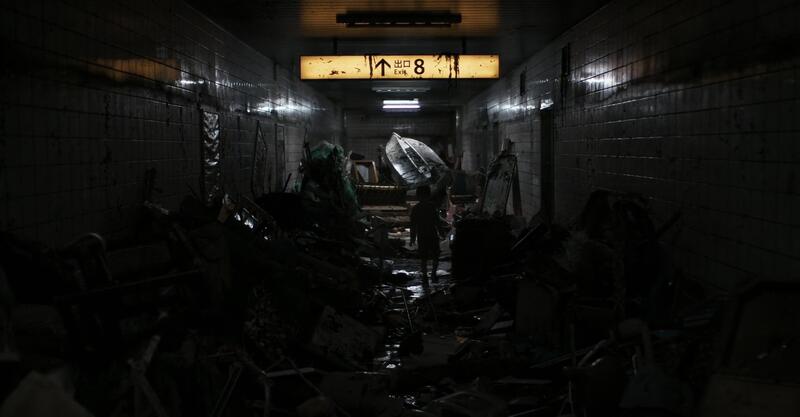
That transformation is really a monumental achievement in EXIT 8, a Japanese adaptation of Kotake Create’s minimalist video game. Its unnamed “Lost Man” finds himself walking through the same underground passage over and over. The instructions for escaping appear simple. When something’s changed, turn around. When everything appears normal, keep moving forward. One mistake sends him back to the beginning.
Kawamura understands that watching someone play this game shouldn’t be a passive experience. The camera repeatedly gives us enough time to inspect the corridor, remember its rules, and question details that would barely register anywhere else. Was that poster always there? Is the light flickering differently? Has the person's expression changed, or are we inventing danger because the film has taught us to distrust familiarity?
For a while, that participation produces considerable tension. The same hallway becomes an observation test in which confidence can be more dangerous than confusion. A viewer might notice an anomaly before the “Lost Man” does, creating the helpless frustration of watching him continue toward an obvious reset. On another pass, he turns around while nothing seems wrong, leaving us to wonder whether he has detected something just outside our understanding.
The film places us inside his perspective as he moves through a crowded subway. People stare at phones, avoid eye contact, and treat the strangers around them as obstacles occupying limited space. The “Lost Man” receives a call from a former partner, who tells him she’s pregnant and needs to know whether he intends to be involved. His inability to answer becomes part of a habit of retreating whenever another person requires something difficult from him.
Kazunari Ninomiya plays that uncertainty without turning the character into a collection of obvious anxieties. His performance is rooted in physical discomfort. Breathing becomes difficult, his eyes move constantly, and each return to the same corner leaves him a little less certain of his senses. He isn’t an adventurous hero solving an elaborate puzzle. He’s an overwhelmed man who wants an exit before he has understood what trapped him.
That distinction gives the film somewhere to go beyond reproducing the game. Kawamura and co-writer Kentaro Hirase treat the passage as a form of purgatory shaped by avoidance, guilt, and emotional paralysis. The “Lost Man” must learn to recognize the suffering he ordinarily dismisses as someone else’s problem. The metaphor fits the character, although it gradually becomes too methodical. Once his fear of responsibility begins influencing the anomalies, the corridor stops feeling mysterious and starts behaving like an aggressive therapist. The connection between his personal life and the underground loop becomes easy to read, reducing some of the unease that came from having no reliable explanation.
Naru Asanuma’s “Boy” gives the “Lost Man” another person to protect and another opportunity to correct his instinct to withdraw. Their connection introduces warmth into an intentionally cold environment, and Asanuma avoids the forced perspective that often accompanies children in supernatural stories. His presence also changes the experience from observation into a more conventional rescue narrative. That shift gives EXIT 8 an emotional direction, but it costs the film some of its impact. The first passages are frightening because the “Lost Man” is alone with rules he doesn’t understand. Once he has someone to explain those rules to and a clear moral responsibility, the situation becomes easier to organize.
Yamato Kochi’s “Walking Man” is far more effective because the film refuses to grant him humanity. He approaches with the same measured stride, carries the same bag, and wears a pleasant expression that never offers comfort. Nothing about him is aggressive. His repetition makes him disturbing, as though a background figure has realized that someone is watching and has begun watching back.
Kawamura rarely wastes the location’s simplicity. Small differences in distance and camera placement make the corridor seem shorter, longer, or misaligned without explaining what happened. A corner that previously promised another familiar stretch can suddenly feel like the edge of something enormous. The practical environment gives the actors weight within the space, preventing the setting from looking like an empty digital stage.
Sound carries an equal share of the tension. Footsteps let you know the “Walking Man” is coming before he appears, while ventilation systems and electrical fixtures create a steady mechanical pressure. Silence doesn’t provide relief because it suggests that part of the established pattern has disappeared. Even Ravel’s “Boléro,” built around insistent repetition and gradual escalation, reinforces the feeling that the film is moving forward while remaining trapped in the same movement.
The anomalies vary considerably. The quiet ones encourage scrutiny and reward patience, especially when the change is small enough to make us question whether we’ve remembered correctly. Larger displays of horror provide scale but sometimes feel like they came from a different movie. Once the passage begins producing physical threats, the fear of overlooking one altered detail gives way to more familiar survival sequences. That uneven escalation exposes the difficulty of extending a game into a 95-minute feature. The rules are easy to understand, and every return must either offer a new anomaly or deepen the character’s emotional struggle. Not every loop accomplishes the desired impact.
The screenplay also assigns clear meanings to images that were stronger when they remained unsettling fragments. The “Lost Man’s” fear of fatherhood, guilt over his passivity, and relationship with the “Boy” eventually align with such precision that very little ambiguity survives. Those ideas aren’t shallow, but the film keeps explaining a nightmare that was more effective when it seemed capable of operating without concern for logic.
EXIT 8 works best before its corridor becomes a lesson. Kawamura successfully converts a simple game mechanic into visual suspense and finds a connection between observation and human responsibility. The film’s determination to add emotional resolution weakens the isolation and uncertainty that made its first half so effective. At the same time, its repetitive structure occasionally struggles to justify another trip around the corner.
The hallway remains memorable because it weaponizes the kind of place most people would pass through without a second glance. By the time the “Lost Man” reaches the next numbered sign, looking away no longer feels careless. It feels dangerous.
Please visit https://linktr.ee/overlyhonestr for more reviews.
You can follow me on Letterboxd, Instagram, Twitter, and YouTube. You can also find my social media accounts on most platforms by searching for 'Overly Honest Reviews'.
I’m always happy to hear from my readers; please don't hesitate to say hello or send me any questions about movies.
[photo courtesy of MOVIES UNLIMITED, ALLIANCE HOME ENTERTAINMENT, NEON]
DISCLAIMER:
At Overly Honest Movie Reviews, we value honesty and transparency. Occasionally, we receive complimentary items for review, including DVDs, Blu-rays, CDs, Vinyl Records, Books, and more. We assure you that these arrangements do not influence our reviews, as we are committed to providing unbiased and sincere evaluations. We aim to help you make informed entertainment choices regardless of our relationship with distributors or producers.
Amazon Affiliate Links:
Additionally, this site contains Amazon affiliate links. If you purchase through these links, we may receive a commission. This affiliate arrangement does not affect our commitment to honest reviews and helps support our site. We appreciate your trust and support as you navigate these links.


Happy
0 %

Sad
0 %

Excited
0 %

Sleepy
0 %

Angry
0 %

Surprise
0 %
 0
0
 0
0



Average Rating