When Fantasy Refuses to Soften Reality
Read Time:9 Minute, 44 Second
MOVIE REVIEW
New York, New York (Collector's Edition) [4K Ultra HD]
 –
– 


Genre: Drama, Music, Romance
Year Released: 1977, 2026 MVD Marguee Collection 4K
Runtime: 2h 43m
Director(s): Martin Scorsese
Writer(s): Earl Mac Rauch, Mardik Martin
Cast: Liza Minnelli, Robert De Niro, Lionel Stander, Barry Primus, Mary Kay Place, Georgie Auld, Dick Miller
Where to Watch: available August 11, 2026, pre-order your copy here: www.mvdshop.com or www.amazon.com
RAVING REVIEW: Martin Scorsese lets loose an old Hollywood musical and then drops one of his most unpleasant leading men directly into it. Jimmy Doyle has the saxophone, confidence, and persistence traditionally used to mark a romantic lead, but the polish has been stripped away. He doesn’t charm Francine Evans into giving him a chance. He exhausts her resistance until she can no longer escape him.
Their first meeting occurs amid the celebration of V-J Day (Victory over Japan Day marks the Official U.S. and Allied Surrender Dates of World War II, celebrated on August 14/15 and September 2, 1945), with the war ending and New York ready to embrace a fresh beginning. The setting promises romance before Jimmy even approaches Francine’s table. Robert De Niro then turns that promise into an endurance test, refusing every dismissal, ignoring every expression of discomfort, and treating her desire to be left alone as another stage of flirtation.
The sequence is funny in places because Liza Minnelli’s annoyed responses are perfectly timed, but the humor becomes harder to accept as Jimmy continues. He isn’t misunderstanding Francine. He understands her and decides that what she wants matters less than what he wants. That behavior remains the defining aspect of their relationship, no matter how beautifully Scorsese photographs the world around them.
NEW YORK, NEW YORK is often described as a tribute to the studio musicals of the 1940s and 1950s, though the idea of a tribute suggests more affection than the film consistently shows. Scorsese recreates the painted skylines, saturated colors, constructed streets, nightclubs, and enormous soundstages associated with that. He then fills those spaces with arguments that feel too invasive, angry, and emotionally uncontrolled to belong there.
The difference is intentional. Classic musicals frequently turned aggressive courtship into romantic determination, asking audiences to accept that the woman would eventually recognize the man’s persistence as devotion. Scorsese removes the protection offered by convention. Jimmy behaves like the same romantic pursuer found in an older movie, except De Niro plays the entitlement, resentment, and hostility that the fantasy normally disguises.
That makes the film unusually difficult to settle into. The sets invite surrender while the relationship creates resistance. A painted city street might appear ready for two people to fall in love, but Jimmy can turn it into another location where Francine must manage his temper. The environment follows the rules of an MGM production. The people occupying it have wandered in from a far darker drama.
Francine and Jimmy find their connection through music. She understands melody, presentation, and the practical demands of entertaining a crowd. He is drawn toward jazz as an expression of independence, resisting anything that might make the work safer or more commercial. Their differences initially seem complementary, with her discipline giving shape to his talent and his spontaneity pulling her beyond the expected. The problem is that Jimmy doesn’t view Francine as an equal whose ambitions deserve the same room as his own. He loves her talent when it serves their partnership, then resents it whenever her success forces him to acknowledge that she doesn’t need him. His artistic pride and insecurity become indistinguishable. Each disagreement turns into a referendum on his authority.
De Niro commits so completely to Jimmy’s volatility that the performance creates as many problems as it solves. His unpredictability gives the film danger, especially when a casual exchange begins tightening into an argument. Jimmy can become cruel without raising his voice, and De Niro understands how a man like this makes everyone around him monitor his mood. The intensity also arrives so early that the relationship has little room to deteriorate. Jimmy is already intolerable during the courtship, leaving the film to spend much of its 163 minutes confirming what Francine should have recognized within their first conversation. There are brief stretches of warmth, humor, and creative excitement, but they never explain why she continues giving him access to her life.
Scorsese may not need the romance to be convincing in a traditional sense. The movie can be understood as a study of how people mistake emotional intensity for love, especially when artistic collaboration makes the relationship feel exceptional. Francine doesn’t remain because Jimmy treats her well. She remains because their music creates the harmony their private lives can’t sustain.
Minnelli holds the movie together whenever Jimmy threatens to consume it. Francine is initially cautious and self-possessed, meeting his relentless behavior with irritation rather than instant attraction. As the relationship changes, Minnelli lets that control weaken without reducing Francine to a passive victim. She continues making choices, even when those choices are shaped by love, exhaustion, professional pressure, and the hope that Jimmy might become the person he occasionally appears capable of being. Her performance also bridges the two conflicting styles better than anyone else. Minnelli can inhabit the artificial grandeur of a studio musical without seeming like she’s impersonating another generation. That tradition is part of her physical and musical vocabulary, but her dramatic work belongs to the rawer emotional environment Scorsese brings into it.
Francine’s rise gives the film a purpose that the relationship alone can’t sustain. The more space she creates between herself and Jimmy, the larger the movie seems to become. Her talent is no longer forced to accommodate his ego, and Minnelli’s performances acquire an authority that changes the balance between them.
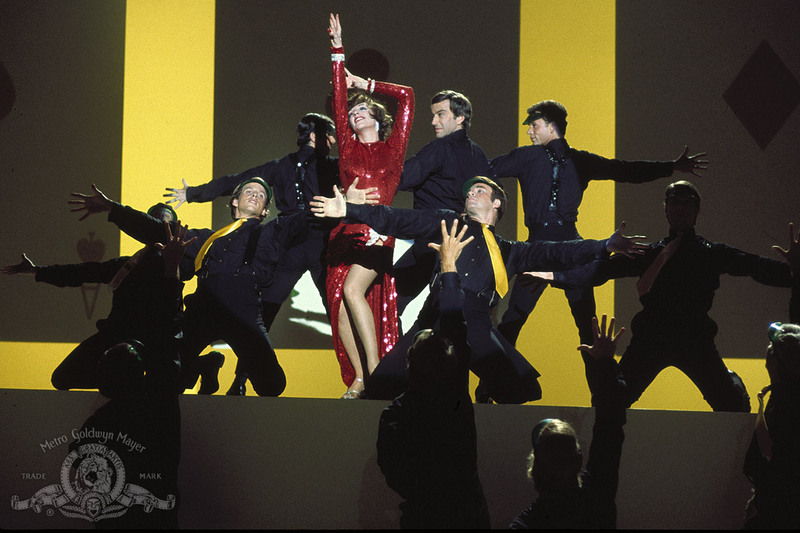
The extended “Happy Endings” production number initially appears to abandon the story for an elaborate musical inside the musical. Its length can test the patience, particularly after the film has already passed the two-hour mark. The detour becomes essential, though, because it shows the fantasy Francine has learned to command. She isn’t merely performing inside Scorsese’s artificial world anymore. She controls it. That sequence also exposes the distance between the movie audiences are watching and the movie its characters might prefer to inhabit. In the musical fantasy, emotion can be arranged through choreography, design, and song. Private pain is put on display, obstacles become steps in a routine, and every disappointment can be guided toward applause. Francine can succeed there because the rules are clear. Life with Jimmy never offers that structure.
The title song arrives with so much familiarity that it can be difficult to hear it as part of this specific story. Minnelli takes possession of it before decades of Frank Sinatra recordings, sporting events, tourist advertisements, and New Year’s celebrations can overwhelm the moment. Her performance isn’t simply a salute to the city. It is Francine announcing that she has survived long enough to define herself without Jimmy.
MVD’s Collector’s Edition gives that visual design the presentation it has long needed. The expanded cut comes from a 16-bit 4K scan of the original camera negative and is presented in the original aspect ratio with HDR. Colors have greater separation without losing the consciously artificial appearance of the sets, and the richer contrast helps the nightclubs, stage lighting, costumes, and painted environments retain their depth. The restoration doesn’t try to make the film resemble a modern production. Grain remains part of the image, and the improvement comes from revealing the materials used to create Scorsese’s fantasy. Fabric, smoke, reflections, theatrical lighting, and background artwork become easier to appreciate without exposing the sets in a way that ruins them. Their artificiality was always the point.
The accompanying Blu-ray contains the 136-minute international version, allowing viewers to compare how significantly length changes the experience. The shorter cut moves more quickly, though the expanded version better expresses the film’s excessive ambition. Neither solves Jimmy, but reducing the runtime also reduces some of the grandeur that makes the movie worth revisiting.
The archival extras make this a substantial collector’s package. Scorsese’s introduction and full commentary with critic Carrie Rickey provide context for the experiment. In contrast, the two-part documentary, the Minnelli featurette, alternate takes, deleted material, photo gallery, trailers, and selected-scene cinematography commentary give the production history appropriate attention. Reversible artwork and the included slipcover complete an edition that treats the film as a major work rather than an embarrassing detour.
The film’s problems aren’t separate from its ambition. Scorsese wanted the amusement of old Hollywood and the emotional honesty those movies often avoided, but Jimmy’s cruelty overwhelms the romance before the fantasy has a chance to work. Minnelli gives the experiment its reason to exist. Francine enters a world that seems designed to contain her within Jimmy’s story, then gradually claims the stage, the music, and the movie itself. The relationship fails because it was built around one man’s refusal to listen. The song survives because Francine finally gets to be heard.
Bonus Materials:
2025 4K Scan and Restoration (16-Bit Scan of the Original Camera Negative) of the Expanded Cut of the film presented in 2160p in its original 1.66:1 Aspect Ratio in HDR
Introduction by Martin Scorsese (5:36)
Audio Commentary by Director Martin Scorsese and Film Critic Carrie Rickey
Optional English Subtitles
5.1 DTS-HD Surround & LPCM 2.0 Stereo
“New York, New York” International Version (HD, 136 minutes) [Blu-ray Bonus Features Disc]
The New York, New York Stories: Part One (25:31) [Blu-ray Bonus Features Disc]
The New York, New York Stories: Part Two (26:58) [Blu-ray Bonus Features Disc]
Liza on New York, New York (22:09) [Blu-ray Bonus Features Disc]
Alternate Takes / Deleted Scenes (19:14) [Blu-ray Bonus Features Disc]
Commentary on Selected Scenes by László Kovács, ASC (10:14) [Blu-ray Bonus Features Disc]
Photo Gallery [Blu-ray Bonus Features Disc]
Theatrical Teaser (2:07) & Theatrical Trailer (3:27) [Blu-ray Bonus Features Disc]
Reversible Artwork
Please visit https://linktr.ee/overlyhonestr for more reviews.
You can follow me on Letterboxd, Instagram, Twitter, and YouTube. You can also find my social media accounts on most platforms by searching for 'Overly Honest Reviews'.
I’m always happy to hear from my readers; please don't hesitate to say hello or send me any questions about movies.
[photo courtesy of MVD ENTERTAINMENT]
DISCLAIMER:
At Overly Honest Movie Reviews, we value honesty and transparency. Occasionally, we receive complimentary items for review, including DVDs, Blu-rays, CDs, Vinyl Records, Books, and more. We assure you that these arrangements do not influence our reviews, as we are committed to providing unbiased and sincere evaluations. We aim to help you make informed entertainment choices regardless of our relationship with distributors or producers.
Amazon Affiliate Links:
Additionally, this site contains Amazon affiliate links. If you purchase through these links, we may receive a commission. This affiliate arrangement does not affect our commitment to honest reviews and helps support our site. We appreciate your trust and support as you navigate these links.


Happy
0 %

Sad
0 %

Excited
100 %

Sleepy
0 %

Angry
0 %

Surprise
0 %
 1
1
 0
0

Average Rating