Dying Through a Stranger’s Eyes
Read Time:7 Minute, 56 Second
MOVIE REVIEW
The Double (La controfigura)
 –
– 

Genre: Drama, Mystery, Thriller
Year Released: 1971, 2026 Radiance Films Blu-ray
Runtime: 1h 28m
Director(s): Romolo Guerrieri
Writer(s): Libero Bigiaretti, Sauro Scavolini, Sandro Continenza
Cast: Jean Sorel, Ewa Aulin, Lucia Bosé, Silvano Tranquilli, Sergio Doria, Marilù Tolo
Where to Watch: available now, order your copy here: www.radiancefilms.co.uk, www.mvdshop.com or www.amazon.com
RAVING REVIEW: An indicator light keeps blinking beside a dying man, repeating its empty warning while his mind struggles to explain how he reached the floor of an underground parking garage. Romolo Guerrieri doesn’t treat the gunshot as the beginning of an investigation. It’s the endpoint of a life already distorted by jealousy, sexual frustration, and a man’s belief that every person around him exists in relation to his desires. THE DOUBLE moves backward from death, although its memories refuse to line up in a way to provide a dependable account of what happened.
Giovanni spends much of the film watching. He watches his wife Lucia speak to other men. He watches her mother, Nora, with a fixation that quickly crosses into obsession. He watches an American drifter named Eddie enter their lives and assigns meaning to every look, gesture, and private exchange. When watching no longer gives him the certainty he wants, Giovanni begins letting his imagination take over. Reality, fantasy, suspicion, and memory gradually lose their borders until his recollections tell us more about his possessiveness than the people he claims to understand.
Jean Sorel makes that self-absorption difficult to dismiss as just foolishness. Giovanni is handsome, financially secure, and accustomed to moving through the world without being challenged. Those advantages have left him with little confidence. He treats Lucia’s independence as an insult, even as he pursues her mother and excuses his own behavior without hesitation. His jealousy isn’t rooted in devotion. It comes from wounded ownership, the fear that someone he considers his might make a choice he can’t control. Sorel gives the character a passive quality that fits this contradiction. Giovanni wants to see himself as the innocent party while doing much of the damage himself. He drifts between resentment and desire, rarely taking responsibility for either. The performance doesn’t ask us to sympathize with his suffering so much as recognize how thoroughly he has arranged his memories around it. Even as death approaches, Giovanni remains the author of a story in which his humiliation matters more than anyone else’s life.
That perspective defines the film’s unusual structure. Guerrieri repeatedly cuts away from beaches, bedrooms, boats, and sunlit Moroccan landscapes to the cold concrete of the parking garage. Giovanni’s body remains where it fell while his mind circles the experiences that might explain the shooting. Each return interrupts whatever emotional momentum was developing at that point, reminding us that the apparent freedom of these memories is trapped inside a final moment.
The editing can be disorienting, though the confusion isn’t random. Giovanni doesn’t recall events as a chain of causes and consequences. He revisits them as fragments charged with shame, envy, and desire. A glance can assume greater importance than a conversation. An imagined act of violence can enter the same stream of consciousness as something that actually occurred. The film’s chronology folds in on itself because Giovanni’s mind is searching for an explanation it may already know but doesn’t want to accept.
Guerrieri’s most effective decision is refusing to turn the mystery into a conventional hunt for clues. THE DOUBLE carries several features associated with the giallo, including erotically charged danger, volatile perception, violence, and an elaborate revelation. Its attention remains fixed on psychological collapse rather than detection. The identity of the gunman matters less than the emotional arrangement that has placed Giovanni in front of him. That choice also creates the film’s largest weakness. Once the initial fascination with its construction settles in, the relationships underneath it aren’t deep enough to support every turn. Giovanni’s jealousy repeats itself in slightly altered forms, and the screenplay often substitutes tension for character development. The fragmented design promises depths that the eventual explanations don’t provide.
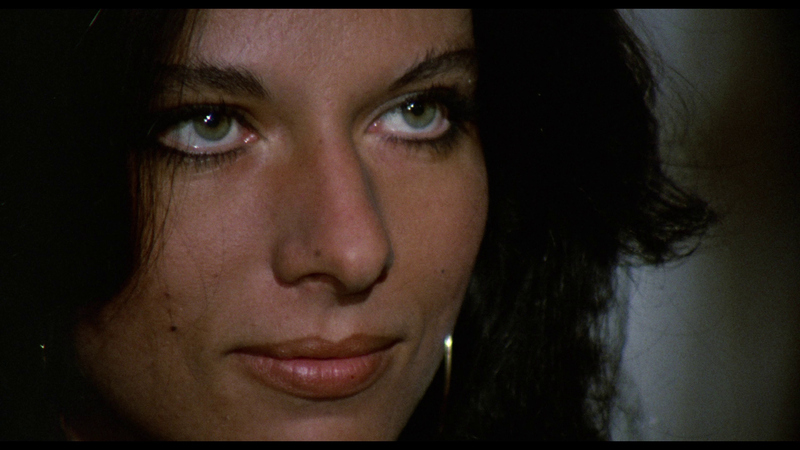
Lucia Bosé's performance as Nora carries a confidence that Giovanni mistakes for an invitation, and her refusal to bend her behavior around his expectations makes her increasingly dangerous to him. Bosé understands that Nora’s appeal lies partly in her emotional distance. She can be amused, provocative, or dismissive without allowing Giovanni to know exactly what she thinks of him.
Ewa Aulin’s Lucia is more difficult to assess because the movie sees her primarily through her husband’s suspicion. She’s flirtatious, restless, and comfortable provoking him, although those traits are filtered through a narrator determined to make her behavior evidence against her. There are moments when Lucia appears to understand Giovanni’s weaknesses better than he does.
The women are frequently photographed as bodies before they’re allowed to function as people. Guerrieri uses sensuality to expose Giovanni’s gaze, but he also indulges that gaze at considerable length. The distinction between critiquing male entitlement and reproducing it becomes uncertain. Nora and Lucia retain enough intensity to resist becoming passive objects, while Marilù Tolo receives far less opportunity to move beyond.
Sergio Doria’s Eddie brings another form of masculinity into Giovanni’s increasingly cramped worldview. Eddie’s ease and apparent rejection of conventional responsibility make him an obvious threat to a man whose confidence depends on status. Giovanni can’t decide whether Eddie is a rival, an intruder, or a fantasy of freedom he secretly envies. That ambiguity gives their encounters more interest than the screenplay’s occasional attempts to turn the drifter into a symbol of generational rebellion.
The score adds a deceptive lightness to these complications. Airy, almost ethereal music follows scenes filled with resentment, making the holiday setting seem both seductive and artificial. Morocco becomes less a fully realized place than an emotional projection, somewhere Giovanni imagines ordinary restrictions have loosened. Sunlight, water, exposed skin, and open landscapes suggest freedom while his thoughts become increasingly confined.
The parking garage scenes provide an effective visual counterweight. Everything there is hard, gray, repetitive, and impersonal. Giovanni’s memories may be filled with color and possibility, but they all lead back to the same concrete floor. The blinking beside him becomes an indifferent rhythm, continuing whether he finds the answer he wants or not.
Radiance Films’ restoration is especially valuable for a movie whose reputation has long depended on compromised or difficult-to-find copies. The restored image allows its landscapes, abrupt visual intrusions, and carefully arranged compositions to register with renewed clarity. Having both Italian and English audio options also helps preserve a production created for international circulation. The supplemental material offers needed perspective on a thriller that doesn’t behave according to the most recognizable rules of its genre.
THE DOUBLE is easier to admire scene by scene than as a complete experience. Its fractured chronology, visual control, and refusal to trust its dying protagonist give it a strange quality, even when the people inside Giovanni’s memories remain underdeveloped. Guerrieri creates the sensation of a mind editing its own downfall in real time, leaving out anything that might threaten its preferred version of events.
Giovanni wants his final recollections to explain why someone shot him. They expose something less comforting. He may have spent his life confusing attention with affection, jealousy with love, and possession with intimacy. The murder provides the ending, but the real trap was built much earlier, each time he looked at another person and saw only what their choices meant for him.
Bonus Materials:
4K restoration from the original negative
Optional Italian and English audio tracks
Original uncompressed mono audio
Audio commentary by Tim Lucas (2026)
Archival interview with director Romolo Guerrieri and star Eva Aulin, newly edited for this release (2026)
Appreciation by author Stephen Thrower (2026)
Easter egg (2 mins)
Reversible sleeve featuring artwork based on original posters
Limited edition booklet featuring new writing by Nathaniel Thompson
Please visit https://linktr.ee/overlyhonestr for more reviews.
You can follow me on Letterboxd, Instagram, Twitter, and YouTube. You can also find my social media accounts on most platforms by searching for 'Overly Honest Reviews'.
I’m always happy to hear from my readers; please don't hesitate to say hello or send me any questions about movies.
[photo courtesy of RADIANCE FILMS, MVD ENTERTAINMENT]
DISCLAIMER:
At Overly Honest Movie Reviews, we value honesty and transparency. Occasionally, we receive complimentary items for review, including DVDs, Blu-rays, CDs, Vinyl Records, Books, and more. We assure you that these arrangements do not influence our reviews, as we are committed to providing unbiased and sincere evaluations. We aim to help you make informed entertainment choices regardless of our relationship with distributors or producers.
Amazon Affiliate Links:
Additionally, this site contains Amazon affiliate links. If you purchase through these links, we may receive a commission. This affiliate arrangement does not affect our commitment to honest reviews and helps support our site. We appreciate your trust and support as you navigate these links.


Happy
0 %

Sad
0 %

Excited
0 %

Sleepy
0 %

Angry
0 %

Surprise
0 %
 0
0
 0
0

Average Rating