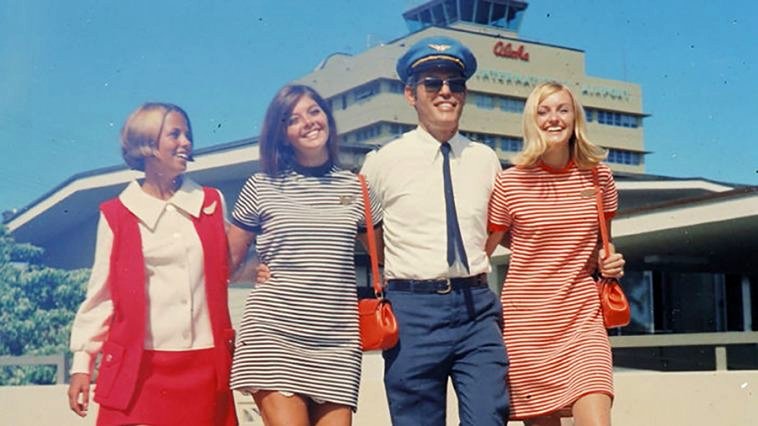
A Film Defined More by Context Than Content
Read Time:5 Minute, 52 Second
MOVIE REVIEW
The Stewardesses
 –
– 


Genre: Comedy, Drama, 3D, Cult
Year Released: 1969, Kino Cult Blu-ray 2026
Runtime: 93 minutes
Director(s): Allan Silliphant
Writer(s): Allan Silliphant
Cast: Christina Hart, Ronald South, William Condos, Angelique De Moulin, Paula Erickson, Kathy Ferrick
Where to Watch: available now, order your copy here: www.kinolorber.com or www.amazon.com
RAVING REVIEW: THE STEWARDESSES is almost easier to talk about as an idea than as a film. The experience of watching it and the significance of what it represents rarely sit in the same place, and that gap never really closes as you watch. One side carries real historical weight, tied to exhibition, technology, and a specific moment in audience demand. The other is what’s actually on screen, and that side struggles to justify itself on its own terms. The strain between those two realities becomes the defining feature of the entire experience.
What’s fascinating is how clearly the film reveals its priorities. It isn’t built around a story and then enhanced by technique. It’s built around technique first, with everything else arranged around it. That inversion shapes every decision. Instead of a narrative guiding the structure, the film moves from setup to setup, each one designed to deliver a particular kind of visual or sensory engagement. The result isn’t a story developing; it’s a sequence of attractions loosely tied together.
That approach creates a contrast. On one hand, you’re watching something that clearly mattered in its time, something that pulled audiences in through novelty and presentation. On the other hand, you’re watching something that, stripped of that original context, feels flimsy and disconnected. The same elements that once made it a draw now expose its limitations. What used to feel immersive now becomes a space between moments designed to grab attention.
The structure reflects that imbalance. Instead of building toward anything, the film drifts. It introduces characters, shifts focus, and then moves on before anything has time to settle. There’s an attempt to create continuity, but it never becomes strong enough to anchor the experience. That lack of cohesion doesn’t feel like a stylistic choice. It feels like a byproduct of a film that wasn’t designed to function as a unified story in the first place.
And yet, that’s where the contradiction intensifies. Because even as the film struggles to hold together as a story, it remains historically significant. It represents a moment when exhibition itself was evolving, when format and presentation could drive success in ways that overshadowed traditional storytelling. That matters. It explains why the film exists in the form it does, and why it found an audience despite its shortcomings.
The problem is that understanding that context doesn’t necessarily make the experience more engaging. It makes it more interesting to think about, but not more compelling to watch. There’s a difference between appreciating what something contributed and being invested in what it’s doing moment to moment. THE STEWARDESSES lives almost entirely on the former side of that divide. That divide shows up in the tone as well. The film shifts between light, almost casual moments and something more uncomfortable without committing to either. Those shifts don’t create meaningful contrast; they create distance. It becomes difficult to settle into the film because it never settles into itself.
The performances reflect that same instability. They’re functional within individual scenes, but they don’t have the space to develop beyond that. With the film constantly moving between scenarios, there’s no real focus on any one character. That lack of continuity reinforces the sense that everything exists in isolation, each moment serving its immediate purpose and then disappearing.
Where the film becomes more compelling again is outside of its narrative. Its place within the broader landscape of late-1960s filmmaking, its relationship to exhibition trends, and its commercial impact all give it a relevance that extends beyond the screen. It’s a clear example of how audiences were drawn into theaters, how technology was used as a selling point, and how those factors influenced the kinds of films being made. That’s the central contrast that never goes away. The film is important because of what it helped represent and enable, but that importance doesn’t translate into the viewing experience itself. It exists around the film, not within it. You can see why it mattered, but you don’t necessarily feel why it should still matter as a piece of storytelling.
In that sense, THE STEWARDESSES becomes less about engagement and more about perspective. It asks you to consider how films are shaped by the conditions in which they’re made, how audience expectations can drive form, and how quickly those elements can lose their impact once the context changes. It’s a reminder that not everything that holds historical value holds up as an experience.
That doesn’t make it disposable. It makes it complicated. There’s real significance here, but it lives alongside equally clear limitations. One doesn’t cancel out the other. They exist in parallel, constantly pulling against each other. And that push and pull is ultimately what defines the film. Not what happens on screen, but the space between what it was and what it is now.
Product Extras:
New Audio Commentary by Author and Film Historian David Del Valle and Producer/Archivist Miles Hunter
How The Stewardesses Took Off, a 2006 Documentary on the Film’s Production and Release
Alternate Opening Title Sequence (3-D)
Outtakes and Lens Test Footage (3-D)
Experiments in Love (1977, 3-D Erotic Short Film)
Parisienne Life (1953, 3-D Glamour Short Film)
Theatrical Trailer
Radio Spot
Please visit https://linktr.ee/overlyhonestr for more reviews.
You can follow me on Letterboxd, Instagram, Twitter, and YouTube. My social media accounts can also be found on most platforms by searching for 'Overly Honest Reviews'.
I’m always happy to hear from my readers; please don't hesitate to say hello or send me any questions about movies.
[photo courtesy of KINO LORBER]
DISCLAIMER:
At Overly Honest Movie Reviews, we value honesty and transparency. Occasionally, we receive complimentary items for review, including DVDs, Blu-rays, CDs, Vinyl Records, Books, and more. We assure you that these arrangements do not influence our reviews, as we are committed to providing unbiased and sincere evaluations. We aim to help you make informed entertainment choices regardless of our relationship with distributors or producers.
Amazon Affiliate Links:
Additionally, this site contains Amazon affiliate links. If you purchase through these links, we may receive a commission. This affiliate arrangement does not affect our commitment to honest reviews and helps support our site. We appreciate your trust and support as you navigate these links.


Happy
0 %

Sad
0 %

Excited
0 %

Sleepy
0 %

Angry
0 %

Surprise
0 %
 0
0
 0
0

Average Rating