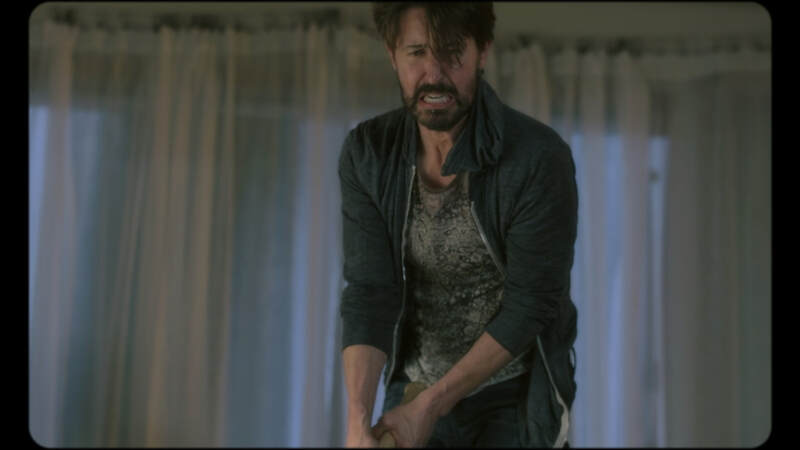
The Hero He Imagines Himself to Be
Read Time:7 Minute, 21 Second
MOVIE REVIEW
Beau Ideal
 –
– 


Genre: Drama, Thriller
Year Released: 2026
Runtime: 1h 49m
Director(s): Patrick D. Green, Edd Blott
Writer(s): Patrick D. Green
Cast: Patrick D. Green, Michèle Tredger, Eric Martin Reid, Kelly Godell, Lindsae Klein, Rylan Andrews, Blaine Palmer, Lowell Deo, Maggie McOmie
Where to Watch: TBD
RAVING REVIEW: BEAU IDEAL takes its time revealing how difficult Jake Carver is to trust. His concern for the boy living next door seems justified, but every new decision makes it harder to tell whether he’s protecting someone or looking for a reason to confront his own past. Jake Carver has built an identity around sensitivity, compassion, and the certainty that he isn’t like the father who hurt him. Once he becomes convinced that a boy living next door is being abused, that carefully maintained self-image stops being private. It becomes permission.
Patrick D. Green, who writes, co-directs with Edd Blott, and plays Jake, uses a neighborhood-thriller to ask an uncomfortable question. When does intervention stop being an act of responsibility and become a way to reenact your own damage? Jake doesn’t consciously think he’s searching for an excuse to confront his past. He believes he’s protecting someone who can’t protect himself, which makes his growing fixation much harder to dismiss.
Jake and Rebecca Hudson have left the city for a quieter life in a picturesque mountain community. Rebecca continues traveling for work while Jake remains behind, hoping the stillness will help him write. Their riverside home appears to offer everything he needs, although the arrival of neighbors Dave and Michelle Rankin quickly gives him another subject to study. Their son Cole is withdrawn, frightened, and uncomfortable around his father, giving Jake enough evidence to be concerned but not enough to understand.
The fact that Jake’s a writer matters. He doesn’t just observe people; he organizes what he sees into a story, assigns roles, and fills the spaces between incomplete pieces of information. Cole becomes the endangered child, Dave becomes the monster, and Jake casts himself as the one man willing to act. The possibility that he may be correct doesn’t make that process any less troubling. A person can recognize real danger while also using it to support a flattering idea about himself.
Green’s years working with Child Protective Services give the premise a sense of experienced frustration. Reporting something doesn’t automatically solve the problem, and recognizing abuse doesn’t provide Jake with the authority to dictate what happens next. The film understands how quickly concern can collide with limited evidence, restraint, history, and the fear of making matters worse. Its interest lies less in whether someone should speak up than in what happens when that person can no longer accept the limits of speaking up.
Green plays Jake as a man whose emotional vocabulary is deeper than his ability to regulate what he feels. He can discuss trauma, condemn destructive masculinity, and insist that he has escaped the attitudes represented by his father. His behavior gradually reveals how much of that identity depends upon never being tested. The moment patience feels inadequate, Jake becomes attracted to the same model of manhood he claims to reject.
Jake wants to be a modern man who listens, cares, and rejects patriarchal control, but he also wants to be the hero who recognizes evil and defeats it through force of will. Those identities can coexist until another person refuses to behave according to his script. Jake’s certainty then begins to resemble entitlement, with protection and control becoming increasingly difficult to separate.
Eric Martin Reid’s performance as Dave prevents that exploration from remaining theoretical. Dave is intimidating without being played as an obvious movie villain, and Reid gives his silences the same weight as his outbursts. His hostility toward Jake can be read as defensive, territorial, guilty, or simply angry at an outsider interfering with his family. That uncertainty keeps their encounters unstable because Jake has already reached conclusions that the film hasn’t confirmed.
The two men are also less different than either would admit. Both guard their households, resent being judged, and react badly when their authority is questioned. Dave represents the kind of masculinity Jake openly condemns, while Jake represents a version that has learned more acceptable ways without necessarily surrendering its appetite for control. Their conflict becomes frightening because each man believes the other has crossed a line, and neither is especially interested in examining his own behavior.
Rylan Andrews handles Cole’s limited dialogue with a convincing wariness. He never turns the child into just someone waiting to be rescued, even though Jake frequently views him that way. Cole’s discomfort is real, but his life remains out of reach, emphasizing how much Jake is constructing from glances, bruises, fragments of conversation, and memories that don’t belong to this family.
Michèle Tredger gives Rebecca a combination of concern, exhaustion, and irritation, suggesting that Jake’s behavior follows a pattern she has encountered before. Her warnings aren’t presented as indifference toward Cole. She recognizes that Jake’s need to intervene has become entangled with something he hasn’t yet acknowledged, although the screenplay occasionally uses her primarily to challenge or restrain him.
Kelly Godell faces a similar limitation as Michelle. Her performance hints at private calculations taking place inside the Rankin household, but the film remains so committed to Jake’s perspective that her experience is kept at a distance. That decision makes sense for a story about experiential bias, though it also means the women affected by these men can feel secondary to the film’s examination of male identity.
Jake’s family history deepens the character without fitting comfortably into the film’s runtime. His dying mother, estranged father, troubled sister, insecurity, stalled writing, and resentment toward his community all contribute to his collapse. The community’s suspicion toward affluent outsiders introduces another worthwhile concern that never receives enough attention. Jake and Rebecca have arrived seeking peace, but their retreat exists within a place where longtime residents recognize the economic and cultural changes represented by people buying second homes. Jake assumes authority over his neighbor shortly after arriving, giving his intervention another layer of privilege that the film touches without fully developing.
The final act forces the audience to reconsider how easily concern became certainty. It doesn’t excuse passivity or suggest that suspected abuse should be ignored. It argues that trauma doesn’t automatically make someone perceptive, righteous, or safe. Pain can create empathy, but it can also distort judgment and give obsession the appearance of principle. Jake’s tragedy is his need to see himself as ideal. He isn’t satisfied with trying to be a decent person under difficult circumstances. He needs to be the enlightened husband, the morally courageous neighbor, the protective son, and the man who has escaped his father’s influence. Each identity begins to crack once reality refuses to confirm it.
BEAU IDEAL reaches for enough ideas that some remain underdeveloped, and its length leaves portions of Jake’s unraveling feeling more relentless than revealing. The strength of its premise survives those excesses. Green and Blott have made a thoughtful psychological drama about the danger of converting another person’s suffering into proof of your own goodness, and its most unsettling moments come from recognizing how easily heroism can become another story a damaged man tells about himself.
Please visit https://linktr.ee/overlyhonestr for more reviews.
You can follow me on Letterboxd, Instagram, Twitter, and YouTube. You can also find my social media accounts on most platforms by searching for 'Overly Honest Reviews'.
I’m always happy to hear from my readers; please don't hesitate to say hello or send me any questions about movies.
[photo courtesy of BEAU IDEAL]
DISCLAIMER:
At Overly Honest Movie Reviews, we value honesty and transparency. Occasionally, we receive complimentary items for review, including DVDs, Blu-rays, CDs, Vinyl Records, Books, and more. We assure you that these arrangements do not influence our reviews, as we are committed to providing unbiased and sincere evaluations. We aim to help you make informed entertainment choices regardless of our relationship with distributors or producers.
Amazon Affiliate Links:
Additionally, this site contains Amazon affiliate links. If you purchase through these links, we may receive a commission. This affiliate arrangement does not affect our commitment to honest reviews and helps support our site. We appreciate your trust and support as you navigate these links.


Happy
0 %

Sad
0 %

Excited
100 %

Sleepy
0 %

Angry
0 %

Surprise
0 %
 0
0
 0
0


Average Rating