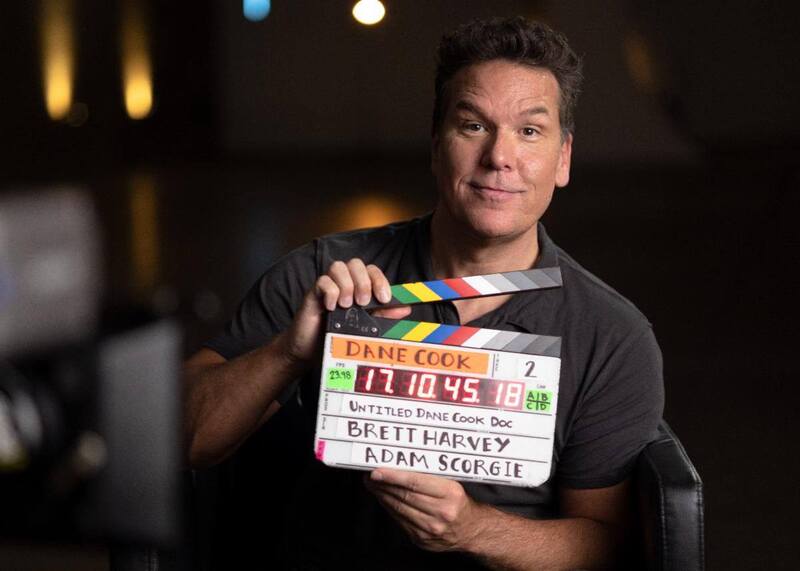
Fame Was Only Half the Story
Read Time:7 Minute, 29 Second
MOVIE REVIEWS
Funny Money: The Dane Cook Story
 –
– 


Genre: Documentary, True Crime, Biography
Year Released: 2026
Runtime: 1h 59m
Director: Brett Harvey
Where to Watch: arrives on VOD & all leading digital platforms on September 29, 2026
RAVING REVIEW: FUNNY MONEY: THE DANE COOK STORY is really about more than just the millions of dollars that disappeared. It explores how Dane Cook could let someone that close to him get away with that kind of theft in the first place, and director Brett Harvey understands that the family relationship is far more interesting than watching numbers disappear from a bank account.
Cook's career provides an almost ludicrous backdrop for the story. During the mid-2000s, he wasn't just successful; he was THE stand-up comedian. He had turned an aggressive embrace of the internet into packed arenas, huge album sales, HBO specials, movie roles, and a fan base that followed him with the kind of intensity normally associated with musicians rather than comedians. FUNNY MONEY spends enough time establishing that scale because the theft means something very different when it's happening while Cook appears to be enjoying the biggest years of his life.
Harvey doesn't build the movie only around Cook's comedy, though, and that's an important distinction. Someone hoping for two hours examining HARMFUL IF SWALLOWED, RETALIATION, TOURGASM, and Cook's place in 2000s stand-up may come away wanting considerably more. His career is the framework, but the documentary gradually tightens its attention around his half-brother Darryl McCauley, who served as Cook's business manager. At the same time, Cook concentrated on performing and amplifying everything around him.
The arrangement sounds harmless when Cook describes how it began. One brother makes the money, the other handles it, and everyone benefits as the operation grows. Because the relationship starts from a shared history, the eventual betrayal carries weight beyond the massive dollar amount attached to it.
McCauley ultimately pleaded guilty after he stole millions from Cook, and he and his wife were ordered to pay $12 million in restitution. Those basic facts have been public for years, so FUNNY MONEY doesn't depend on hiding where the story ends. Instead, Harvey turns the process of reaching that point into the attraction, using financial records, court material, archival footage, interviews, and reactions to information that some participants are apparently encountering for the first time.
The presentation is one of the documentary's better choices. Rather than relying entirely on interview footage broken up by old photographs, the editing often treats the story like an evidence file that's constantly being reopened. Documents, memories, recordings, and pieces of family history accumulate until the theft feels less like the unbelievable act and more like something that grew over Cook's career.
Details like the large withdrawals, missing money, purchases made while Cook remained unaware of what was happening, and even cash hidden in jars of spaghetti sauce all belong to the actual story. Harvey doesn't need to exaggerate much because the specifics are already strange enough, and the documentary works best when it lets one piece of information land before moving to the next.
Cook is also a more effective documentary subject when he stops being Dane Cook the performer. Anyone familiar with his stand-up knows how animated and deliberately oversized his stage personality can be, but FUNNY MONEY often gets something quieter from him. The moments that stick aren't necessarily about losing millions of dollars. They're about recognizing that the person accused of taking it was someone Cook trusted with a part of his life most people would hesitate to give anyone.
That matters because money alone could make the story feel strangely distant. Twelve million dollars is such an enormous figure that it risks turning the crime into a headline rather than something relatable. Broken family trust is easier to understand, and the documentary repeatedly returns to the uncomfortable reality that Cook wasn't dealing with some anonymous accountant who discovered a weakness in his finances.
His childhood and early family life are given substantial room. Old footage and memories establish relationships before fame complicated them, while Cook's parents and their illnesses add another layer to a period already defined by enormous professional change. Some of this initially seems far removed from the crime itself. It gradually makes sense because Harvey tries to establish what family meant to Cook before one of those relationships became the source of such a massive betrayal.
The beginning takes a little longer than necessary to reach the documentary's strongest exploration, while the closing sections could stand to tighten their grip once the major facts are established. Harvey clearly wants the crime to have emotional context rather than presenting it as a collection of shocking transactions, and that's the right instinct. There are simply stretches where one additional anecdote or reaction reinforces something that didn't really need reinforcing.
Cook is the person telling this story, and the movie is fundamentally concerned with what happened to him rather than constructing an argument between two brothers. That gives FUNNY MONEY intimacy, but it also means viewers are experiencing events largely through the people gathered around Cook and the documentary's assembled evidence.
Harvey manages that better than a promotional doc would, especially when the records themselves can carry some of the storytelling. The closer FUNNY MONEY gets to Cook personally, the more obvious it becomes that this isn't meant to be an exhaustive investigation of every possible interpretation of his family history. It's Cook finally laying out his version of an experience that has followed him for years.
The movie is smart not to pretend that his professional success needs retroactive validation. Cook was enormously popular, and he was also one of the most divisive comedians of his generation. FUNNY MONEY doesn't need to settle that because whether someone loved his comedy, hated it, or hasn't thought about him in years has little bearing on the betrayal being documented.
If anything, that complicated reputation makes the story more interesting. Cook's public image at his peak was built on enormous confidence and constant forward momentum. At the same time, the documentary reveals how little control he actually had over an important part of the empire growing around him. The contrast between those sold-out arenas and what was happening behind closed doors gives the movie its strongest recurring ideas.
By the time FUNNY MONEY reaches the criminal consequences and aftermath, the missing millions almost feel secondary to everything that’s been done. A court can assign restitution, prison sentences can be handed down, and financial records can establish where at least some of the money went. There isn't an easy way to account for what happens when someone realizes that a person they trusted for years had been using that trust against them.
That's ultimately why FUNNY MONEY works better as a story about family than as some celebrity documentary. Dane Cook's fame gets people through the door, while the crime gives Harvey a hook, but neither matters as much as the relationship connecting them. The film runs longer than it needs to and occasionally retreads information after the point was already clear, yet the underlying story remains difficult to shake.
Cook may have been selling out arenas while all of this was happening, but FUNNY MONEY makes those crowds feel almost incidental by the end. Millions of strangers knowing your name doesn't offer much protection when the person causing the greatest damage is already sitting beside you, signing checks and calling himself family.
Please visit https://linktr.ee/overlyhonestr for more reviews.
You can follow me on Letterboxd, Instagram, Twitter, and YouTube. You can also find my social media accounts on most platforms by searching for 'Overly Honest Reviews'.
I’m always happy to hear from my readers; please don't hesitate to say hello or send me any questions about movies.
[photo courtesy of UP STREAM FLIX]
DISCLAIMER:
At Overly Honest Movie Reviews, we value honesty and transparency. Occasionally, we receive complimentary items for review, including DVDs, Blu-rays, CDs, Vinyl Records, Books, and more. We assure you these arrangements do not influence our reviews, as we are committed to unbiased, sincere evaluations. We aim to help you make informed entertainment choices regardless of our relationship with distributors or producers.
Amazon Affiliate Links:
This site also contains Amazon affiliate links. If you purchase through these links, we may receive a commission. This affiliate arrangement does not affect our commitment to honest reviews and helps support our site. We appreciate your trust and support as you navigate these links.


Happy
0 %

Sad
0 %

Excited
0 %

Sleepy
0 %

Angry
0 %

Surprise
0 %
 0
0
 0
0


Average Rating