Free Speech Through a Crooked Lens
Read Time:9 Minute, 42 Second
MOVIE REVIEW
The People vs. Larry Flynt [Limited Edition]
 –
– 


Genre: Biography, Comedy, Drama
Year Released: 1996, 2026 Arrow Video 4K
Runtime: 2h 10m
Director: Miloš Forman
Writers: Scott Alexander, Larry Karaszewski
Cast: Woody Harrelson, Courtney Love, Edward Norton, Brett Harrelson, Donna Hanover, James Cromwell, Crispin Glover, Vincent Schiavelli, James Carville
Where to Watch: available August 4, 2026, pre-order your copy here: www.arrowvideo.com, www.mvdshop.com, or www.amazon.com
RAVING REVIEW: The most difficult constitutional principles are rarely tested by people we find admirable. They’re tested by figures like Larry Flynt, provocateurs whose conduct can be repellent even when the rights they defend are essential. Miloš Forman’s 1996 biopic understands that contradiction and builds around it, asking whether freedom still means anything when its protections must extend to someone many would rather condemn. Where the film compromises is in making Flynt easier to digest and defend than the real man likely was, softening his cruelties so the principle can stand apart from the person. Thirty years later, that feels even more urgent. In an era increasingly comfortable with deciding that certain voices are too offensive, dangerous, or undeserving to protect, the film’s warning carries greater weight than it did upon release.
THE PEOPLE VS. LARRY FLYNT never asks us to admire Flynt or even his publications. It argues that personal disgust shouldn’t determine which speech receives protection, and placing an obnoxious pornography publisher at the center makes that point far more impactful than choosing a respectable journalist. The risk comes from allowing the constitutional principle and the person defending it to become too closely associated. Protecting Flynt’s rights doesn’t require turning him into some sort of folk hero, even when the movie occasionally behaves as though it does.
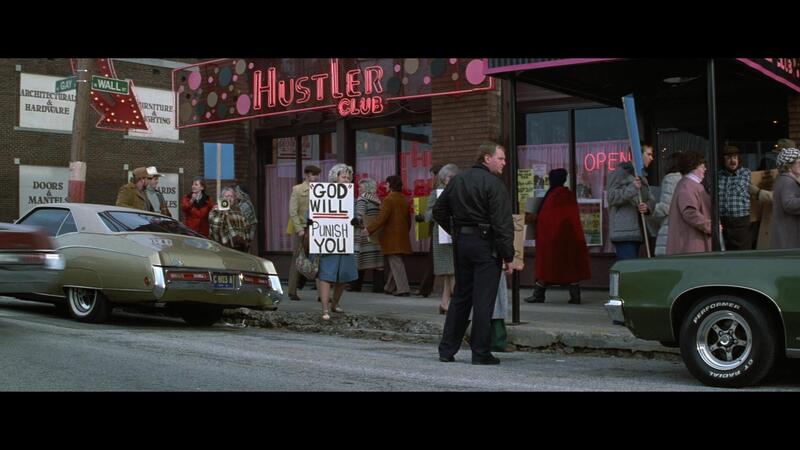
Writers Scott Alexander and Larry Karaszewski ground Flynt’s story in poverty, ambition, and an almost instinctive understanding of what people will pay to see. He doesn’t start the film as a principled defender of civil liberties, nor does he appear especially interested in becoming one. He begins as an opportunist, using a primitive newsletter to draw customers into his struggling clubs before recognizing that the provocation itself could become the product. His political significance develops almost by accident, emerging only after his hunger for profit and attention brings him into conflict with religious leaders, prosecutors, and those who believe the law should enforce their definition of decency.
Woody Harrelson makes the contradictions entertaining before the screenplay starts explaining them. His Flynt can be calculating and reckless within the same conversation, shifting from amusement to defiance without becoming two separate characters. Harrelson doesn’t imitate a collection of mannerisms and expect them to carry the performance. He gives Flynt a recognizable hunger that remains consistent through wealth, punishment, personal loss, physical suffering, and national attention.
The early version of Flynt carries the excitement of someone discovering that bad taste can be monetized. Later, Harrelson lets the same excitement harden into resentment and obsession. Even when Flynt’s legal fights gain greater importance, his behavior remains partly driven by the pleasure of humiliating people who once tried to control him. He becomes a defender of free expression without ever losing the instincts of a provocateur who enjoys watching his opponents flinch.
Harrelson’s performance also gives the film a warmth its subject doesn’t automatically deserve. He’s funny, vulnerable, and charismatic enough to invite sympathy before we’ve had time to decide whether Flynt has earned it. That’s effective drama, although it contributes to the movie’s habit of guiding us toward affection while keeping more damaging questions safely outside the frame.
Courtney Love feels like nails on a chalkboard as Althea Leasure but is without a doubt the most impactful role in the film, even as the focus tries to remain on Flynt. The role could have been reduced to a wild companion who matches Flynt’s appetites and adds chaos to his private life. Love instead creates someone who recognizes his ambition, feeds it, challenges it, and gradually becomes essential to the story's emotion.
There’s an unguarded quality to Love’s work that suits Althea better than a carefully controlled performance would. She can be funny and aggressive without making either trait feel forced, and her connection with Harrelson has enough intimacy to survive the movie’s frequent jumps through time. Their relationship is dysfunctional, indulgent, and often damaging, but it doesn’t feel like it's merely meant to soften Flynt’s public persona.
The film relies heavily on Althea once it needs consequences. Her decline brings sadness and gravity to a story that otherwise moves quickly from one controversy to another, while also exposing another imbalance. Althea is allowed to be complicated primarily in relation to Flynt. Her pain matters most because of what it does to him, leaving Love to create something deeper that the screenplay doesn’t spend enough time examining on its own.
Edward Norton takes on a quieter role as attorney Alan Isaacman. Norton had already demonstrated how quickly he could command attention, but restraint serves him better here. Isaacman has to function as a lawyer, translator, reluctant babysitter, and the nearest thing Flynt has to a conscience. His exasperation keeps the courtroom from becoming too self-congratulatory, especially when Flynt treats legal strategy as another stage for public disruption.
The partnership between Flynt and Isaacman gives the movie something reliable throughout. Flynt pushes every situation toward disorder, while Isaacman tries to extract a constitutional argument from the wreckage. Norton’s controlled reactions make Harrelson’s excesses funnier, and Harrelson prevents the legal passages from turning into lectures. The two performances keep meeting in the space between an important case and an exhausting client.
Small clubs become offices, mansions, courtrooms, television appearances, and public spectacles, all while Flynt remains emotionally connected to the thrill of causing trouble. The physical expansion of his world makes his self-destructive impulses appear even more absurd. He gains access to everything he once lacked and remains determined to fight anyone who tells him no.
The movie eventually reaches the dispute that gave Flynt’s legal legacy its lasting importance. Hustler’s attack on Jerry Falwell was deliberately offensive, but it was also presented as parody rather than fact. The case forced the courts to consider whether a public figure could use a claim of emotional distress to punish satire that couldn’t reasonably be mistaken for a factual account. The principle at stake reaches far beyond pornography, Flynt, or Falwell, because satire becomes useless once the person being mocked can silence it simply by proving offense.
THE PEOPLE VS. LARRY FLYNT narrows much of the opposition to prosecutors, conservative activists, and religious figures whose hypocrisy is easier to expose. James Cromwell brings authority to Charles Keating, while Richard Paul plays Jerry Falwell as both offended adversary and comic target. Their presence gives Flynt recognizable institutions to fight, but the movie rarely allows an opposing argument to arrive from anyone it respects.
The screenplay also follows the familiar biographical habit of racing through decades by selecting a succession of defining incidents. The pace works for most of the 130-minute runtime, though the middle begins to feel like a collection of confrontations connected by headlines and personal crises. Flynt’s transformation is dramatically persuasive, though it never feels complete. He goes from selling provocation to defending principle, and the movie could have spent more time examining where opportunism ended and conviction began.
Arrow Video’s 30th-anniversary limited edition gives the film a substantial physical-media release. The two-disc set includes a new 4K restoration sourced from the original 35mm negative, Dolby Vision with HDR10 compatibility, lossless stereo, and a DTS-HD MA 5.1 option. Archival commentaries from Harrelson, Love, Norton, Alexander, and Karaszewski are joined by new interviews with Harrelson, the screenwriters, Lisa Henson, and Janet Yang.
The second disc adds material about Forman, Rousselot’s cinematography, the production, deleted scenes, promotional materials, and the original script. A booklet with new and archival writing gives the release room to address areas the movie condenses or avoids. That context is especially valuable for a biography whose argument depends on leaving several unresolved.
THE PEOPLE VS. LARRY FLYNT remains engaging because its core principle hasn’t become easier with age. Defending expression is simple when the speaker is thoughtful, responsible, and agreeable. The real test arrives when the person demanding protection is offensive, selfish, and eager to abuse the attention he receives. Forman, Harrelson, Love, and Norton turn that test into a frequently moving film. THE PEOPLE VS. LARRY FLYNT makes a persuasive case for protecting speech we despise, but it’s less willing to confront every reason people despise the man doing the speaking.
Bonus Materials:
4K ULTRA HD BLU-RAY LIMITED EDITION CONTENTS
Reversible sleeve featuring original artwork
Collectors’ booklet featuring new writing on the film by Miloš Forman expert Andreas Halskov, an archival essay by screenwriters Scott Alexander and Larry Karaszewski, and an archival Forman interview conducted by director Adam Davidson
DISC 1 – FEATURE (4K ULTRA HD)
4K (2160p) UHD Blu-ray presentation in Dolby Vision (HDR10 compatible)
Original lossless stereo audio and DTS-HD MA 5.1 surround audio option
Optional English subtitles for the deaf and hard of hearing
Archival audio commentary with cast members Woody Harrelson, Courtney Love, and Edward Norton
Archival audio commentary with screenwriters Scott Alexander and Larry Karaszewski
DISC 2 – SPECIAL FEATURES (BLU-RAY)
Hail Larry, a brand new interview with lead actor Woody Harrelson
Satire in Satin, a brand new interview with Columbia Pictures’ ex-production president Lisa Henson and producer Janet Yang
Only in America, a brand new interview with screenwriters Scott Alexander and Larry Karaszewski
À la lumière de l’évidence, an archival interview with cinematographer Philippe Rousselot
Miloš Forman on The Charlie Rose Show, a 1997 interview with the director
Free Speech or Porn?, an archival featurette about the making of the film
Larry Flynt Exposed, an archival featurette narrated by Dennis Hopper
Deleted Scenes with optional audio commentary by Woody Harrelson and Larry Karaszewski
Theatrical trailer
TV spots
Image galleries, including the original script
Please visit https://linktr.ee/overlyhonestr for more reviews.
You can follow me on Letterboxd, Instagram, Twitter, and YouTube. My social media accounts can also be found on most platforms by searching for 'Overly Honest Reviews'.
I’m always happy to hear from my readers; please don't hesitate to say hello or send me any questions about movies.
[photo courtesy of ARROW VIDEO, MVD ENTERTAINMENT]
DISCLAIMER:
At Overly Honest Movie Reviews, we value honesty and transparency. Occasionally, we receive complimentary items for review, including DVDs, Blu-rays, CDs, Vinyl Records, Books, and more. We assure you that these arrangements do not influence our reviews, as we are committed to providing unbiased and sincere evaluations. We aim to help you make informed entertainment choices regardless of our relationship with distributors or producers.
Amazon Affiliate Links:
Additionally, this site contains Amazon affiliate links. If you purchase through these links, we may receive a commission. This affiliate arrangement does not affect our commitment to honest reviews and helps support our site. We appreciate your trust and support as you navigate these links.


Happy
0 %

Sad
0 %

Excited
100 %

Sleepy
0 %

Angry
0 %

Surprise
0 %
 1
1
 0
0



Average Rating