Trusting What No One Else Can Sense
Read Time:7 Minute, 41 Second
MOVIE REVIEWS
A Scent
 –
– 


Genre: Drama, Short
Year Released: 2026
Runtime: 18m
Director(s): Johnny Russell
Writer(s): Johnny Russell, Archie Thomson
Cast: Josie Walker, Cal MacAninch, Laura Rollins, Rob Jarvis, Jane Paul-Gets
Where to Watch: shown at the 2026 HollyShorts Film Festival
RAVING REVIEW: A SCENT is the kind of true story that could easily be overplayed. A nurse discovering that she can detect Parkinson's through smell sounds almost unbelievable, yet Johnny Russell's 18-minute drama treats that less as a medical miracle than as something capable of altering a career, a marriage, and a woman's confidence in what she knows. Keeping the focus there gives the short a foundation that proves considerably more interesting than just celebrating an extraordinary ability.
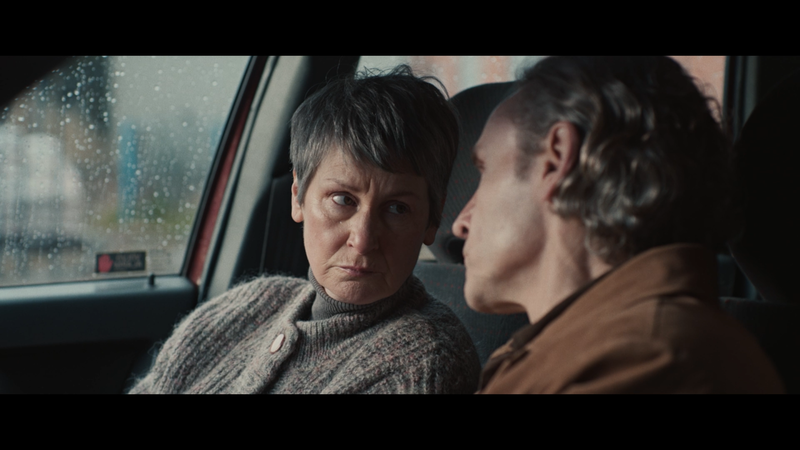
Russell and co-writer Archie Thomson draw inspiration from Joy Milne, the Scottish nurse whose exceptional sense of smell eventually contributed to legitimate Parkinson's research. Rather than attempting to recreate Milne's life as a micro-biography, the film centers the fictional Nancy (Josie Walker) on the discovery. Nancy detects a persistent odor during her work as a scrub nurse, then begins noticing enough connections to suspect she's sensing something significant, and explaining it to others proves considerably harder than recognizing it herself.
The skepticism makes a lot sense. Nancy can't point to a scan, blood test, or medical procedure. She has a smell that other people can't and an increasingly firm belief about what it means. A SCENT benefits from allowing the situation to sound as strange to the people around her as it would to almost anyone hearing it for the first time. That keeps their disbelief from turning everyone into an antagonist, even as the film becomes increasingly interested in why Nancy's observations are so readily dismissed. Honestly, had I not heard about this in some dogs, I would have thought this was all made up.
Her husband Gavin (Cal MacAninch) makes the tension personal. He's a surgeon, placing Nancy in the uncomfortable position of trying to convince someone who knows medicine intimately yet sees little reason to accept what she’s going through. The disagreement isn't confined to the hospital once Nancy begins to recognize its implications closer to home. MacAninch gives Gavin enough warmth that his resistance doesn't feel like cruelty. Fear, certainty, pride, and denial become tangled together, making his reactions more understandable even when they're frustrating.
Walker has to carry nearly the entire film within a very limited amount of time, and her restraint is one of the film's strongest choices. Nancy isn't shown as someone announcing a medical breakthrough. She's trying to understand something that doesn't make sense, even to herself, while repeatedly questioning how much she should trust herself. Walker keeps those doubts visible without exaggerating them. There are moments when Nancy appears to measure her next sentence before speaking; she already knows how unbelievable it will sound. There’s something about it that just feels right in her heart.
That uncertainty helps the film address deeper questions and doubts without abandoning the characters. Nancy is a trained medical professional, but she's also a nurse working in an environment where authority doesn't necessarily follow experience. Her observations can be dismissed as intuition, while those with a higher standing decide what's credible. Russell doesn't turn A SCENT into a lecture about women being ignored in medicine, which is probably why the point locks in as well as it does. Nancy keeps encountering closed doors, and the pattern speaks for itself.
Laura Rollins, as Tahira, gives the story an important variation to the story.. Not everyone needs to believe Nancy immediately for the film to work, but having someone willing to listen prevents the conflict from becoming a divide between Nancy and an entire profession determined to silence her. Rob Jarvis also makes an impression within the short's limited space, helping connect Nancy's unusual perception to those who could eventually benefit from someone taking it seriously.
Russell doesn't waste much time getting Nancy from uncertainty to conviction, which gives A SCENT a strong sense of purpose. The trade-off is that some relationships and professional conflicts develop through shorthand. Gavin's resistance has enough context to work, although a few more scenes could have made the changes in their marriage feel less compressed. Some of the supporting characters exist primarily to move Nancy toward the next stage of understanding.
Russell and cinematographer Max Brunner give the hospital a restrained, subdued character rather than trying to represent scent through obvious visual effects. That's an important decision because the premise already asks the audience to accept something that can't be seen or heard. The filmmaking doesn't need to keep reminding us how unusual Nancy's experience is. Instead, the muted spaces and controlled compositions keep attention on her reactions, with the imagery gradually becoming more expressive as the story moves away from fear and toward acceptance. If you’ve ever spent any time in a hospital, as a patient or visitor, you’ll know that they have an endless amount of unique smells, which makes this experience so much more certain.
Adiescar Chase's score supports the unease surrounding Nancy's discovery without trying to manufacture suspense from a story that isn't really a mystery. We know she's onto something. The question is what that means for her and the people around her. When the film eventually allows more warmth into its presentation, the shift feels earned because so much of what came before has been emotionally restrained.
The final moments also reveal what Russell appears to care about most. Parkinson's isn't reduced to the tragic consequence waiting at the end of Nancy's discovery. People living with the condition remain people with relationships, humor, autonomy, and affection. The participation of members of Virtual Motion Dance, an organization whose classes support people with Parkinson's, gives those closing moments an authenticity that can't be manufactured by simply staging a conclusion. The film becomes less interested in Nancy proving herself than in what happens after everyone has to live with what she's discovered.
That doesn't keep A SCENT from occasionally leaning a little heavily toward solace. Its final stretch smooths some of the harder edges that were present earlier, and the transition from professional and marital conflict toward something more hopeful happens quickly. The intention is understandable, particularly given how little value there would be in reducing Parkinson's to misery. Although a slightly less resolute landing might have left more room for the complications the film handles so well elsewhere.
The real story of Joy Milne makes the premise even more remarkable. Her observation that her husband's scent had changed years before his Parkinson's diagnosis eventually attracted researchers, helping inspire studies into chemical markers associated with the disease. Knowing that background could easily turn A SCENT into an inspirational account of a woman vindicated by science. Russell avoids making vindication the entire point. Nancy wants to be believed, but being correct also means confronting information she'd rather not have.
That's where the short finds its strongest moments. An extraordinary ability isn't necessarily comforting when it tells you something that painful before anyone else is prepared to hear it. A SCENT respects the significance of its inspiration while recognizing the human cost underneath it, and Walker gives that a face worth following. At 18 minutes, there are areas where the story could use more room, but Russell uses the time he has to turn an unusual piece of medical history into an intimate story about trust, fear, and learning how to listen.
Please visit https://linktr.ee/overlyhonestr for more reviews.
You can follow me on Letterboxd, Instagram, Twitter, and YouTube. My social media accounts can also be found on most platforms by searching for 'Overly Honest Reviews'.
I’m always happy to hear from my readers; please don't hesitate to say hello or send me any questions about movies.
[photo courtesy of MILK MACHINE]
DISCLAIMER:
At Overly Honest Movie Reviews, we value honesty and transparency. Occasionally, we receive complimentary items for review, including DVDs, Blu-rays, CDs, Vinyl Records, Books, and more. We assure you that these arrangements do not influence our reviews, as we are committed to providing unbiased and sincere evaluations. We aim to help you make informed entertainment choices regardless of our relationship with distributors or producers.
Amazon Affiliate Links:
Additionally, this site contains Amazon affiliate links. If you purchase through these links, we may receive a commission. This affiliate arrangement does not affect our commitment to honest reviews and helps support our site. We appreciate your trust and support as you navigate these links.


Happy
0 %

Sad
0 %

Excited
0 %

Sleepy
0 %

Angry
0 %

Surprise
0 %
 0
0
 0
0



Average Rating